







Question: Make a parallel circuit with one loop, and then two loops. Make observations as you connect the second loop. 1. When you connected the second
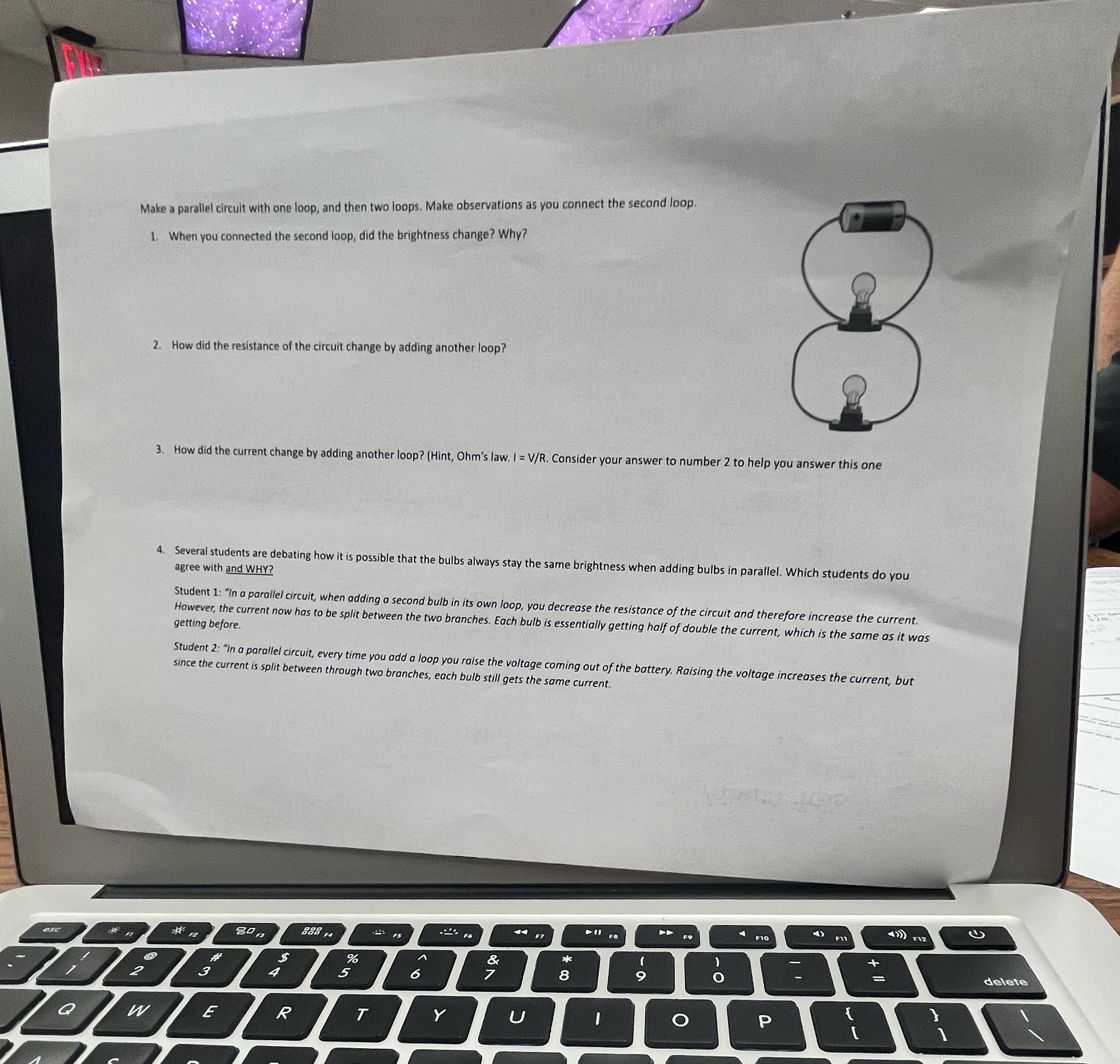
Make a parallel circuit with one loop, and then two loops. Make observations as you connect the second loop. 1. When you connected the second loop, did the brightness change? Why? 2. How did the resistance of the circuit change by adding another loop? 3. How did the current change by adding another loop? (Hint, Ohm's law. I = V/R. Consider your answer to number 2 to help you answer this one 4. Several students are debating how it is possible that the bulbs always stay the same brightness when adding bulbs in parallel. Which students do you agree with and WHY? Student 1: "In a parallel circuit, when adding a second bulb in its own loop, you decrease the resistance of the circuit and therefore increase the current. However, the current now has to be split between the two branches. Each bulb is essentially getting half of double the current, which is the same as it was getting before. Student 2: "In a parallel circuit, every time you add a loop you raise the voltage coming out of the battery. Raising the voltage increases the current, but since the current is split between through two branches, each bulb still gets the same current. 44 17 -I FO DP FO F10 80 13 888 o delete P W R Y U O E
Step by Step Solution
There are 3 Steps involved in it

Get step-by-step solutions from verified subject matter experts
 Study Help