



Question: Manufacturing Process Information Slam, Dunk, Score, Inc. started a small manufacturing plant that manufactures mini sport balls with logos printed on them. The manufacturing process
Manufacturing Process Information
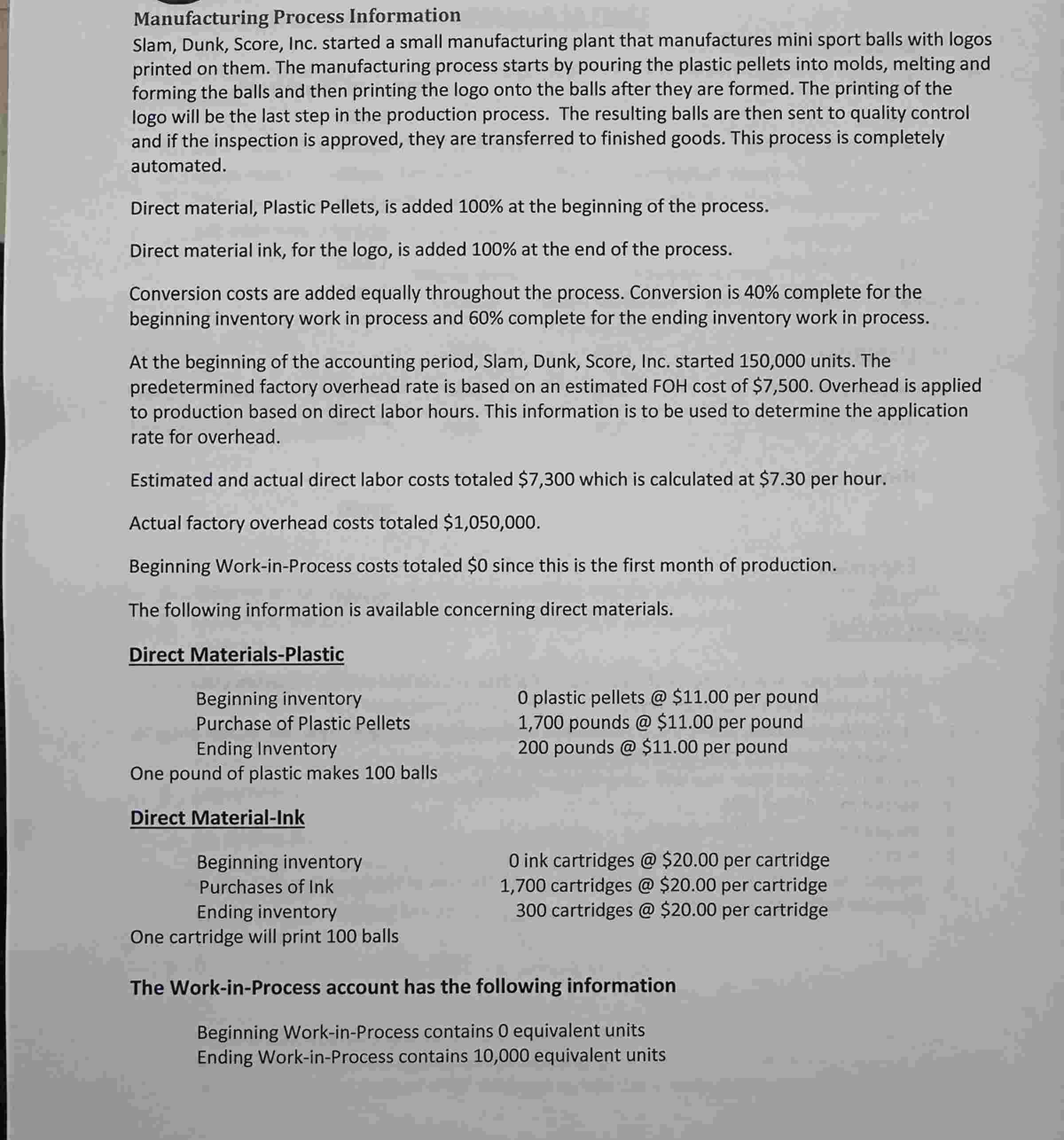
Slam, Dunk, Score, Inc. started a small manufacturing plant that manufactures mini sport balls with logos printed on them. The manufacturing process starts by pouring the plastic pellets into molds, melting and forming the balls and then printing the logo onto the balls after they are formed. The printing of the logo will be the last step in the production process. The resulting balls are then sent to quality control and if the inspection is approved, they are transferred to finished goods. This process is completely automated.
Direct material, Plastic Pellets, is added at the beginning of the process.
Direct material ink, for the logo is added at the end of the process.
Conversion costs are added equally throughout the process. Conversion is complete for the beginning inventory work in process and complete for the ending inventory work in process.
At the beginning of the accounting period, Slam, Dunk, Score, Inc. started units. The predetermined factory overhead rate is based on an estimated FOH cost of $ Overhead is applied to production based on direct labor hours. This information is to be used to determine the application rate for overhead.
Estimated and actual direct labor costs totaled $ which is calculated at $ per hour.
Actual factory overhead costs totaled $
Beginning WorkinProcess costs totaled $ since this is the first month of production.
The following information is available concerning direct materials.
Direct MaterialsPlastic
Beginning inventory
Purchase of Plastic Pellets
Ending Inventory
One pound of plastic makes balls
plastic pellets @ $ per pound
pounds @ $ per pound
pounds @ $ per pound
Direct MaterialInk
Beginning inventory
Purchases of Ink
Ending inventory
One cartridge will print balls
ink cartridges @ $ per cartridge
cartridges @ $ per cartridge
cartridges @ $ per cartridge
The WorkinProcess account has the following information
Beginning WorkinProcess contains equivalent units
Ending WorkinProcess contains equivalent units The Finished Goods account has the following Information
Beginning Finished Goods contains balls
Ending Finished Goods contains balls
The selling price is $ per ball and balls were sold
Selling and Administrative Costs totaled mathbf$ ; tax rate is mathbf Steps for Part
Step Determine the predetermined OH rate
Step Determine the total number of balls to account for see example on page
Step Determine the Equivalent Units Schedule see example on page
Step Determine the total costs for the plastic pellets and the unit plastic pellet cost per ball.
Step Determine the total costs for the ink and the unit ink cost per ball.
Step Determine the total conversion cost and the conversion cost per ball using the predetermined rate.
Step Determine the total equivalent cost per ball plastic pellet cost per unit, plus the ink cost per ball, plus, the conversion cost per ball
Step Prepare a Cost of Production Report Turn the equivalent unit schedule into dollars See provided example on page Use FIFO costing
Step Ending WIP in Units and Dollars
Step Ending Finished Goods Inventory in Units and Dollars
Step COGS calculation
Step OverUnder Applied FOH
Step Income Statement showing Gross Margin, Income before taxes, Tax Amount and Net Income
Step Prepare the necessary Journal Entries related to the manufacturing cycle for this accounting period. Use the Chart of Account numbers for the journal entries.
a In the first journal entry record the purchase of Plastic Pellets and Ink using cash using one journal entry.
b Record the materials, plastic pellets and ink, transferred to WIP. Again, use one journal entry to record the transfer of the plastic pellets and the ink to WIP.
c Record the direct labor in WIP using Wages Payable.
d Record the applied FOH
e Record the actual FOH using cash.
f Record the over or under applied FOH. g Record the sale of the goods on account along with the cost of the inventory that was sold. Record the sale first, then the COGS entry.
Step by Step Solution
There are 3 Steps involved in it
1 Expert Approved Answer
Step: 1 Unlock

Question Has Been Solved by an Expert!
Get step-by-step solutions from verified subject matter experts
Step: 2 Unlock
Step: 3 Unlock