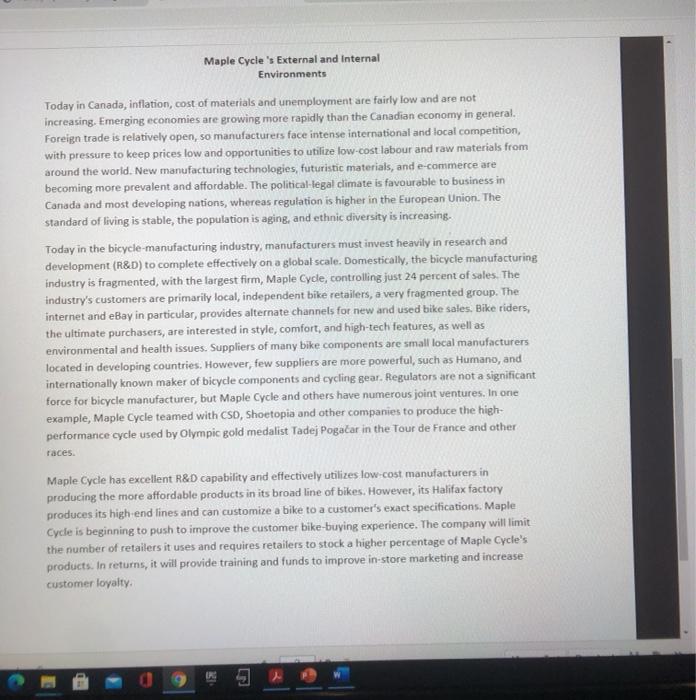
Question: Maple Cycle's External and internal Environments Today in Canada, inflation, cost of materials and unemployment are fairly low and are not increasing. Emerging economies are
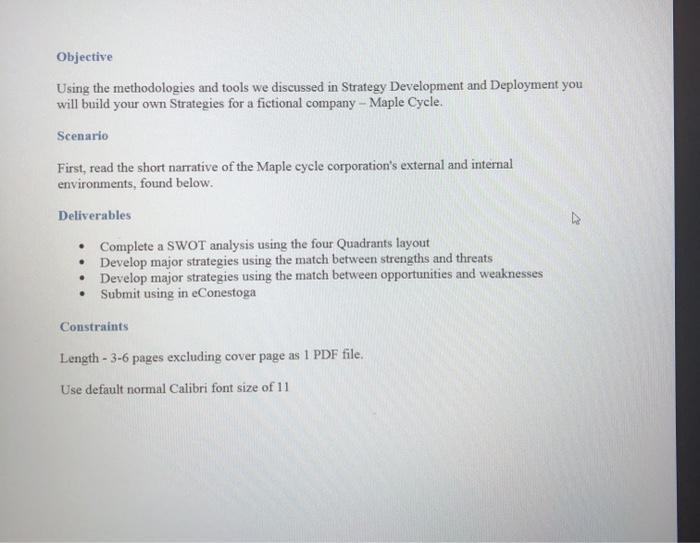
Maple Cycle's External and internal Environments Today in Canada, inflation, cost of materials and unemployment are fairly low and are not increasing. Emerging economies are growing more rapidly than the Canadian economy in general. Foreign trade is relatively open, so manufacturers face intense international and local competition, with pressure to keep prices low and opportunities to utilize low-cost labour and raw materials from around the world. New manufacturing technologies, futuristic materials, and e-commerce are becoming more prevalent and affordable. The political-legal climate is favourable to business in Canada and most developing nations, whereas regulation is higher in the European Union. The standard of living is stable, the population is aging, and ethnic diversity is increasing- Today in the bicycle-manufacturing industry, manufacturers must invest heavily in research and development (R&D) to complete effectively on a global scale. Domestically, the bicycle manufacturing industry is fragmented, with the largest firm, Maple Cyde, controlling just 24 percent of sales. The industry's customers are primarily local, independent bike retailers, a very fragmented group. The internet and eBay in particular, provides alternate channels for new and used bike sales. Bike riders, the ultimate purchasers, are interested in style, comfort, and high-tech features, as well as environmental and health issues. Suppliers of many bike components are small local manufacturers located in developing countries. However, few suppliers are more powerful, such as Humano, and internationally known maker of bicyde components and cycling gear. Regulators are not a significant force for bicycle manufacturer, but Maple Cycle and others have numerous joint ventures. In one example, Maple Cycle teamed with CSD, Shoetopia and other companies to produce the high- performance cycle used by Olympic gold medalist Tadej Pogaar in the Tour de France and other races Maple Cycle has excellent R&D capability and effectively utilizes low-cost manufacturers in producing the more affordable products in its broad line of bikes. However, its Halifax factory produces its high-end lines and can customize a bike to a customer's exact specifications. Maple Cycle is beginning to push to improve the customer bike-buying experience. The company will limit the number of retailers it uses and requires retailers to stock a higher percentage of Maple Cycle's products. In returns, it will provide training and funds to improve in-store marketing and increase customer loyalty. Objective Using the methodologies and tools we discussed in Strategy Development and Deployment you will build your own Strategies for a fictional company - Maple Cycle. Scenario First, read the short narrative of the Maple cycle corporation's external and internal environments, found below. Deliverables Complete a SWOT analysis using the four Quadrants layout Develop major strategies using the match between strengths and threats Develop major strategies using the match between opportunities and weaknesses Submit using in eConestoga Constraints Length - 3-6 pages excluding cover page as 1 PDF file. Use default normal Calibri font size of 11









 Study Help