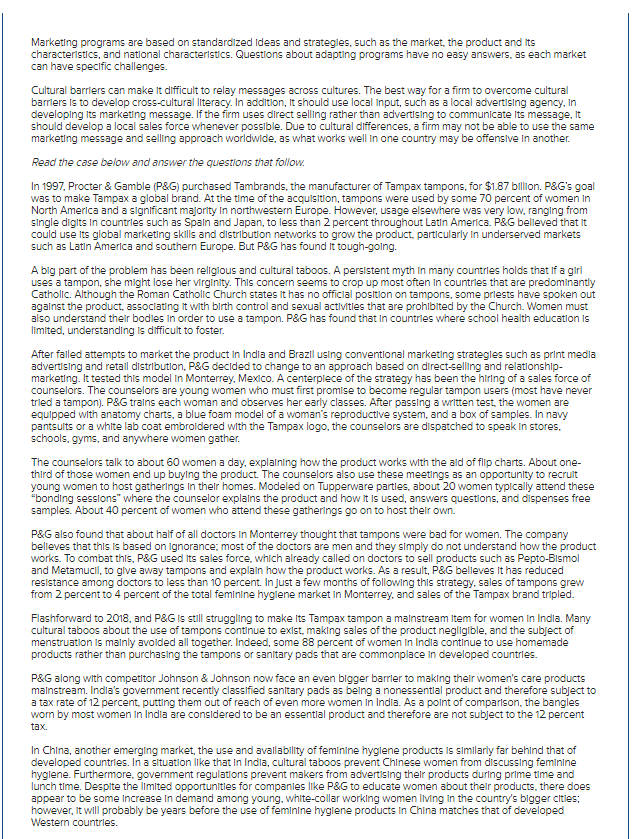
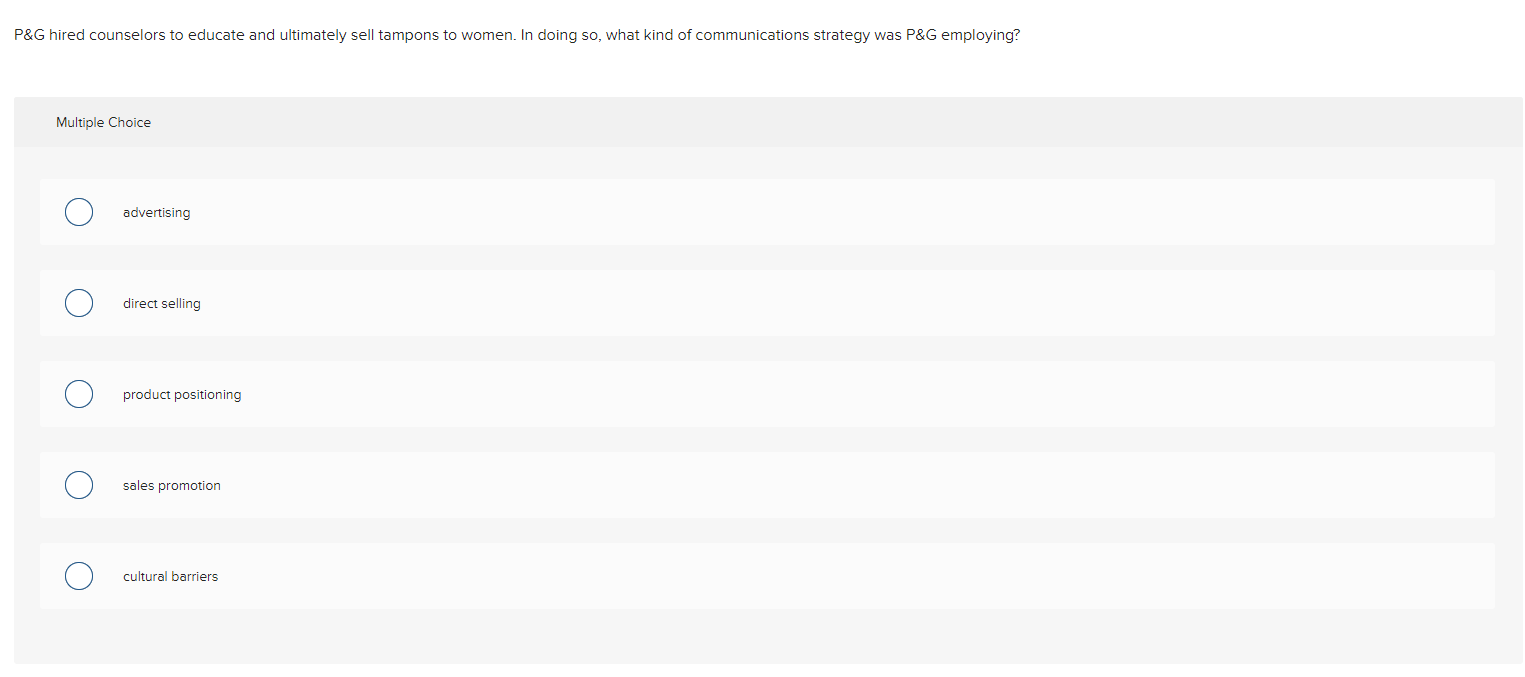
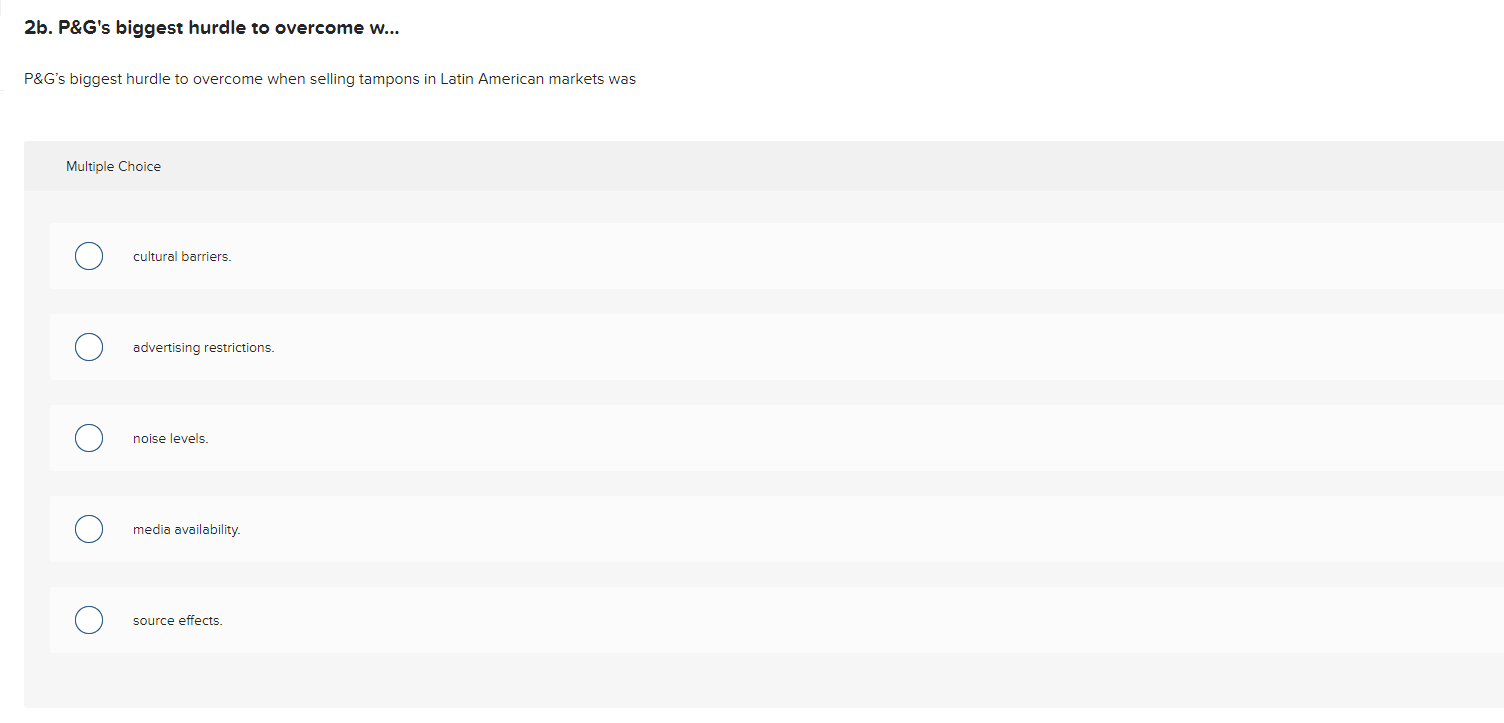
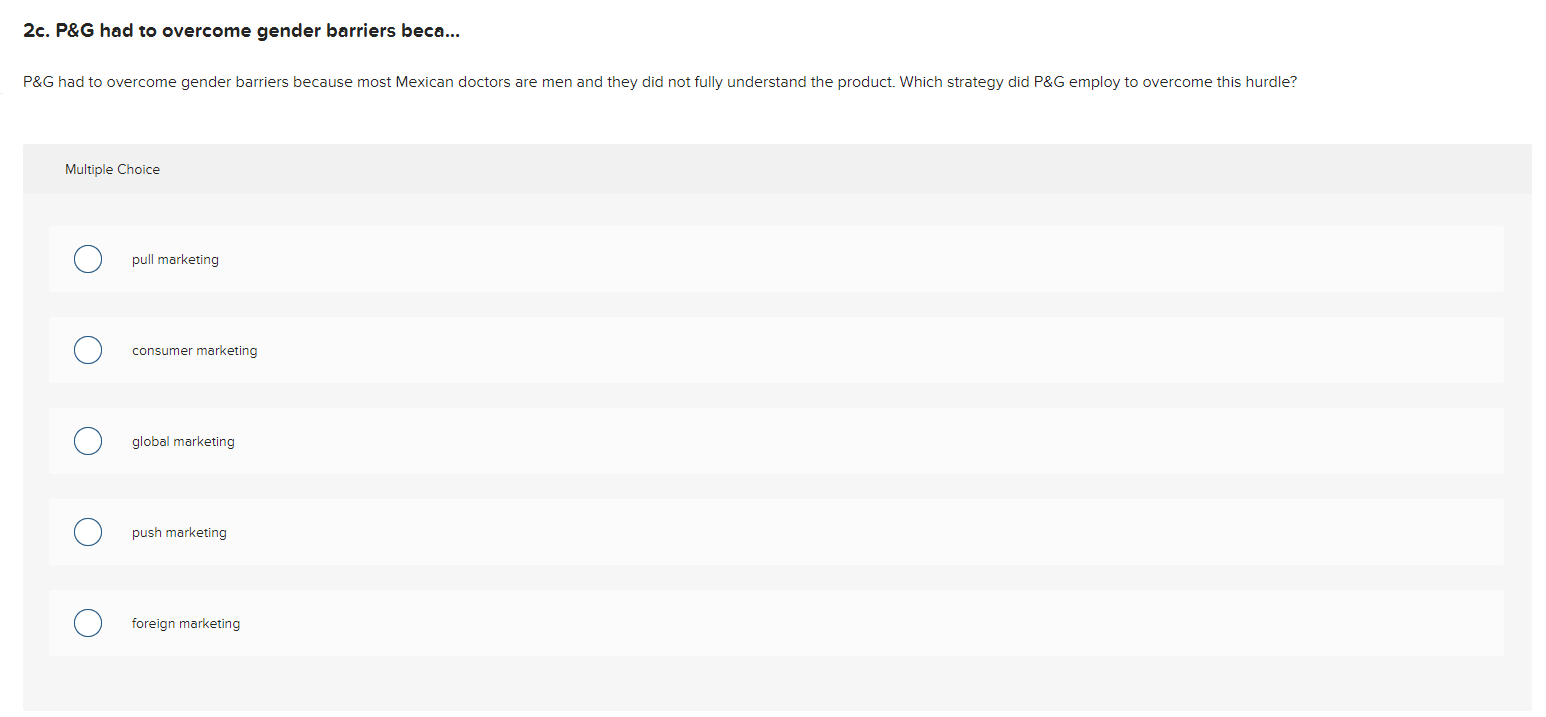
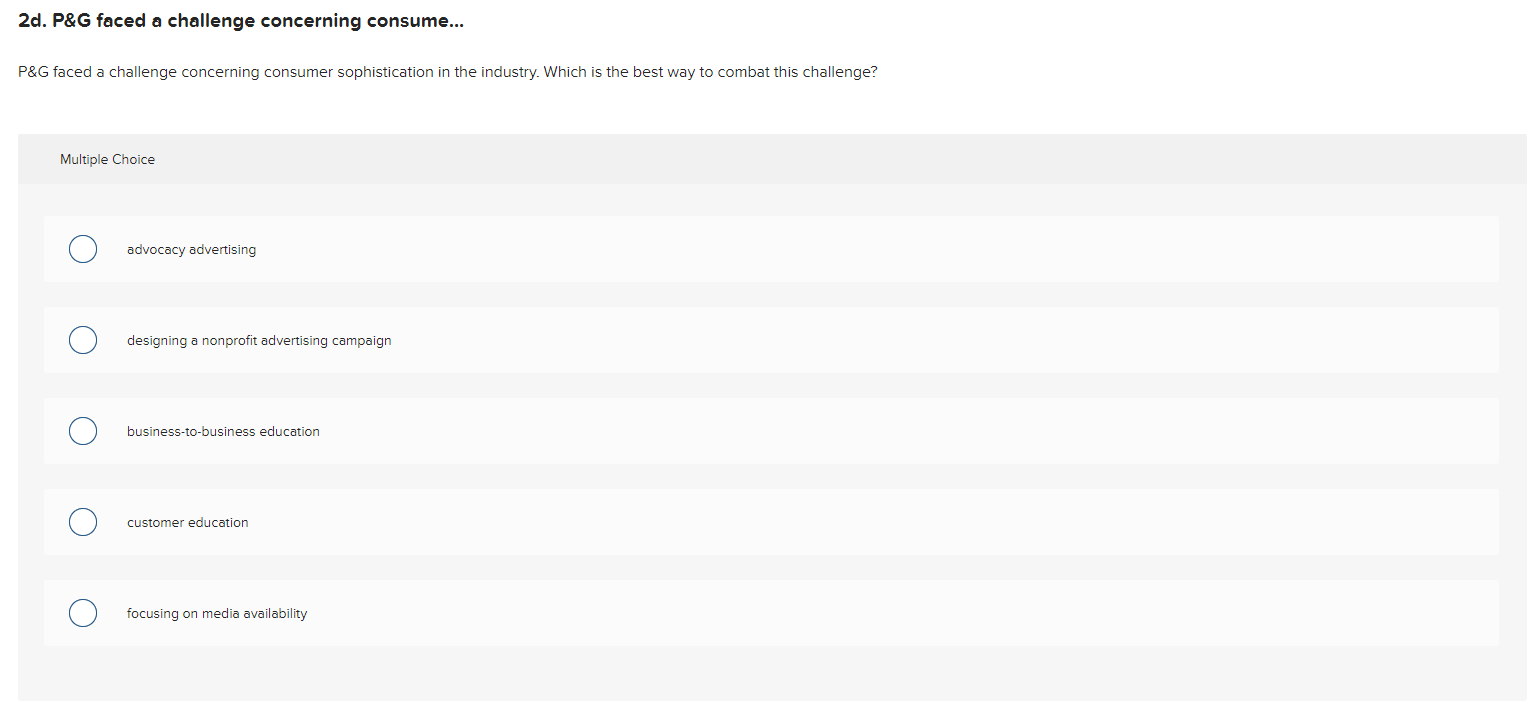
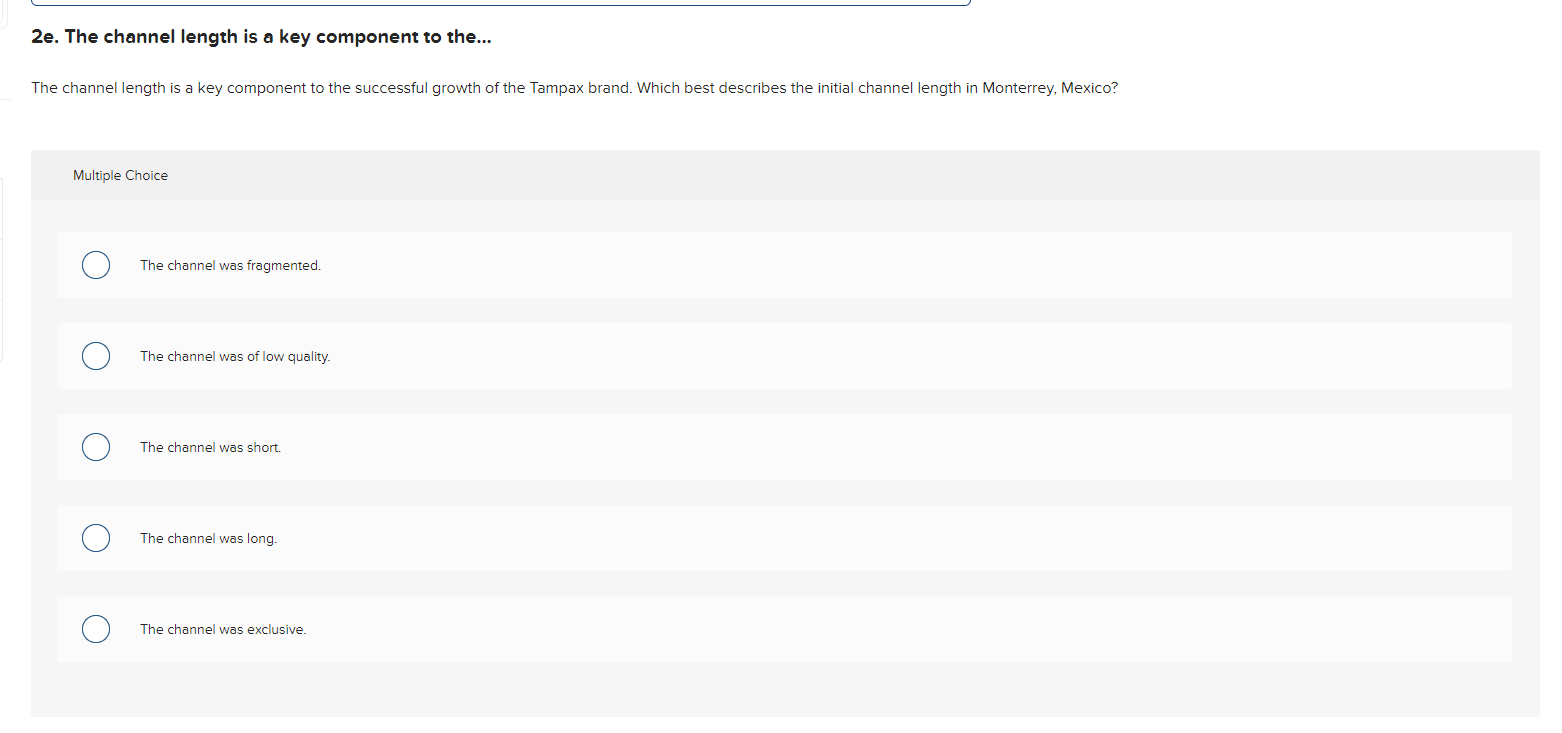
Marketing programs are based on standardized Ideas and strategies, such as the market, the product and its characteristics, and national characteristics. Questions about adapting programs have no easy answers, as each market can have specific challenges. Cultural barriers can make it difficult to relay messages across cultures. The best way for a firm to overcome cultural barriers is to develop cross-cultural literacy. In addition, it should use local Input, such as a local advertising agency. In developing its marketing message. If the firm uses direct selling rather than advertising to communicate its message. It should develop a local sales force whenever possible. Due to cultural differences, a firm may not be able to use the same marketing message and selling approach worldwide, as what works well in one country may be offensive in another. Read the case below and answer the questions that follow. In 1997, Procter & Gamble (P&G) purchased Tambrands, the manufacturer of Tampax tampons, for $1.87 billion. P&G's goal was to make Tampax a global brand. At the time of the acquisition, tampons were used by some 70 percent of women in North America and a significant majority in northwestern Europe. However, usage elsewhere was very low, ranging from single digits In countries such as Spain and Japan, to less than 2 percent throughout Latin America. P&G believed that it could use its global marketing skills and distribution networks to grow the product, particularly in underserved markets such as Latin America and southern Europe. But P&G has found it tough-going. A big part of the problem has been religious and cultural taboos. A persistent myth in many countries holds that if a girl uses a tampon, she might lose her virginity. This concern seems to crop up most often in countries that are predominantly Catholic. Although the Roman Catholic Church states it has no official position on tampons, some prlests have spoken out against the product, associating it with birth control and sexual activities that are prohibited by the Church. Women must also understand their bodies in order to use a tampon. P&G has found that in countries where school health education is limited, understanding is difficult to foster. After failed attempts to market the product in India and Brazil using conventional marketing strategies such as print media advertising and retail distribution, P&G decided to change to an approach based on direct-selling and relationship- marketing. It tested this model in Monterrey, Mexico. A centerplece of the strategy has been the hiring of a sales force of counselors. The counselors are young women who must first promise to become regular tampon users (most have never tried a tampon). P&G trains each woman and observes her early classes. After passing a written test the women are equipped with anatomy charts, a blue foam model of a woman's reproductive system, and a box of samples. In navy pantsuits or a white lab coat embroidered with the Tampax logo, the counselors are dispatched to speak in stores. schools, gyms, and anywhere women gather. The counselors talk to about 60 women a day, explaining how the product works with the aid of flip charts. About one- third of those women end up buying the product. The counselors also use these meetings as an opportunity to recrult young women to host gatherings in their homes. Modeled on Tupperware parties, about 20 women typically attend these *bonding sessions where the counselor explains the product and how it is used, answers questions, and dispenses free samples. About 40 percent of women who attend these gatherings go on to host their own. P&G also found that about half of all doctors in Monterrey thought that tampons were bad for women. The company believes that this is based on ignorance: most of the doctors are men and they simply do not understand how the product works. To combat this, P&G used its sales force, which already called on doctors to sell products such as Pepto-Bismol and Metamucil, to give away tampons and explain how the product works. As a result, P&G believes It has reduced resistance among doctors to less than 10 percent. In just a few months of following this strategy, sales of tampons grew from 2 percent to 4 percent of the total feminine hygiene market in Monterrey, and sales of the Tampax brand tripled. Flashforward to 2018, and P&G is still struggling to make its Tampax tampon a mainstream item for women in India. Many cultural taboos about the use of tampons continue to exist, making sales of the product negligible, and the subject of menstruation is mainly avoided all together. Indeed, some 88 percent of women in India continue to use homemade products rather than purchasing the tampons or sanitary pads that are commonplace in developed countries. P&G along with competitor Johnson & Johnson now face an even bigger barrier to making their women's care products mainstream. India's government recently classified sanitary pads as being a nonessential product and therefore subject to a tax rate of 12 percent, putting them out of reach of even more women in India. As a point of comparison, the bangles wom by most women in India are considered to be an essential product and therefore are not subject to the 12 percent tax In China, another emerging market, the use and availability of feminine hygiene products is similarly far behind that of developed countries. In a situation like that in India, cultural taboos prevent Chinese women from discussing feminine hyglene. Furthermore, government regulations prevent makers from advertising their products during prime time and lunch time. Despite the limited opportunities for companies like P&G to educate women about their products, there does appear to be some increase in demand among young, white collar working women living in the country's bigger cities: however, it will probably be years before the use of feminine hygiene products in China matches that of developed Westem countries P&G hired counselors to educate and ultimately sell tampons to women. In doing so, what kind of communications strategy was P&G employing? Multiple Choice advertising direct selling product positioning O sales promotion cultural barriers 2b. P&G's biggest hurdle to overcome w... P&G's biggest hurdle to overcome when selling tampons in Latin American markets was Multiple Choice cultural barriers. O advertising restrictions. O noise levels. media availability O O source effects. 2c. P&G had to overcome gender barriers beca... P&G had to overcome gender barriers because most Mexican doctors are men and they did not fully understand the product. Which strategy did P&G employ to overcome this hurdle? Multiple Choice pull marketing o consumer marketing O global marketing push marketing O O O foreign marketing 2d. P&G faced a challenge concerning consume... P&G faced a challenge concerning consumer sophistication in the industry. Which is the best way to combat this challenge? Multiple Choice advocacy advertising designing a nonprofit advertising campaign business-to-business education customer education focusing on media availability 2e. The channel length is a key component to the... The channel length is a key component to the successful growth of the Tampax brand. Which best describes the initial channel length in Monterrey, Mexico? Multiple Choice The channel was fragmented. The channel was of low quality. The channel was short. O The channel was long. The channel was exclusive




