







Question: Marketing Writing a Case Study Analysis A case study analysis requires you to investigate a business problem, examine the alternative solutions, and propose the most
Marketing
Writing a Case Study Analysis
A case study analysis requires you to investigate a business problem, examine the alternative solutions, and propose the most effective solution
using supporting evidence.
Preparing the Case
Before you begin writing, follow these quidelines to help you prepare and understand the case study:
1. Read and Examine the Case Thoroughly
e Take notes, highlight relevant facts, underline key problems.
2. Focus Your Analysis
eIdentify two to five key problems.
eWhy do they exist?
How do they impact the organization? eWho is responsible for them?
3. Uncover Possible Solutions/Changes Needed
eReview course readings, discussions, outside research, your experience.
4. Select the Best Solution
Consider strong supporting evidence, pros, and cons. Is this solution realistic?
Drafting the Case
Once you have gathered the necessary
information, a draft of your analysis should include these general sections, but these may differ depending on your assignment directions or your specific case study:
1. Introduction
Identify the key problems and issues in the case study.
Formulate and include a thesis statement, summarizing the outcome of your analysis in 1-2 sentences.
2. Background
e Set the scene: background information, relevant facts, and the most important issues. Demonstrate that you have researched the
problems in this case study.
3. Evaluation of the Case
Outline the various pieces of the case study that you are focusing on.
Evaluate these pieces by discussing what is working and what is not working.
State why these parts of the case study are or are not working well.
4. Proposed Solution/Changes
Provide specific and realistic solution(s) or changes needed.
Explain why this solution was chosen. Support this solution with solid evidence, such as: Concepts from class (text readings,
discussions, lectures)
Outside research
Personal experience (anecdotes)
5. Recommendations
Determine and discuss specific strategies for accomplishing the proposed solution. If applicable, recommend further action to
resolve some of the issues. What should be done and who should do it?
Finalizing the Case
After you have composed the first draft of your case study analysis, read through it to check for any gaps or inconsistencies in content or structure:
Is your thesis statement clear and direct? Have you provided solid evidence?
Is any component from the analysis missing?
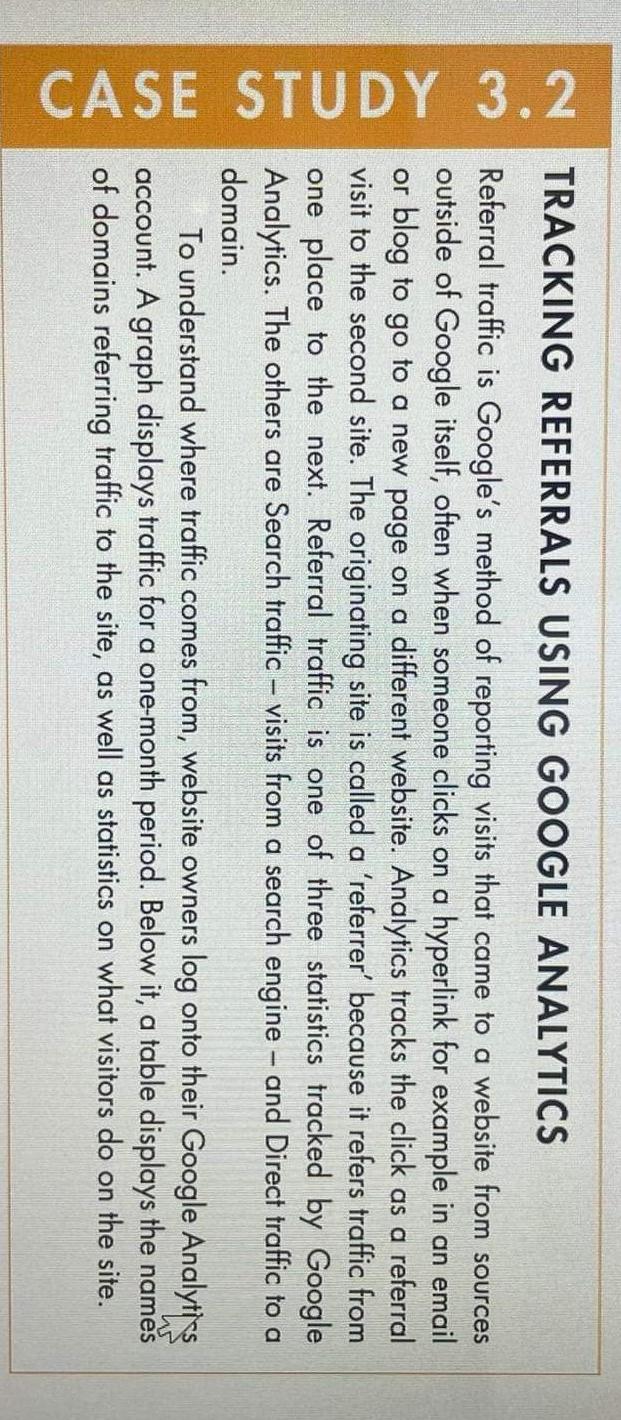
TRACKING REFERRALS USING GOOGLE ANALYTICS Referral traffic is Google's method of reporting visits that came to a website from sources outside of Google itself, often when someone clicks on a hyperlink for example in an email or blog to go to a new page on a different website. Analytics tracks the click as a referral visit to the second site. The originating site is called a 'referrer' because it refers traffic from one place to the next. Referral traffic is one of three statistics tracked by Google Analytics. The others are Search traffic - visits from a search engine - and Direct traffic to a domain. To understand where traffic comes from, website owners log onto their Google Analytiss account. A graph displays traffic for a one-month period. Below it, a table displays the names of domains referring traffic to the site, as well as statistics on what visitors do on the siteStep by Step Solution
There are 3 Steps involved in it

Get step-by-step solutions from verified subject matter experts
 Study Help