



Question: Marksman John Average is trying to qualify for the COVID-19 delayed 2021 Summer Olympic games in Japan. He is shooting at a circular target that
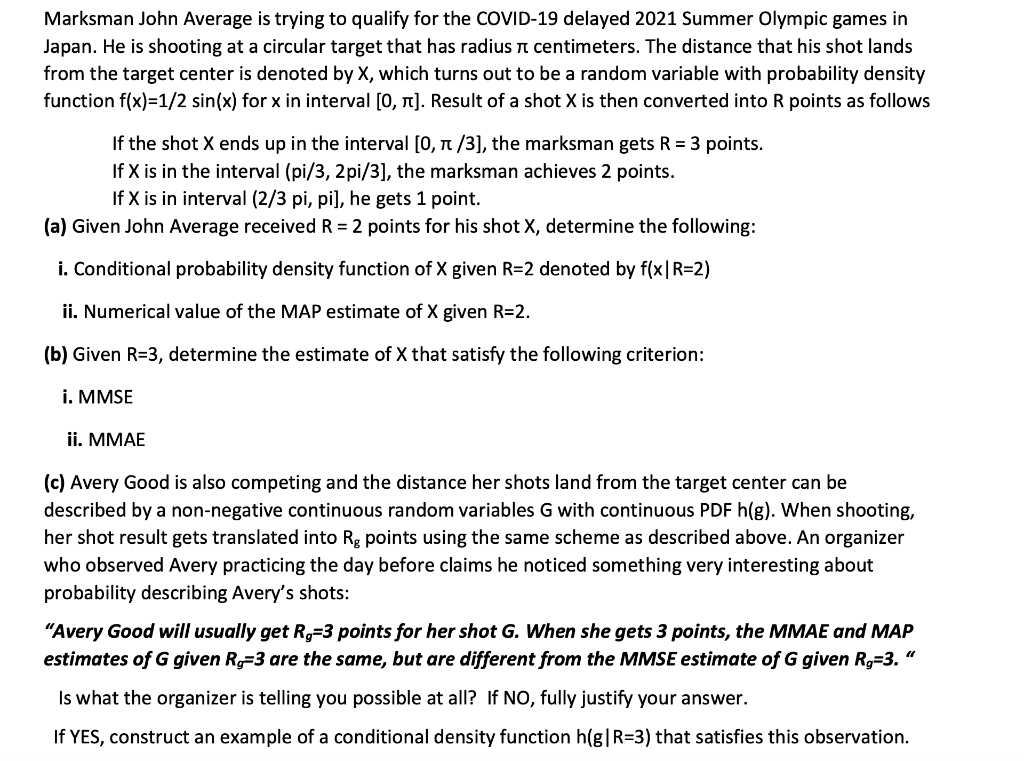
Marksman John Average is trying to qualify for the COVID-19 delayed 2021 Summer Olympic games in Japan. He is shooting at a circular target that has radius i centimeters. The distance that his shot lands from the target center is denoted by X, which turns out to be a random variable with probability density function f(x)=1/2 sin(x) for x in interval [0, r). Result of a shot X is then converted into R points as follows If the shot X ends up in the interval [0, 1/3), the marksman gets R = 3 points. If X is in the interval (pi/3, 2pi/3], the marksman achieves 2 points. If X is in interval (2/3 pi, pi], he gets 1 point. (a) Given John Average received R = 2 points for his shot X, determine the following: i. Conditional probability density function of X given R=2 denoted by f(x|R=2) ii. Numerical value of the MAP estimate of X given R=2. (b) Given R=3, determine the estimate of X that satisfy the following criterion: i. MMSE ii. MMAE (c) Avery Good is also competing and the distance her shots land from the target center can be described by a non-negative continuous random variables G with continuous PDF h(g). When shooting, her shot result gets translated into Rg points using the same scheme as described above. An organizer who observed Avery practicing the day before claims he noticed something very interesting about probability describing Avery's shots: "Avery Good will usually get Rg=3 points for her shot G. When she gets 3 points, the MMAE and MAP estimates of G given Rg=3 are the same, but are different from the MMSE estimate of G given Rg=3. Is what the organizer is telling you possible at all? If NO, fully justify your answer. If YES, construct an example of a conditional density function h(g|R=3) that satisfies this observation. Marksman John Average is trying to qualify for the COVID-19 delayed 2021 Summer Olympic games in Japan. He is shooting at a circular target that has radius i centimeters. The distance that his shot lands from the target center is denoted by X, which turns out to be a random variable with probability density function f(x)=1/2 sin(x) for x in interval [0, r). Result of a shot X is then converted into R points as follows If the shot X ends up in the interval [0, 1/3), the marksman gets R = 3 points. If X is in the interval (pi/3, 2pi/3], the marksman achieves 2 points. If X is in interval (2/3 pi, pi], he gets 1 point. (a) Given John Average received R = 2 points for his shot X, determine the following: i. Conditional probability density function of X given R=2 denoted by f(x|R=2) ii. Numerical value of the MAP estimate of X given R=2. (b) Given R=3, determine the estimate of X that satisfy the following criterion: i. MMSE ii. MMAE (c) Avery Good is also competing and the distance her shots land from the target center can be described by a non-negative continuous random variables G with continuous PDF h(g). When shooting, her shot result gets translated into Rg points using the same scheme as described above. An organizer who observed Avery practicing the day before claims he noticed something very interesting about probability describing Avery's shots: "Avery Good will usually get Rg=3 points for her shot G. When she gets 3 points, the MMAE and MAP estimates of G given Rg=3 are the same, but are different from the MMSE estimate of G given Rg=3. Is what the organizer is telling you possible at all? If NO, fully justify your answer. If YES, construct an example of a conditional density function h(g|R=3) that satisfies this observation
Step by Step Solution
There are 3 Steps involved in it

Get step-by-step solutions from verified subject matter experts