







Question: Materials Science & Engineering Problem! (Chemical Engineering) Please answer this question as soon as possible with specific explanation. If you're going to write it in
Materials Science & Engineering Problem! (Chemical Engineering)
Please answer this question as soon as possible with specific explanation.
If you're going to write it in handwriting, please write it clearly so I can recognize it. I don't want you to write solution in cursive letter.
I can give you thumbs up when your answer is correct.
Thanks.
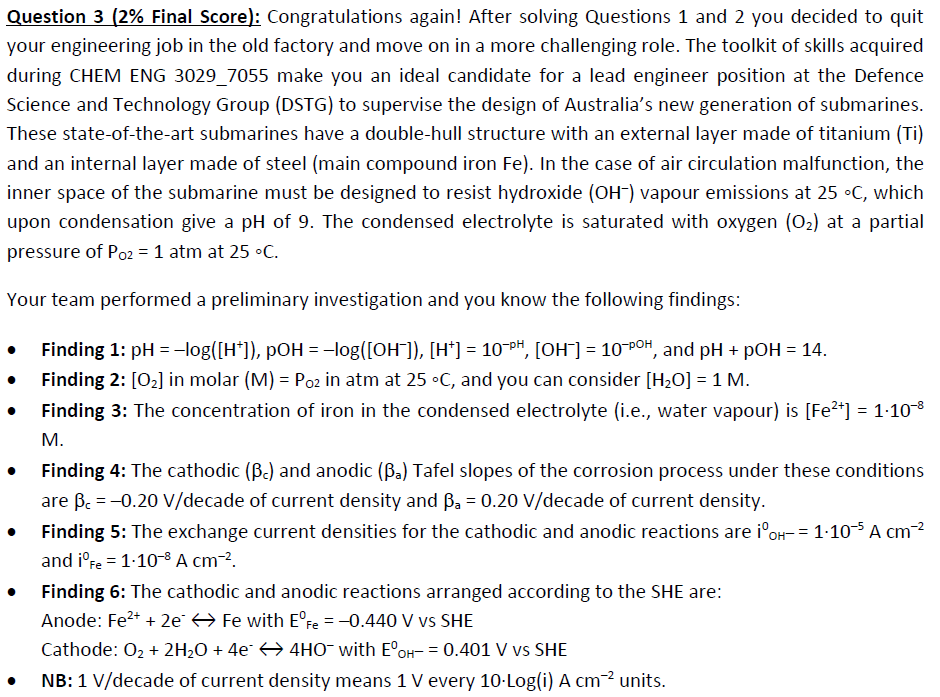
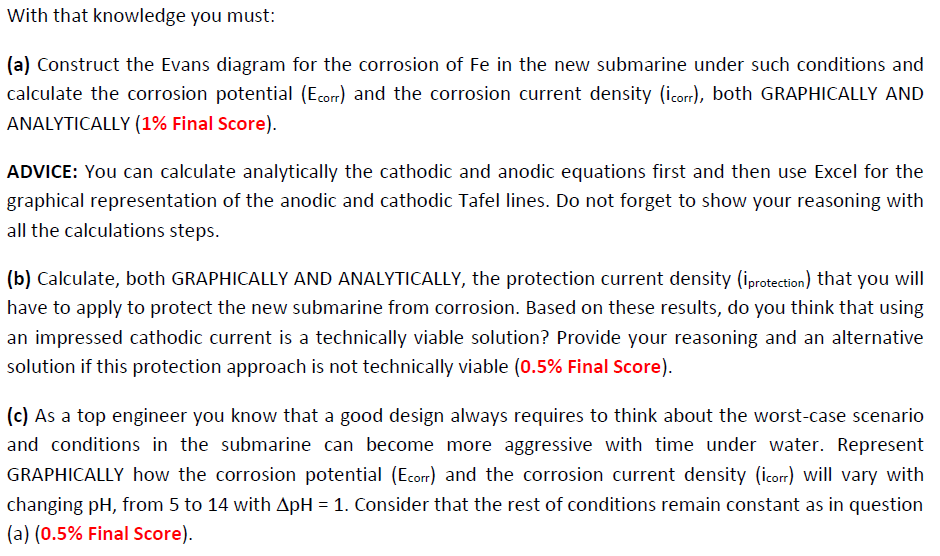
Question 3 (2% Final Score): Congratulations again! After solving Questions 1 and 2 you decided to quit your engineering job in the old factory and move on in a more challenging role. The toolkit of skills acquired during CHEM ENG 3029_7055 make you an ideal candidate for a lead engineer position at the Defence Science and Technology Group (DSTG) to supervise the design of Australia's new generation of submarines. These state-of-the-art submarines have a double-hull structure with an external layer made of titanium (Ti) and an internal layer made of steel (main compound iron Fe). In the case of air circulation malfunction, the inner space of the submarine must be designed to resist hydroxide (OH-) vapour emissions at 25 C, which upon condensation give a pH of 9. The condensed electrolyte is saturated with oxygen (O2) at a partial pressure of Po2 = 1 atm at 25C. Your team performed a preliminary investigation and you know the following findings: = 1 Finding 1: pH = -log([HH]), pOH = -log([OH-]), [H+) = 10-PH, [OH-] = 10-POH, and pH + pOH = 14. Finding 2: (O2) in molar (M) = Poz in atm at 25C, and you can consider [H2O) = 1 M. Finding 3: The concentration of iron in the condensed electrolyte (i.e., water vapour) is [Fe2+] = 1.10-8 - M. Finding 4: The cathodic (Bc) and anodic (Ba) Tafel slopes of the corrosion process under these conditions are B. =-0.20 V/decade of current density and Ba = 0.20 V/decade of current density. Finding 5: The exchange current densities for the cathodic and anodic reactions are ior- = 1.10-5 A cm? and ife = 1.10-8 A cm? Finding 6: The cathodic and anodic reactions arranged according to the SHE are: Anode: Fe2+ + 2e + Fe with EFe = -0.440 V vs SHE Cathode: O2 + 2H20 + 4e + 4H0-with Eor- = 0.401 V vs SHE NB: 1 V/decade of current density means 1 V every 10 Log(i) A cm2 units. + OH With that knowledge you must: (a) Construct the Evans diagram for the corrosion of Fe in the new submarine under such conditions and calculate the corrosion potential (Ecorr) and the corrosion current density (icorr), both GRAPHICALLY AND ANALYTICALLY (1% Final Score). ADVICE: You can calculate analytically the cathodic and anodic equations first and then use Excel for the graphical representation of the anodic and cathodic Tafel lines. Do not forget to show your reasoning with all the calculations steps. (b) Calculate, both GRAPHICALLY AND ANALYTICALLY, the protection current density (iprotection) that you will have to apply to protect the new submarine from corrosion. Based on these results, do you think that using an impressed cathodic current is a technically viable solution? Provide your reasoning and an alternative solution if this protection approach is not technically viable (0.5% Final Score). (c) As a top engineer you know that a good design always requires to think about the worst-case scenario and conditions in the submarine can become more aggressive with time under water. Represent GRAPHICALLY how the corrosion potential (Ecorr) and the corrosion current density (icorr) will vary with changing pH, from 5 to 14 with ApH = 1. Consider that the rest of conditions remain constant as in question (a) (0.5% Final Score). Question 3 (2% Final Score): Congratulations again! After solving Questions 1 and 2 you decided to quit your engineering job in the old factory and move on in a more challenging role. The toolkit of skills acquired during CHEM ENG 3029_7055 make you an ideal candidate for a lead engineer position at the Defence Science and Technology Group (DSTG) to supervise the design of Australia's new generation of submarines. These state-of-the-art submarines have a double-hull structure with an external layer made of titanium (Ti) and an internal layer made of steel (main compound iron Fe). In the case of air circulation malfunction, the inner space of the submarine must be designed to resist hydroxide (OH-) vapour emissions at 25 C, which upon condensation give a pH of 9. The condensed electrolyte is saturated with oxygen (O2) at a partial pressure of Po2 = 1 atm at 25C. Your team performed a preliminary investigation and you know the following findings: = 1 Finding 1: pH = -log([HH]), pOH = -log([OH-]), [H+) = 10-PH, [OH-] = 10-POH, and pH + pOH = 14. Finding 2: (O2) in molar (M) = Poz in atm at 25C, and you can consider [H2O) = 1 M. Finding 3: The concentration of iron in the condensed electrolyte (i.e., water vapour) is [Fe2+] = 1.10-8 - M. Finding 4: The cathodic (Bc) and anodic (Ba) Tafel slopes of the corrosion process under these conditions are B. =-0.20 V/decade of current density and Ba = 0.20 V/decade of current density. Finding 5: The exchange current densities for the cathodic and anodic reactions are ior- = 1.10-5 A cm? and ife = 1.10-8 A cm? Finding 6: The cathodic and anodic reactions arranged according to the SHE are: Anode: Fe2+ + 2e + Fe with EFe = -0.440 V vs SHE Cathode: O2 + 2H20 + 4e + 4H0-with Eor- = 0.401 V vs SHE NB: 1 V/decade of current density means 1 V every 10 Log(i) A cm2 units. + OH With that knowledge you must: (a) Construct the Evans diagram for the corrosion of Fe in the new submarine under such conditions and calculate the corrosion potential (Ecorr) and the corrosion current density (icorr), both GRAPHICALLY AND ANALYTICALLY (1% Final Score). ADVICE: You can calculate analytically the cathodic and anodic equations first and then use Excel for the graphical representation of the anodic and cathodic Tafel lines. Do not forget to show your reasoning with all the calculations steps. (b) Calculate, both GRAPHICALLY AND ANALYTICALLY, the protection current density (iprotection) that you will have to apply to protect the new submarine from corrosion. Based on these results, do you think that using an impressed cathodic current is a technically viable solution? Provide your reasoning and an alternative solution if this protection approach is not technically viable (0.5% Final Score). (c) As a top engineer you know that a good design always requires to think about the worst-case scenario and conditions in the submarine can become more aggressive with time under water. Represent GRAPHICALLY how the corrosion potential (Ecorr) and the corrosion current density (icorr) will vary with changing pH, from 5 to 14 with ApH = 1. Consider that the rest of conditions remain constant as in question (a) (0.5% Final Score)
Step by Step Solution
There are 3 Steps involved in it

Get step-by-step solutions from verified subject matter experts
 Study Help