Question: Maths a) So we can talk about the point (xi. yr, zr) where o .r; is the projection of the line connecting the point to

Maths

a)
Maths a) So we can talk about the point (xi. yr,Maths a) So we can talk about the point (xi. yr,Maths a) So we can talk about the point (xi. yr,Maths a) So we can talk about the point (xi. yr,Maths a) So we can talk about the point (xi. yr,
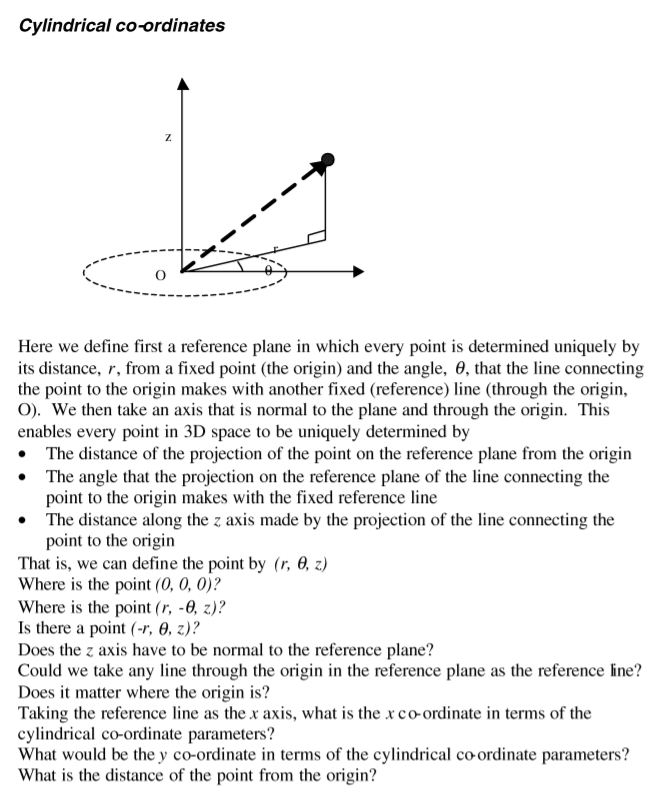
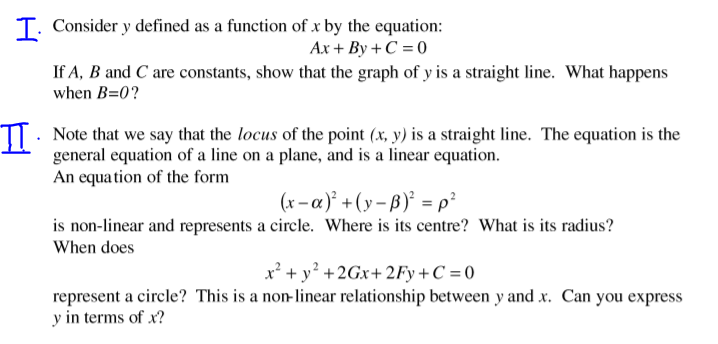
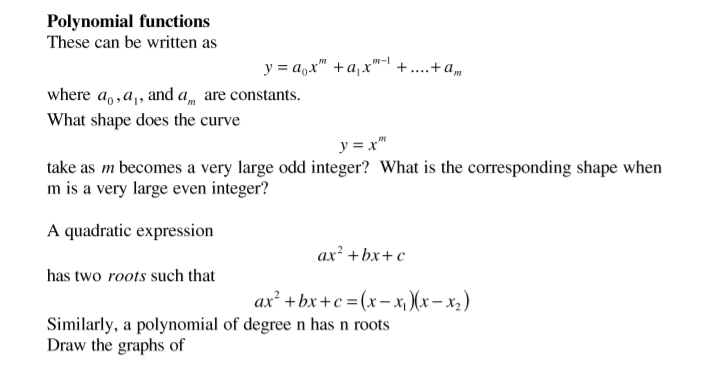
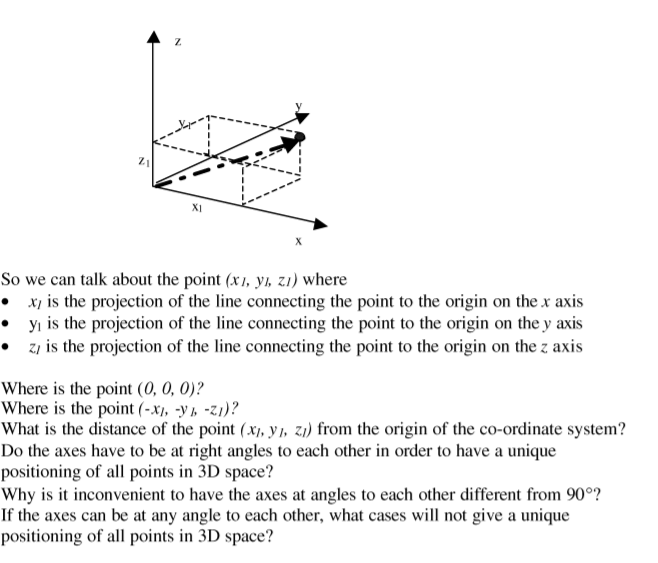
So we can talk about the point (xi. yr, zr) where o .r; is the projection of the line connecting the point to the origin on the .r axis 0 3:1 is the projection of the line connecting the point to the origin on the y axis 0 z; is the projection of the line connecting the point to the origin on the z axis Where is the point (0. 0, 0)? Where is the point f-Jn. -y;, {y}? What is the distance of the point (xi. y;. 3;] from the origin of the coordinate system?I Do the axes have to be at right angles to exh other in order to have a unique positioning of all points in 3D space? Why.r is it inconvenient to have the axes at angles to each other different from 90"? If the taxes can be at any angle to each other. what cases will not give a unique positioning of all points in 3D space? Cylindrical eta-ordinates Here we dene rst a reference plane in which every point is determined uniquely by its distance, r. from a xed point (the origin) and the angle, 6'. that the line connecting the point to the origin makes with another xed {reference} line {through the origin. 0). We then take an axis that is normal to the plane and through the origin. This enables every point in 3D space to be uniquely determined by I The distance of the projection of the point on the reference plane from the origin I The angle that the projection on the reference plane of the line connecting the point to the origin makes with the fixed reference line I The distance along the z axis made by the projection of the line connecting the point to the origin That is. we can dene the point by fr, 9. all Where is the point {0, 0, 0}? Where is the point tr. -6, z)? Is there a point (-r. 6. z)? Does the z axis have to be normal to the reference plane?I Could we take any line through the origin in the reference plane as the reference ine'? Does it matter where the origin is?I Taking the reference line as the x axis. what is the x coordinate in terms of the cylindrical coortlinate parameters? What would be they coordinate in terms of the cylindrical co ordinate parameters? Whm is the distance of the point fmm the origin? I. Consider y dened as a function of x by the equation: Ax + By + C = 0 HA, B and C are constants. show that the graph of y is a straight line. What happens when 3:0? E . Note that we say that the focus of the point (x, y) is a straight line. The equation is the general equation of a line on a plane. and is a linear equation. An equation of the form 2 2 (Jr-or) +{y-) = p' is non-linear and represents a circle. Where is its centre? What is its radius? When does 3:2 + y2 +ZGx+ 2Fy+C= 0 represent a circle? This is a non-linear relationship between 3: and x. Can you express 3: in terms of x? Polynomial functions These can be written as l+....+.::: y = aux" + 1111:\" where at, .al. and am are constants. What shape does the curve y = I\" take as or becomes a very large odd integer? What is the corresponding shape when m is a very large even integer? A quadratic expression of + bx+ c has two roars such that rmI +bx+e ={xxl ){xxz) Similarly, a polynomial of degree n has n roots Draw the graphs of y=X-x-6 y=x- 2x+3 y=-x- - 2x+3

Step by Step Solution

There are 3 Steps involved in it

1 Expert Approved Answer
Step: 1 Unlock blur-text-image

Question Has Been Solved by an Expert!

Get step-by-step solutions from verified subject matter experts

Step: 2 Unlock
Step: 3 Unlock

Students Have Also Explored These Related Mathematics Questions!