







Question: (matlab code only) (matlab code only) (matlab code only) (matlab code only) (matlab code only) (matlab code only) (matlab code only) (matlab code only) (matlab

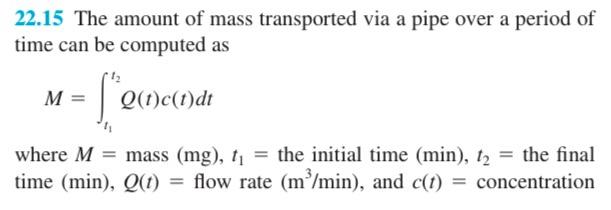
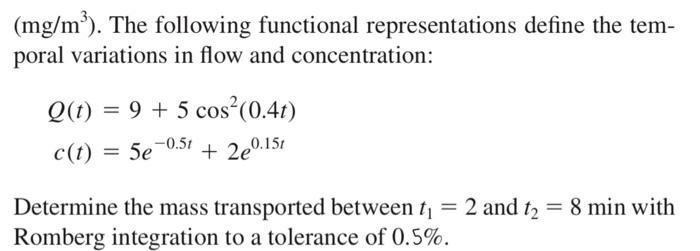
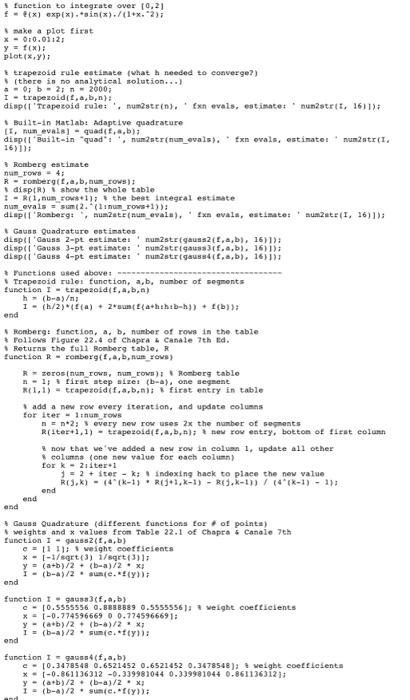
Repeat Problem 22.15: Using 5-point and 6-point Gauss quadrature. Compare to your answer from the previous problem, and also compare to the result using the built-in quad function. 22.15 The amount of mass transported via a pipe over a period of time can be computed as M = Q(1)c(1)dt where M = mass (mg), t the initial time (min), 12 the final time (min), Q(t) = flow rate (m/min), and c(t) = concentration (mg/m). The following functional representations define the tem- poral variations in flow and concentration: Q(t) c(t) = 5e-0.51 = 9 + 5 cos?(0.4t) 5e -0.51 + 2e0.151 Determine the mass transported between t1 = 2 and t2 = 8 min with Romberg integration to a tolerance of 0.5%. function to integrate over 10,2) f - x) exp(x)..sin(x)./(1+x.-2); make a plot first X-010.01:21 y = f(x): plot(x,y); trapezoid rule estimate (what h needed to converge?) (there is no analytical solution...) - - 0; b - 21 - 2000; I trapezoide, a,b,n) di spettrapezoid rule: . num2strin). * Exnevals, estinate: nun2str I. 1611) Built-in Matlabi Adaptive quadrature di spi! Built-in "quad: hun2strinum_evals) .txe ovals, estimatet numstre. Romberg estimate num_rows - 4: R - romberg, a,b,numrows) dispiR) show the whole table 1 - Rinun_row+1); the best Integral estimate num_evals - sum 2. 1. num_rows+1)): dispe Romberg: , num stefnun evala), Exnevals, estimate: numat(I, 16) Gauss Quadraturo estimates dispil'Gauss 2-pt estimate: 'numst gauss(f, a,b), 16)); displGauss 3-pt estimate: num2ste gauss 3.a,b), 16)); displ'Gauss 4-pt estimates num2 strgauss(f, a,b), 1651) Punctions used above: Trapezoid rule: function, a,b. number of segmonts function I - trapezoidif, a,b,n) h = (b-a) I - (h/2)(a) + 2 sunt(athihibh )) + f(b)); end Romberg: function, a, b, number of rows in the table Follows Figure 22.4 of Chapra 4 Canale 7th Ed. Returns the full Romberg tablo, R function R - ronberg(a, b, nam rows) Rzorosinun roVS, nun_rown) Romberg table n-1: first step size: (b-a), one segment (1.1) - trapezoidif.a,b,n); first entry in table add a new row every iteration, and update columns for iter - linum row n = 12; every new row uses 2x the number of segments R(Iter+1.1) - trapezoid!,,b.); new row entry, bottom of first column now that we've added a new row in column 1, update all other columns (one new value for each column) fork - 2. iter 1 1 = 2 + iter - K: Indexing back to place the new value ROD,K) - (4 (k-1). R(+1, k-1) - REJ.K-1))/ (41k-1) - 1) end end end Gauss Quadrature (different functions for of points) weights and values from Table 22.1 of Chapra & Canale 7th function 1 - gauss 2(f.a,b) c=11111 weight coefficients * - !-1/sqrt(3) 1/sqrt{3)); y = (a+b)/2 + (b-a)/2 x; I - (-a)/2 .se. ()) end function I - 483, a.b) 10.5558$56.6, E88 8 889 5.68SSSS6): 1 weight coefficients y - (a+b)/2 + (b-a)/2 x; I = (-a)/2 sumie.173 end function I - gauss(f, a,b) e-10.3478548 0.6521452 0.6521452 0.3478548); weight coefficients * - 1-0.861136312 -0.339981044 0.399981044 0.8611363121 y - (a+b)/2 + (b-a)/2 x 1 = (-a)/2 . sume.f))
Step by Step Solution
There are 3 Steps involved in it

Get step-by-step solutions from verified subject matter experts
 Study Help