







Question: (matlab code only) (matlab code only) (matlab code only) (matlab code only) (matlab code only) (matlab code only) (matlab code only) (matlab code only) (matlab

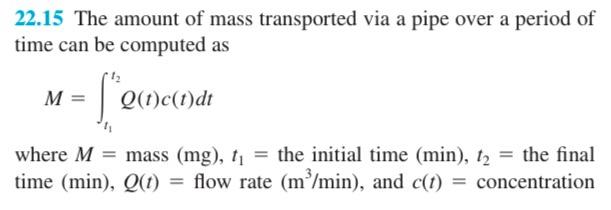
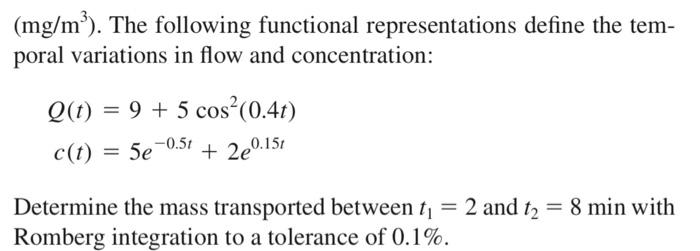
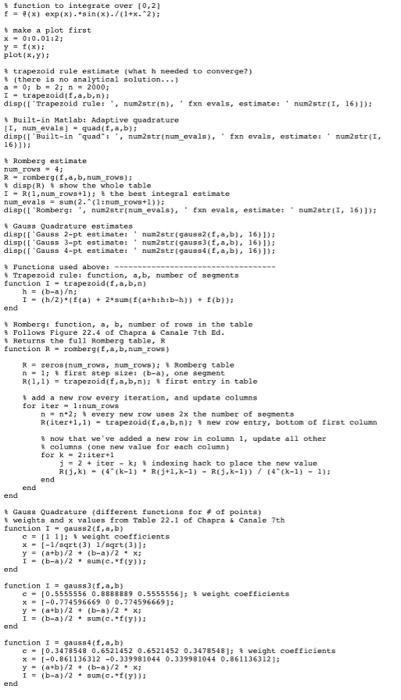
Problem 22.15: Note: The problem asks you to perform Romberg integration to a tolerance of 0.1%. Use tolerance of 0.05% instead of 0.1%. This refers to the % change in the integral estimate between iterations (ie., each time you add a new row to the Romberg table). You will need to modify the class code to implement a stopping condition based on tolerance, which we did not do in class. 22.15 The amount of mass transported via a pipe over a period of time can be computed as M = Q(1)c(1)dt where M = mass (mg), t the initial time (min), 12 the final time (min), Q(t) = flow rate (m/min), and c(t) = concentration (mg/m). The following functional representations define the tem- poral variations in flow and concentration: Q(t) = 9 + 5 cos?(0.41) c(t) = 5e +0.51 + 2e0.151 Determine the mass transported between t1 = 2 and t2 = 8 min with Romberg integration to a tolerance of 0.1%. function to integrate over 10,21 =**) exp(x).sin(x)/(1+x. 2): make a plot first X-010.0112 y = f(x): plot*,): trapezoid rule estimate what he needed to converge?) (there is no analytical solution...) a. 0; b. 2; n2000; I trapezoidit,,b.n) displ Traperoid rulei, numstrin). Exnevats, estimate: Str. 1671) Built-in Matlab: Adaptive quadrature 11, nun evals! - quadct,a,b); disp Built-in "quad.numstrinun_evals), fan evals, estimate: numatri, 16)) Romberg estimate num_rows - Rronbergit.a, b, numrove) disp() show the whole table 1 . RC1, num_rowa +1); the best integral estimate despit "Romberg, numetrinun_evais, Exnevals, estimate numer 11, 36) Gauss Quadrature estimates displt Gauss 2-pt estimate namastrgaus 82(1,2,b), 16)) displl Gauss 3-pt estimate: nustegauss 3.a,b). 1671) dispil Gauss 4-pt estimate: numst aussit.a,b). 16) 1); Punetions used above: Trapezoid rule: function, a,b, number of segments function I - trapezoid(f.a,b,n) h = (-a): 1 = (1/2)*(a) + 2*suntf(a+hahb-hi) ton end Rombergi function, a, b, number of rows in the table 9 Follows Figure 22.4 of Chapra Canale 7th Ed. Returns the full Romberg table. R function - Tombergi,,b,nun rows - zeros inun_rowa, nun_rows): Ronberg table n. 1; first step siset (-a), one segment R41,1) - trapezoid(fab.n) first entry in table add a new row every iteration, and update columns for Iter - 1.nun rows - n2: every new row uses 2x the number of segments Reiter+1,1) - trapezoid.&.b.n) new row entry, bottom of first column now that we've added a new row in column 1, update all other columns (one new value for each column) Eork - 2:iter! - 2 + iter -ki indexing hack to place the new value RU,X) - ( 4-1). R(+1,-1) - R.K-1)) / 4 (k-1) - 3) end end end Gauss Quadrature (different functions for of points) weights and x values from Table 22.1 of Chapra Canale 7th function 1- gauss(a,b) c=111) weight coefficients * - -1/aqrt(3) 1/get(3)]: y (a+b)/2 = (-a)/2 X (b-a)/2 aume. (Y) ond function 1 = gauss(1,a,b) c10.5555556 0. SEBEEST 0.5555556); weight coefficients * - 1 -0.774596669 0.72459666911 y - (a+b)/2 + (-a)/2 X I = (b-a)/2 sum(c.ffy) end function Igaun(...) c - 10.3478548 0.6521452 0.6521452 0.3478548); t weight coefficients * - -0.861136312 -0.339981044 0.339981044 0.8611363123 Y - (a+b)/2 (-a)/2 X I= (-a)/2 sume. (y) end
Step by Step Solution
There are 3 Steps involved in it

Get step-by-step solutions from verified subject matter experts
 Study Help