







Question: Matlab problem Below is lutx. Just copy and paste to your MATLAB function [L,U,p] = lutx(A) %LUTX Triangular factorization, textbook version % [L,U,p] = lutx(A)
Matlab problem
Below is lutx. Just copy and paste to your MATLAB
function [L,U,p] = lutx(A) %LUTX Triangular factorization, textbook version % [L,U,p] = lutx(A) produces a unit lower triangular matrix L, % an upper triangular matrix U, and a permutation vector p, % so that L*U = A(p,:) % Copyright 2014 Cleve Moler % Copyright 2014 The MathWorks, Inc. [n,n] = size(A); p = (1:n)'; for k = 1:n-1 % Find index of largest element below diagonal in k-th column [r,m] = max(abs(A(k:n,k))); m = m+k-1; % Skip elimination if column is zero if (A(m,k) ~= 0) % Swap pivot row if (m ~= k) A([k m],:) = A([m k],:); p([k m]) = p([m k]); end % Compute multipliers i = k+1:n; A(i,k) = A(i,k)/A(k,k); % Update the remainder of the matrix j = k+1:n; A(i,j) = A(i,j) - A(i,k)*A(k,j); end end % Separate result L = tril(A,-1) + eye(n,n); U = triu(A);
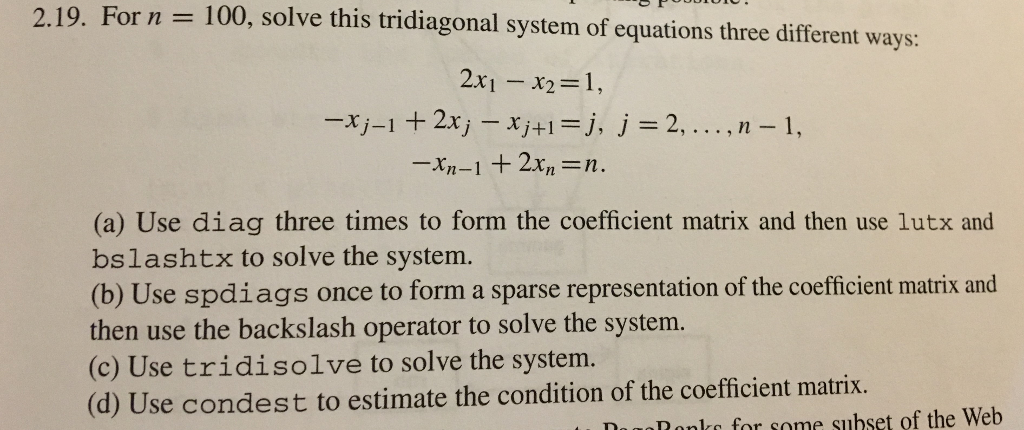
2.19. For n = 100, solve this tridiagonal system of equations three different ways: 2x1-x2 = 1, (a) Use diag three times to form the coefficient matrix and then use lutx and bslashtx to solve the system. (b) Use spdiags once to form a sparse representation of the coefficient matrix and then use the backslash operator to solve the system. (c) Use tridisolveto solve the system. (d) Use condest to estimate the condition of the coefficient matrix. DagaRanke for some subset of the Web
Step by Step Solution
There are 3 Steps involved in it
1 Expert Approved Answer
Step: 1 Unlock

Question Has Been Solved by an Expert!
Get step-by-step solutions from verified subject matter experts
Step: 2 Unlock
Step: 3 Unlock
 Study Help