







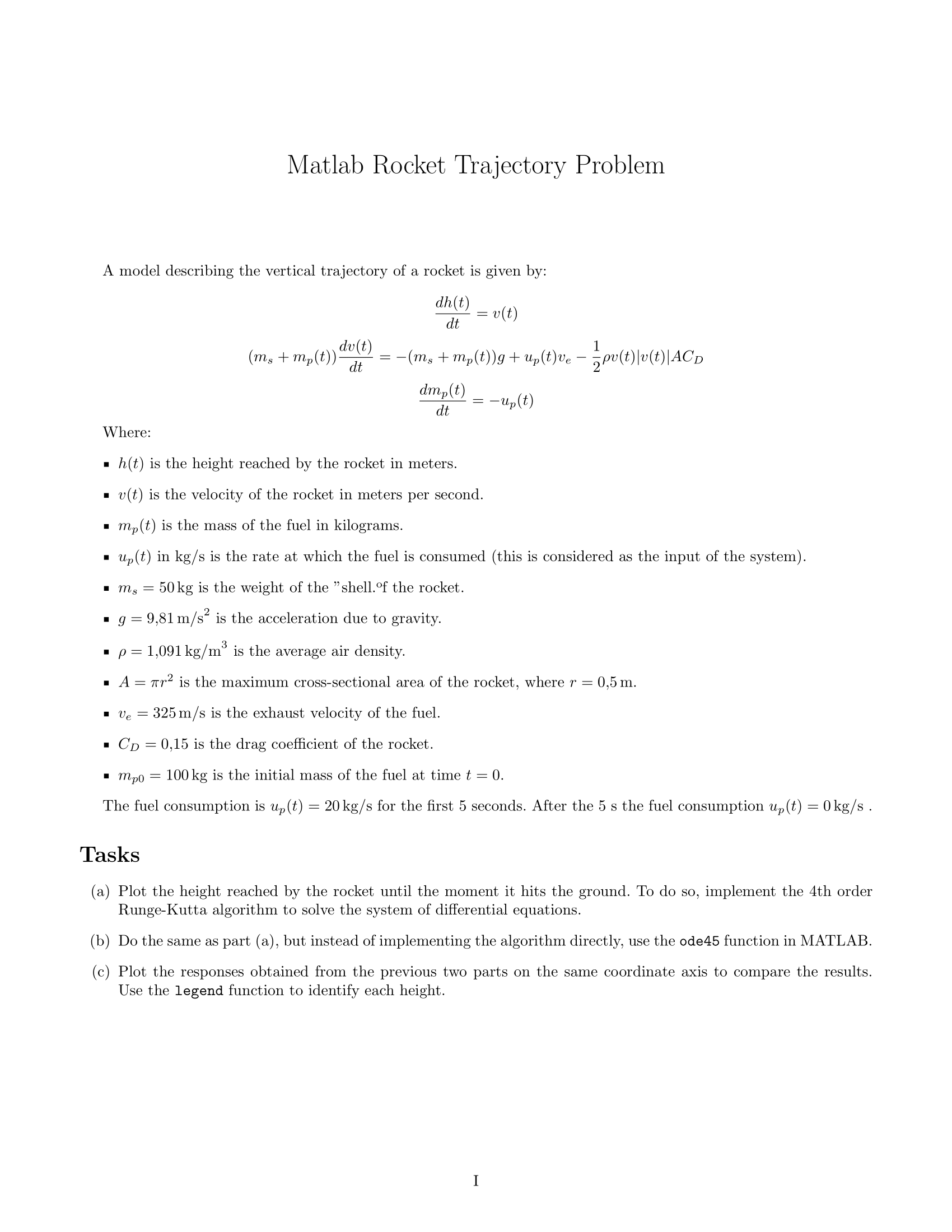
Question: Matlab Provide the complete code explianing how you implemented it for the following problem please! Rocket Trajectory Problem A model describing the vertical trajectory of
Matlab
Provide the complete code explianing how you implemented it for the following problem please!
Rocket Trajectory Problem
A model describing the vertical trajectory of a rocket is given by:
Where:
is the height reached by the rocket in meters.
is the velocity of the rocket in meters per second.
is the mass of the fuel in kilograms.
in is the rate at which the fuel is consumed this is considered as the input of the system
is the weight of the "shell. of the rocket.
is the acceleration due to gravity.
is the average air density.
is the maximum crosssectional area of the rocket, where
is the exhaust velocity of the fuel.
is the drag coefficient of the rocket.
is the initial mass of the fuel at time
The fuel consumption is for the first seconds. After the s the fuel consumption
Tasks
a Plot the height reached by the rocket until the moment it hits the ground. To do so implement the th order
RungeKutta algorithm to solve the system of differential equations.
b Do the same as part a but instead of implementing the algorithm directly, use the ode function in MATLAB.
c Plot the responses obtained from the previous two parts on the same coordinate axis to compare the results.
Use the legend function to identify each height.
Step by Step Solution
There are 3 Steps involved in it
1 Expert Approved Answer
Step: 1 Unlock

Question Has Been Solved by an Expert!
Get step-by-step solutions from verified subject matter experts
Step: 2 Unlock
Step: 3 Unlock
 Study Help