



Question: Methane (CH4) and chlorine (Cl2) react to form dichloromethane (CH2Cl2) and hydrochloric acid (HCl). A stoichiometric mixture (fresh feed) of methane and chlorine flows at
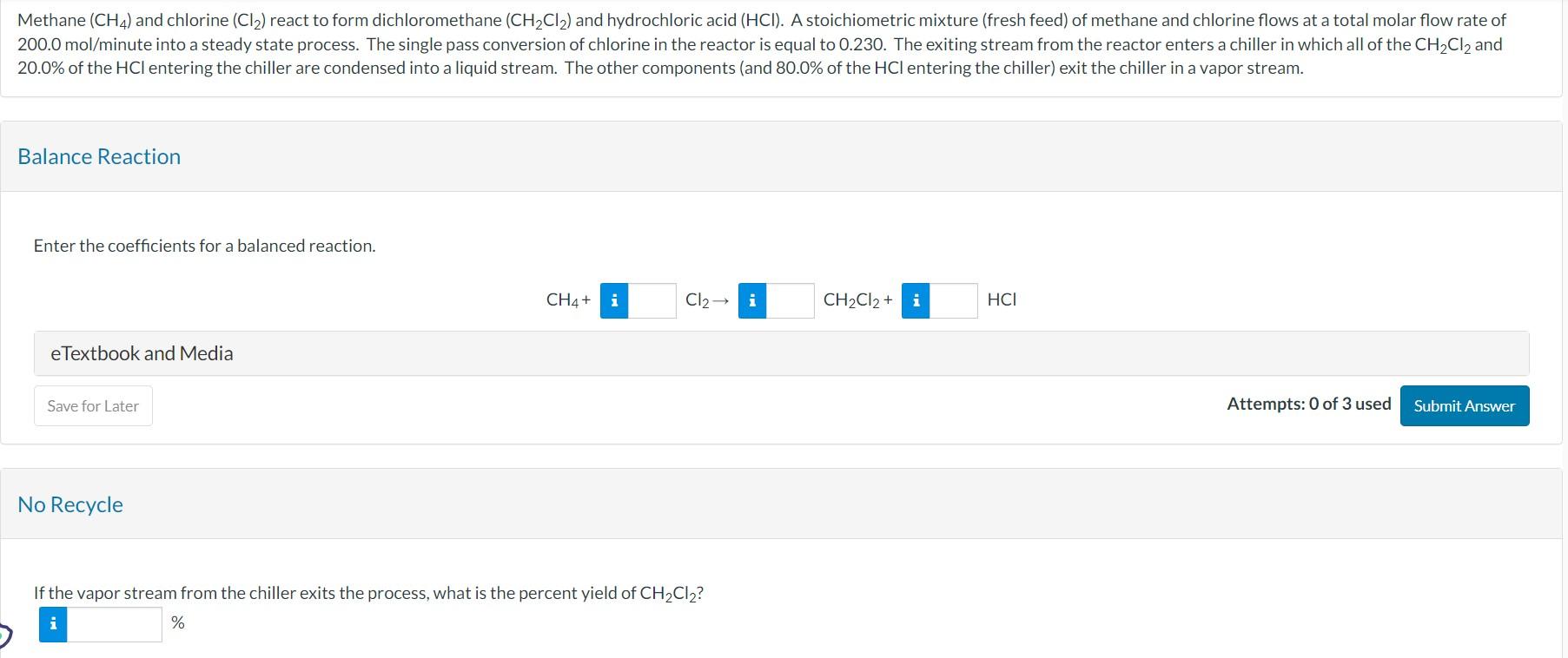
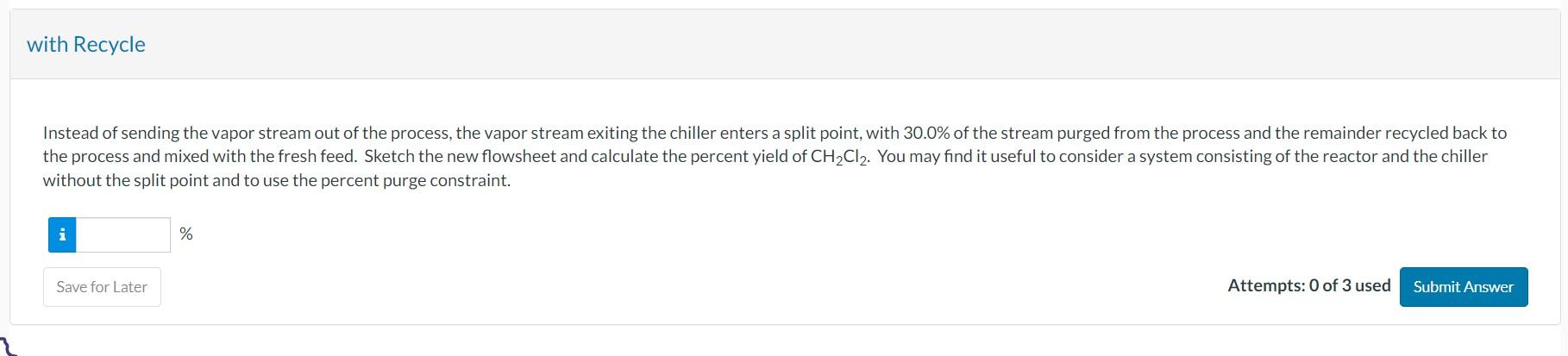
Methane (CH4) and chlorine (Cl2) react to form dichloromethane (CH2Cl2) and hydrochloric acid (HCl). A stoichiometric mixture (fresh feed) of methane and chlorine flows at a total molar flow rate of 200.0mol/minute into a steady state process. The single pass conversion of chlorine in the reactor is equal to 0.230 . The exiting stream from the reactor enters a chiller in which all of the CH2Cl2 and 20.0% of the HCl entering the chiller are condensed into a liquid stream. The other components (and 80.0% of the HCl entering the chiller) exit the chiller in a vapor stream. Balance Reaction Enter the coefficients for a balanced reaction. CH4+Cl2CH2Cl2+HCl eTextbook and Media Attempts: 0 of 3 used No Recycle If the vapor stream from the chiller exits the process, what is the percent yield of CH2Cl2 ? % Instead of sending the vapor stream out of the process, the vapor stream exiting the chiller enters a split point, with 30.0% of the stream purged from the process and the remainder recycled back to the process and mixed with the fresh feed. Sketch the new flowsheet and calculate the percent yield of CH2Cl2. You may find it useful to consider a system consisting of the reactor and the chiller without the split point and to use the percent purge constraint. % Attempts: 0 of 3 used
Step by Step Solution
There are 3 Steps involved in it

Get step-by-step solutions from verified subject matter experts