







Question: Mini Case #2 Halton Public Services Halton Public Services (HPS) is a not-for-profit organization and has been in existence since 2015. HPS has a set
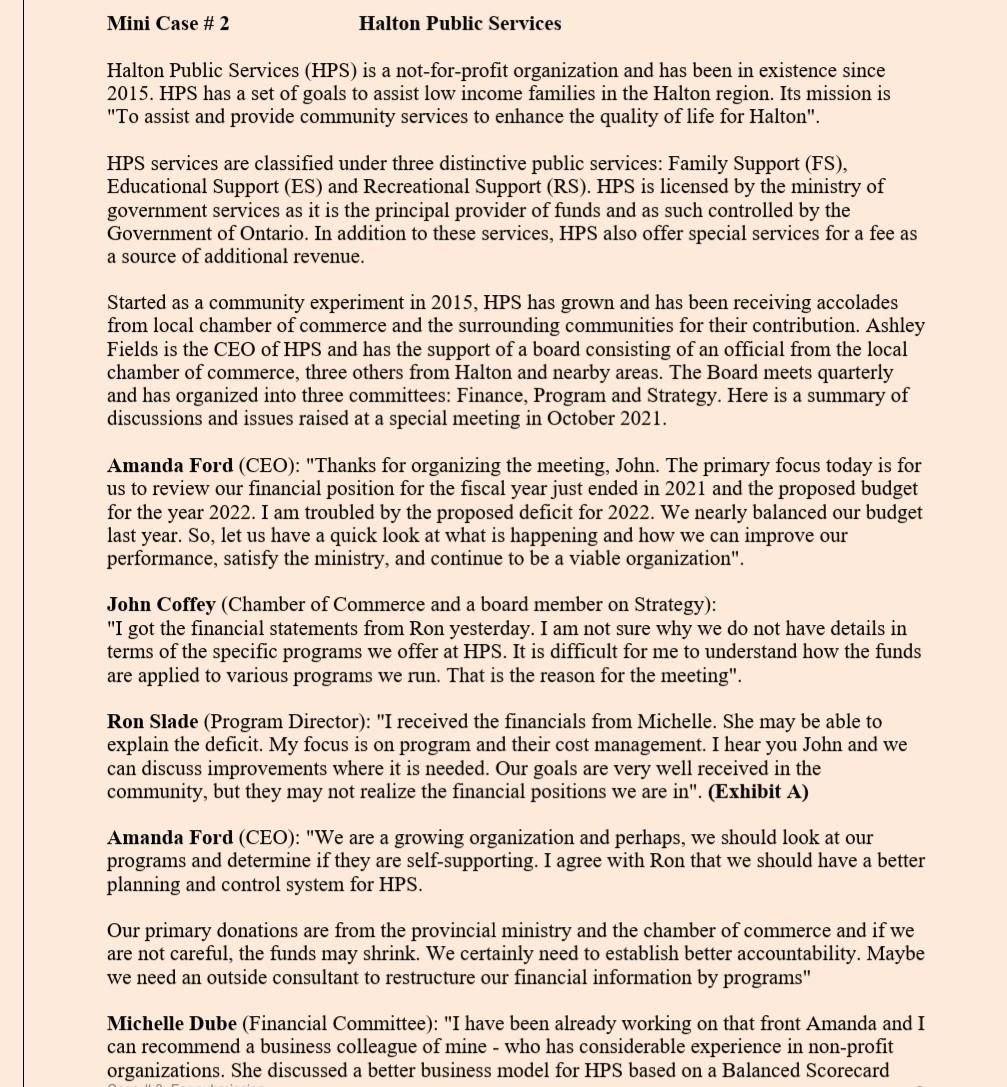
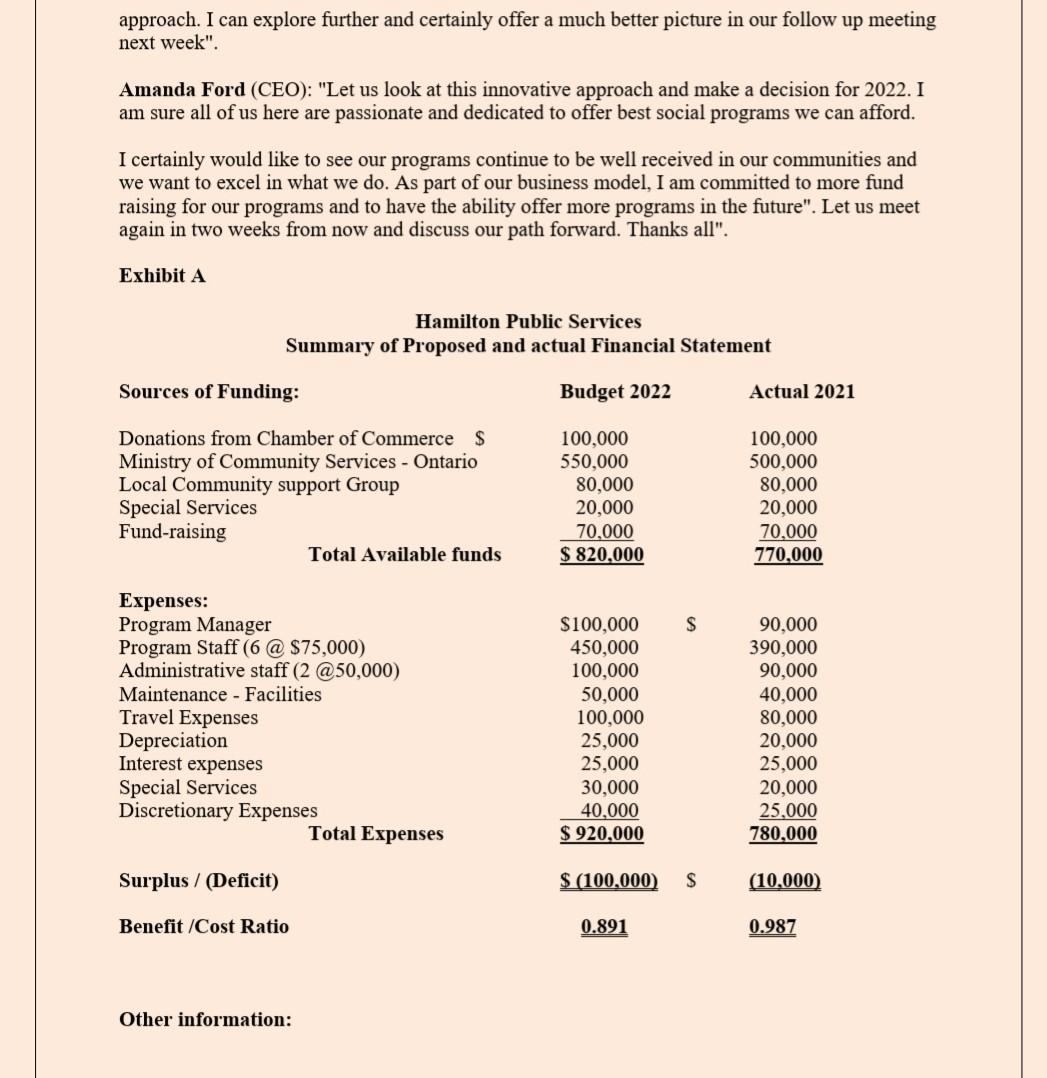
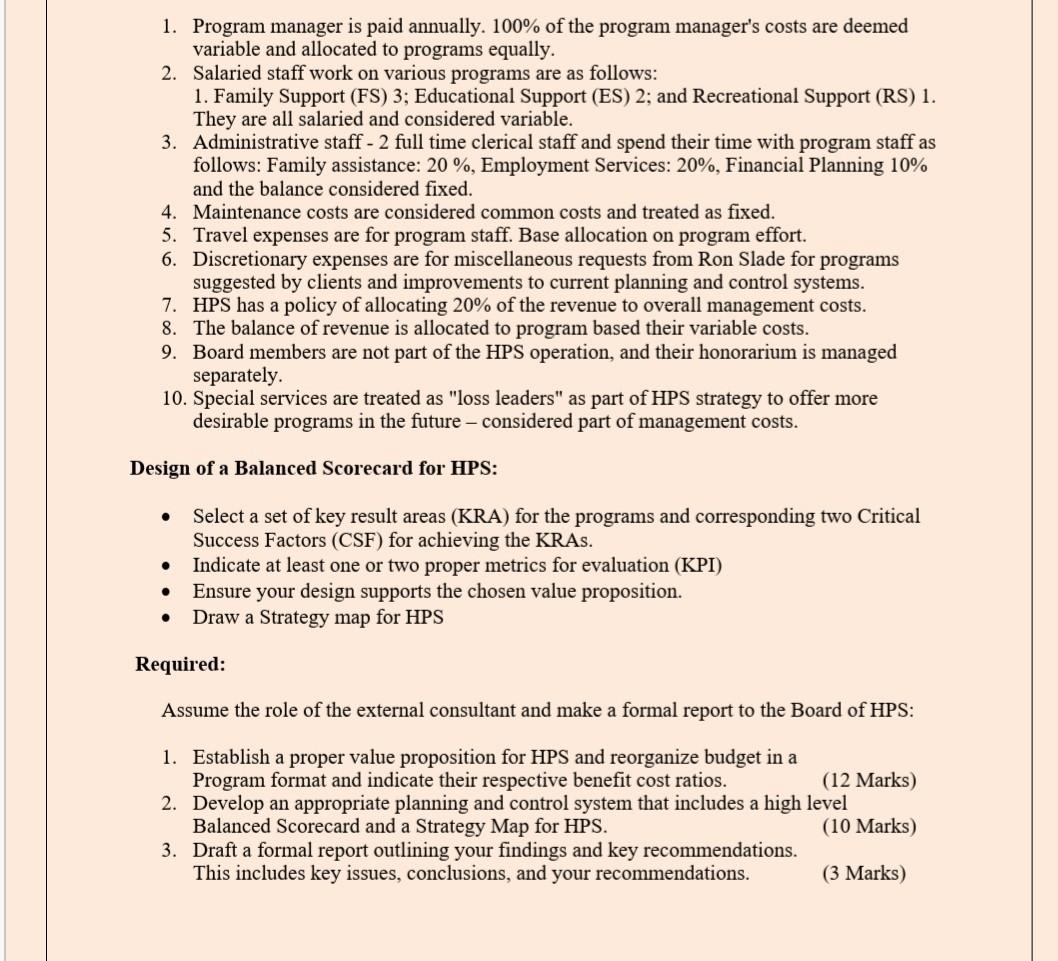
Mini Case #2 Halton Public Services Halton Public Services (HPS) is a not-for-profit organization and has been in existence since 2015. HPS has a set of goals to assist low income families in the Halton region. Its mission is "To assist and provide community services to enhance the quality of life for Halton". HPS services are classified under three distinctive public services: Family Support (FS), Educational Support (ES) and Recreational Support (RS). HPS is licensed by the ministry of government services as it is the principal provider of funds and as such controlled by the Government of Ontario. In addition to these services, HPS also offer special services for a fee as a source of additional revenue. Started as a community experiment in 2015, HPS has grown and has been receiving accolades from local chamber of commerce and the surrounding communities for their contribution. Ashley Fields is the CEO of HPS and has the support of a board consisting of an official from the local chamber of commerce, three others from Halton and nearby areas. The Board meets quarterly and has organized into three committees: Finance, Program and Strategy. Here is a summary of discussions and issues raised at a special meeting in October 2021. Amanda Ford (CEO): "Thanks for organizing the meeting, John. The primary focus today is for us to review our financial position for the fiscal year just ended in 2021 and the proposed budget for the year 2022. I am troubled by the proposed deficit for 2022. We nearly balanced our budget last year. So, let us have a quick look at what is happening and how we can improve our performance, satisfy the ministry, and continue to be a viable organization". John Coffey (Chamber of Commerce and a board member on Strategy): "I got the financial statements from Ron yesterday. I am not sure why we do not have details in terms of the specific programs we offer at HPS. It is difficult for me to understand how the funds are applied to various programs we run. That is the reason for the meeting". Ron Slade (Program Director): "I received the financials from Michelle. She may be able explain the deficit. My focus is on program and their cost management. I hear you John and we can discuss improvements where it is needed. Our goals are very well received in the community, but they may not realize the financial positions we are in". (Exhibit A) Amanda Ford (CEO): "We are a growing organization and perhaps, we should look at our programs and determine if they are self-supporting. I agree with Ron that we should have a better planning and control system for HPS. Our primary donations are from the provincial ministry and the chamber of commerce and if we are not careful, the funds may shrink. We certainly need to establish better accountability. Maybe we need an outside consultant to restructure our financial information by programs" Michelle Dube (Financial Committee): "I have been already working on that front Amanda and I can recommend a business colleague of mine - who has considerable experience in non-profit organizations. She discussed a better business model for HPS based on a Balanced Scorecard approach. I can explore further and certainly offer a much better picture in our follow up meeting next week". Amanda Ford (CEO): "Let us look at this innovative approach and make a decision for 2022. I am sure all of us here are passionate and dedicated to offer best social programs we can afford. I certainly would like to see our programs continue to be well received in our communities and we want to excel in what we do. As part of our business model, I am committed to more fund raising for our programs and to have the ability offer more programs in the future". Let us meet again in two weeks from now and discuss our path forward. Thanks all". Exhibit A Hamilton Public Services Summary of Proposed and actual Financial Statement Sources of Funding: Budget 2022 Actual 2021 Donations from Chamber of Commerce $ Ministry of Community Services - Ontario Local Community support Group Special Services Fund-raising Total Available funds 100,000 550,000 80,000 20,000 70,000 $ 820,000 100,000 500,000 80,000 20,000 70,000 770,000 $ Expenses: Program Manager Program Staff (6 @ $75,000) Administrative staff (2 @50,000) Maintenance - Facilities Travel Expenses Depreciation Interest expenses Special Services Discretionary Expenses Total Expenses $100,000 450,000 100,000 50,000 100,000 25,000 25,000 30,000 40,000 $ 920,000 90,000 390.000 90,000 40,000 80,000 20,000 25,000 20,000 25,000 780,000 Surplus / (Deficit) $ (100,000) S (10,000) Benefit /Cost Ratio 0.891 0.987 Other information: 1. Program manager is paid annually. 100% of the program manager's costs are deemed variable and allocated to programs equally. 2. Salaried staff work on various programs are as follows: 1. Family Support (FS) 3; Educational Support (ES) 2; and Recreational Support (RS) 1. They are all salaried and considered variable. 3. Administrative staff - 2 full time clerical staff and spend their time with program staff as follows: Family assistance: 20 %, Employment Services: 20%, Financial Planning 10% and the balance considered fixed. 4. Maintenance costs are considered common costs and treated as fixed. 5. Travel expenses are for program staff. Base allocation on program effort. 6. Discretionary expenses are for miscellaneous requests from Ron Slade for programs suggested by clients and improvements to current planning and control systems. 7. HPS has a policy of allocating 20% of the revenue to overall management costs. 8. The balance of revenue is allocated to program based their variable costs. 9. Board members are not part of the HPS operation, and their honorarium is managed separately. 10. Special services are treated as "loss leaders" as part of HPS strategy to offer more desirable programs in the future considered part of management costs. Design of a Balanced Scorecard for HPS: . Select a set of key result areas (KRA) for the programs and corresponding two Critical Success Factors (CSF) for achieving the KRAS. Indicate at least one or two proper metrics for evaluation (KPI) Ensure your design supports the chosen value proposition. Draw a Strategy map for HPS . . Required: Assume the role of the external consultant and make a formal report to the Board of HPS: 1. Establish a proper value proposition for HPS and reorganize budget in a Program format and indicate their respective benefit cost ratios. (12 Marks) 2. Develop an appropriate planning and control system that includes a high level Balanced Scorecard and a Strategy Map for HPS. (10 Marks) 3. Draft a formal report outlining your findings and key recommendations. This includes key issues, conclusions, and your recommendations. (3 Marks) Mini Case #2 Halton Public Services Halton Public Services (HPS) is a not-for-profit organization and has been in existence since 2015. HPS has a set of goals to assist low income families in the Halton region. Its mission is "To assist and provide community services to enhance the quality of life for Halton". HPS services are classified under three distinctive public services: Family Support (FS), Educational Support (ES) and Recreational Support (RS). HPS is licensed by the ministry of government services as it is the principal provider of funds and as such controlled by the Government of Ontario. In addition to these services, HPS also offer special services for a fee as a source of additional revenue. Started as a community experiment in 2015, HPS has grown and has been receiving accolades from local chamber of commerce and the surrounding communities for their contribution. Ashley Fields is the CEO of HPS and has the support of a board consisting of an official from the local chamber of commerce, three others from Halton and nearby areas. The Board meets quarterly and has organized into three committees: Finance, Program and Strategy. Here is a summary of discussions and issues raised at a special meeting in October 2021. Amanda Ford (CEO): "Thanks for organizing the meeting, John. The primary focus today is for us to review our financial position for the fiscal year just ended in 2021 and the proposed budget for the year 2022. I am troubled by the proposed deficit for 2022. We nearly balanced our budget last year. So, let us have a quick look at what is happening and how we can improve our performance, satisfy the ministry, and continue to be a viable organization". John Coffey (Chamber of Commerce and a board member on Strategy): "I got the financial statements from Ron yesterday. I am not sure why we do not have details in terms of the specific programs we offer at HPS. It is difficult for me to understand how the funds are applied to various programs we run. That is the reason for the meeting". Ron Slade (Program Director): "I received the financials from Michelle. She may be able explain the deficit. My focus is on program and their cost management. I hear you John and we can discuss improvements where it is needed. Our goals are very well received in the community, but they may not realize the financial positions we are in". (Exhibit A) Amanda Ford (CEO): "We are a growing organization and perhaps, we should look at our programs and determine if they are self-supporting. I agree with Ron that we should have a better planning and control system for HPS. Our primary donations are from the provincial ministry and the chamber of commerce and if we are not careful, the funds may shrink. We certainly need to establish better accountability. Maybe we need an outside consultant to restructure our financial information by programs" Michelle Dube (Financial Committee): "I have been already working on that front Amanda and I can recommend a business colleague of mine - who has considerable experience in non-profit organizations. She discussed a better business model for HPS based on a Balanced Scorecard approach. I can explore further and certainly offer a much better picture in our follow up meeting next week". Amanda Ford (CEO): "Let us look at this innovative approach and make a decision for 2022. I am sure all of us here are passionate and dedicated to offer best social programs we can afford. I certainly would like to see our programs continue to be well received in our communities and we want to excel in what we do. As part of our business model, I am committed to more fund raising for our programs and to have the ability offer more programs in the future". Let us meet again in two weeks from now and discuss our path forward. Thanks all". Exhibit A Hamilton Public Services Summary of Proposed and actual Financial Statement Sources of Funding: Budget 2022 Actual 2021 Donations from Chamber of Commerce $ Ministry of Community Services - Ontario Local Community support Group Special Services Fund-raising Total Available funds 100,000 550,000 80,000 20,000 70,000 $ 820,000 100,000 500,000 80,000 20,000 70,000 770,000 $ Expenses: Program Manager Program Staff (6 @ $75,000) Administrative staff (2 @50,000) Maintenance - Facilities Travel Expenses Depreciation Interest expenses Special Services Discretionary Expenses Total Expenses $100,000 450,000 100,000 50,000 100,000 25,000 25,000 30,000 40,000 $ 920,000 90,000 390.000 90,000 40,000 80,000 20,000 25,000 20,000 25,000 780,000 Surplus / (Deficit) $ (100,000) S (10,000) Benefit /Cost Ratio 0.891 0.987 Other information: 1. Program manager is paid annually. 100% of the program manager's costs are deemed variable and allocated to programs equally. 2. Salaried staff work on various programs are as follows: 1. Family Support (FS) 3; Educational Support (ES) 2; and Recreational Support (RS) 1. They are all salaried and considered variable. 3. Administrative staff - 2 full time clerical staff and spend their time with program staff as follows: Family assistance: 20 %, Employment Services: 20%, Financial Planning 10% and the balance considered fixed. 4. Maintenance costs are considered common costs and treated as fixed. 5. Travel expenses are for program staff. Base allocation on program effort. 6. Discretionary expenses are for miscellaneous requests from Ron Slade for programs suggested by clients and improvements to current planning and control systems. 7. HPS has a policy of allocating 20% of the revenue to overall management costs. 8. The balance of revenue is allocated to program based their variable costs. 9. Board members are not part of the HPS operation, and their honorarium is managed separately. 10. Special services are treated as "loss leaders" as part of HPS strategy to offer more desirable programs in the future considered part of management costs. Design of a Balanced Scorecard for HPS: . Select a set of key result areas (KRA) for the programs and corresponding two Critical Success Factors (CSF) for achieving the KRAS. Indicate at least one or two proper metrics for evaluation (KPI) Ensure your design supports the chosen value proposition. Draw a Strategy map for HPS . . Required: Assume the role of the external consultant and make a formal report to the Board of HPS: 1. Establish a proper value proposition for HPS and reorganize budget in a Program format and indicate their respective benefit cost ratios. (12 Marks) 2. Develop an appropriate planning and control system that includes a high level Balanced Scorecard and a Strategy Map for HPS. (10 Marks) 3. Draft a formal report outlining your findings and key recommendations. This includes key issues, conclusions, and your recommendations
Step by Step Solution
There are 3 Steps involved in it

Get step-by-step solutions from verified subject matter experts
 Study Help