







Question: Model 1: Ionic Charges for Selected Elements Metals form cations (positive ions); Nonmetals form anions (Hydrogen can form both) H* Lit Na* K+ Mg+
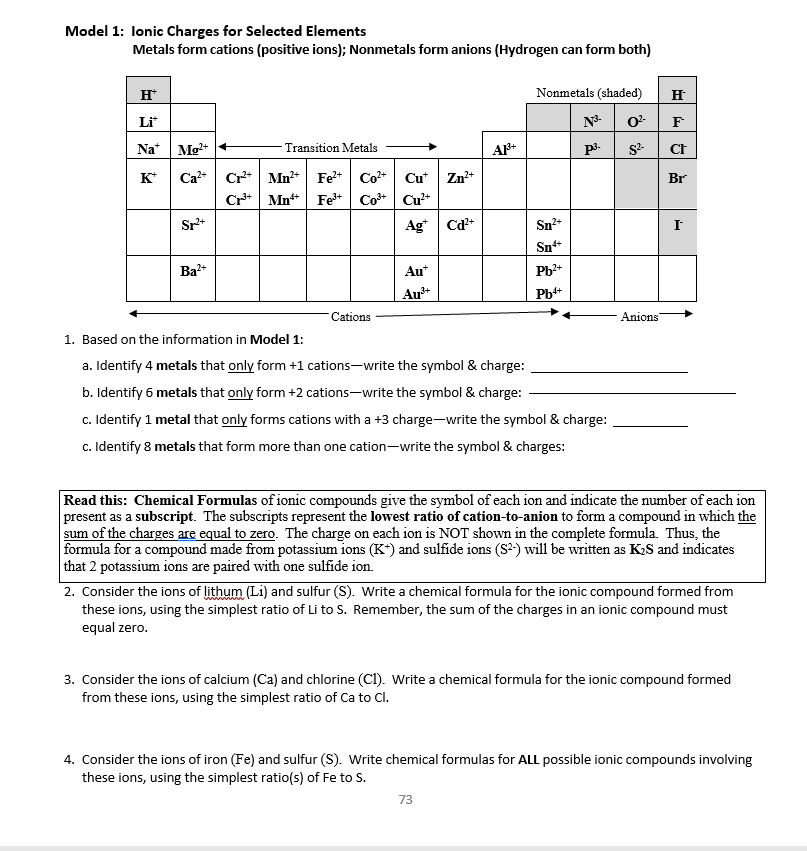
Model 1: Ionic Charges for Selected Elements Metals form cations (positive ions); Nonmetals form anions (Hydrogen can form both) H* Lit Na* K+ Mg+ Ca+ Cr+ Mn+ Fe+ Co+ Cu* Zn+ Cr+ Mn Fe+ Co+ Cu+ Sp+ Transition Metals Ba+ Cations Ag Cd+ Au* Au+ Nonmetals (shaded) 0- S- Ct Br Sn+ Sn** Pb+ Pb4+ N- p. 1. Based on the information in Model 1: a. Identify 4 metals that only form +1 cations-write the symbol & charge: b. Identify 6 metals that only form +2 cations-write the symbol & charge: c. Identify 1 metal that only forms cations with a +3 charge-write the symbol & charge: c. Identify 8 metals that form more than one cation-write the symbol & charges: Anions 73 H FO I Read this: Chemical Formulas of ionic compounds give the symbol of each ion and indicate the number of each ion present as a subscript. The subscripts represent the lowest ratio of cation-to-anion to form a compound in which the sum of the charges are equal to zero. The charge on each ion is NOT shown in the complete formula. Thus, the formula for a compound made from potassium ions (K+) and sulfide ions (S-) will be written as KS and indicates that 2 potassium ions are paired with one sulfide ion. 2. Consider the ions of lithum (Li) and sulfur (S). Write a chemical formula for the ionic compound formed from these ions, using the simplest ratio of Li to S. Remember, the sum of the charges in an ionic compound must equal zero. 3. Consider the ions of calcium (Ca) and chlorine (C1). Write a chemical formula for the ionic compound formed from these ions, using the simplest ratio of Ca to Cl. 4. Consider the ions of iron (Fe) and sulfur (S). Write chemical formulas for ALL possible ionic compounds involving these ions, using the simplest ratio(s) of Fe to S.
Step by Step Solution
3.38 Rating (148 Votes )
There are 3 Steps involved in it
a Li Na K Rb b Be2 Mg2 Cat2 Sr Bat2 Zn c A1 d Mg2 ... View full answer

Get step-by-step solutions from verified subject matter experts
 Study Help