







Question: Module 10 q3 Please Answer all in BOLD. WILL UPVOTE. Data collected from selected major metropolitan areas in the eastern United States show that 1%
Module 10 q3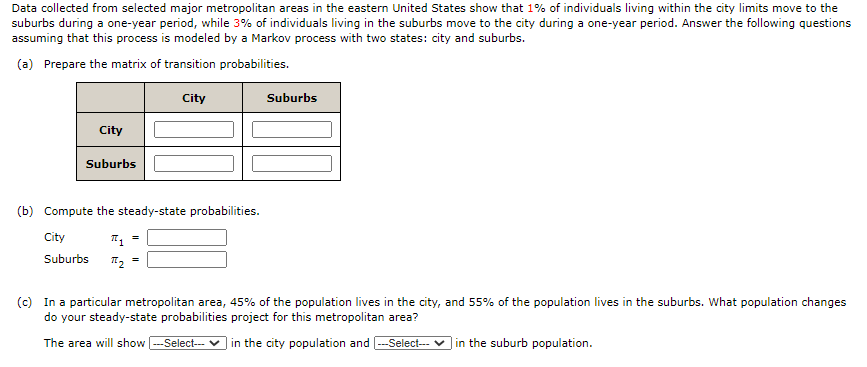
Please Answer all in BOLD. WILL UPVOTE.
Data collected from selected major metropolitan areas in the eastern United States show that 1% of individuals living within the city limits move to the suburbs during a one-year period, while 3% of individuals living in the suburbs move to the city during a one-year period. Answer the following questions assuming that this process is modeled by a Markov process with two states: city and suburbs. (a) Prepare the matrix of transition probabilities. City Suburbs City Suburbs (b) Compute the steady-state probabilities. City TI1 Suburbs TI2 (c) In a particular metropolitan area, 45% of the population lives in the city, and 55% of the population lives in the suburbs. What population changes do your steady-state probabilities project for this metropolitan area? The area will show -Select--- V in the city population and G-Select--- in the suburb populationStep by Step Solution
There are 3 Steps involved in it
1 Expert Approved Answer
Step: 1 Unlock

Question Has Been Solved by an Expert!
Get step-by-step solutions from verified subject matter experts
Step: 2 Unlock
Step: 3 Unlock
 Study Help