







Question: My third time asking for the same question. I wish an expert can solve it for real. I already got two answers wrong. CASE STUDIES
My third time asking for the same question. I wish an expert can solve it for real. I already got two answers wrong.
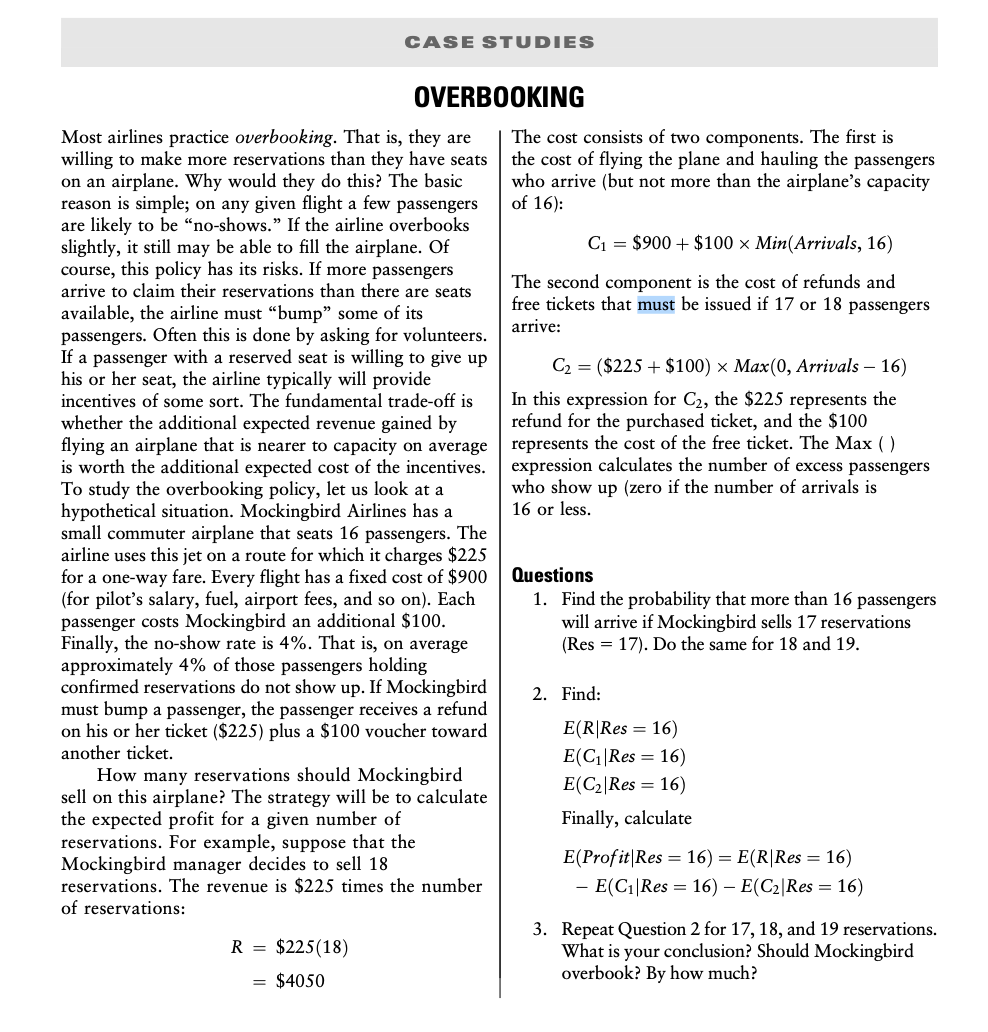
CASE STUDIES OVERBOOKING Most airlines practice overbooking. That is, they are willing to make more reservations than they have seats on an airplane. Why would they do this? The basic reason is simple; on any given flight a few passengers are likely to be \"noshows.\" If the airline overbooks slightly, it still may be able to ll the airplane. Of course, this policy has its risks. If more passengers arrive to claim their reservations than there are seats available, the airline must \"bump\" some of its passengers. Often this is done by asking for volunteers. If a passenger with a reServed seat is willing to give up his or her seat, the airline typically will provide incentives of some sort. The fundamental trade-off is whether the additional expected revenue gained by ying an airplane that is nearer to capacity on average is worth the additional expected cost of the incentives. To study the overbooking policy, let us look at a hypothetical situation. Mockingbird Airlines has a small commuter airplane that seats 16 passengers. The airline uses this jet on a route for which it charges $225 for a oneway fare. Every flight has a fixed cost of $900 {for pilot's salary, fuel, airport fees, and so on). Each passenger eusts Mockingbird an addition] $100. Finally, the noshow rate is 4%. That is, on average approximately 4% of those passengers holding confirmed reservations do not show up. If Mockingbird must bump a passenger, the passenger receives a refund on his or her ticket ($225) plus a $100 voucher toward another ticket. How many reservations should Mockingbird sell on this airplane? The strategy will be to calculate the expected profit for a given number of reservations. For example, suppose that the Mockingbird manager decides to sell 18 reservations. The revenue is $225 times the number of reservations: R = $2,25(13) $4050 The cost consists of two components. The first is the cost of flying the plane and hauling the passengers who arrive {but not more than the airplane's capacity of 16): C1 = $900 + $100 x MinMrrimIs, 16) The second component is the cost of refunds and free tickets that must be issued if 17 or 18 passengers arrive: C2 = ($225 + $100) X M11110, Arrivals 16) In this expression for C2, the $225 represents the refund for the purchased ticket, and the $100 represents the cost of the free ticket. The Max If } expression calculates the number of excess passengers who show up (zero if the number of arrivals is 16 or less. Questions 1. Find the probability that more than 16 passengers will arrive if Mockingbird sells 17 reservations (Res = 17}. Do the same for 18 and 19. 2. Find: EfRIReS = 16) E(C1|Res = 16) magmas = 16) Finally, calculate E(Profit|Res : 16) : ERIRes : 16) E(C1|Res =16) E(C2|Res :16) 3. Repeat Question 2 for 17, 18, and 19 reservations. that is your conclusion? Should Mockingbird overbook? By how much
Step by Step Solution
There are 3 Steps involved in it

Get step-by-step solutions from verified subject matter experts
 Study Help