







Question: n the resource-based model of above-average returns, a capability is: a. an input into a firm's production process. b. the foundation for a firm's mission.
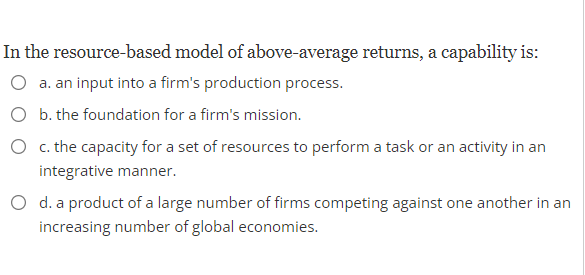
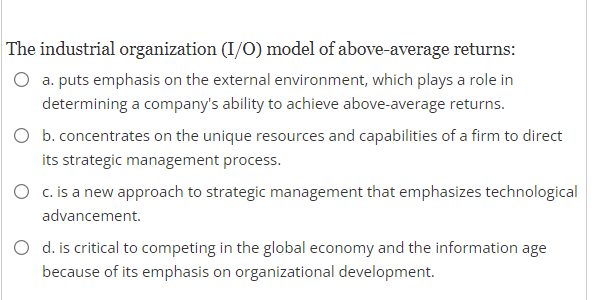
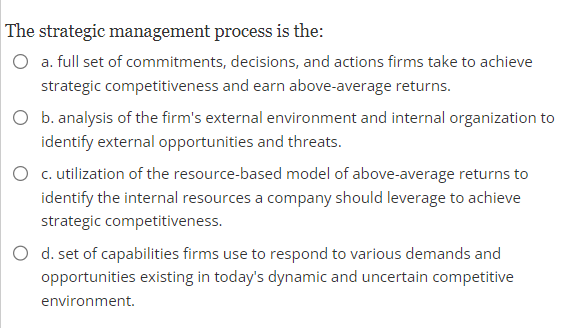
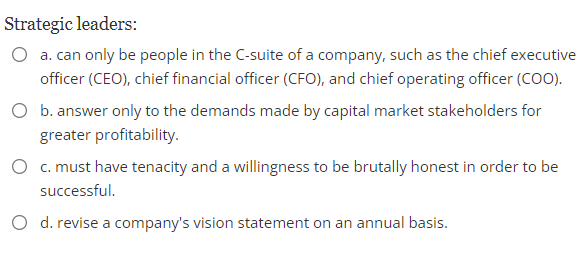
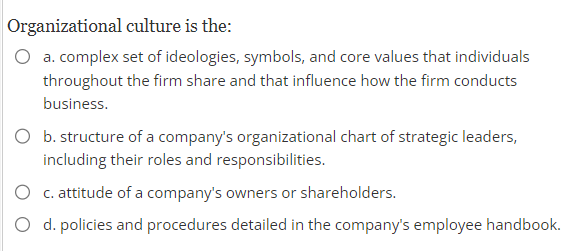
n the resource-based model of above-average returns, a capability is: a. an input into a firm's production process. b. the foundation for a firm's mission. c. the capacity for a set of resources to perform a task or an activity in an integrative manner. d. a product of a large number of firms competing against one another in a increasing number of global economies. The strategic management process is the: a. full set of commitments, decisions, and actions firms take to achieve strategic competitiveness and earn above-average returns. b. analysis of the firm's external environment and internal organization to identify external opportunities and threats. c. utilization of the resource-based model of above-average returns to identify the internal resources a company should leverage to achieve strategic competitiveness. d. set of capabilities firms use to respond to various demands and opportunities existing in today's dynamic and uncertain competitive environment. Strategic leaders: a. can only be people in the C-suite of a company, such as the chief executive officer (CEO), chief financial officer (CFO), and chief operating officer (COO). b. answer only to the demands made by capital market stakeholders for greater profitability. c. must have tenacity and a willingness to be brutally honest in order to be successful. d. revise a company's vision statement on an annual basis. Organizational culture is the: a. complex set of ideologies, symbols, and core values that individuals throughout the firm share and that influence how the firm conducts business. b. structure of a company's organizational chart of strategic leaders, including their roles and responsibilities. c. attitude of a company's owners or shareholders. d. policies and procedures detailed in the company's employee handbook. The industrial organization (I/O) model of above-average returns: a. puts emphasis on the external environment, which plays a role in determining a company's ability to achieve above-average returns. b. concentrates on the unique resources and capabilities of a firm to direct its strategic management process. c. is a new approach to strategic management that emphasizes technological advancement. d. is critical to competing in the global economy and the information age because of its emphasis on organizational development. n the resource-based model of above-average returns, a capability is: a. an input into a firm's production process. b. the foundation for a firm's mission. c. the capacity for a set of resources to perform a task or an activity in an integrative manner. d. a product of a large number of firms competing against one another in a increasing number of global economies. The strategic management process is the: a. full set of commitments, decisions, and actions firms take to achieve strategic competitiveness and earn above-average returns. b. analysis of the firm's external environment and internal organization to identify external opportunities and threats. c. utilization of the resource-based model of above-average returns to identify the internal resources a company should leverage to achieve strategic competitiveness. d. set of capabilities firms use to respond to various demands and opportunities existing in today's dynamic and uncertain competitive environment. Strategic leaders: a. can only be people in the C-suite of a company, such as the chief executive officer (CEO), chief financial officer (CFO), and chief operating officer (COO). b. answer only to the demands made by capital market stakeholders for greater profitability. c. must have tenacity and a willingness to be brutally honest in order to be successful. d. revise a company's vision statement on an annual basis. Organizational culture is the: a. complex set of ideologies, symbols, and core values that individuals throughout the firm share and that influence how the firm conducts business. b. structure of a company's organizational chart of strategic leaders, including their roles and responsibilities. c. attitude of a company's owners or shareholders. d. policies and procedures detailed in the company's employee handbook. The industrial organization (I/O) model of above-average returns: a. puts emphasis on the external environment, which plays a role in determining a company's ability to achieve above-average returns. b. concentrates on the unique resources and capabilities of a firm to direct its strategic management process. c. is a new approach to strategic management that emphasizes technological advancement. d. is critical to competing in the global economy and the information age because of its emphasis on organizational development
Step by Step Solution
There are 3 Steps involved in it

Get step-by-step solutions from verified subject matter experts
 Study Help