



Question: Name Date Physical Science I Lab: Lenses & Mirrors - PhET Watch the Lenses & Mirrors Tips & Pointers video in Canvas and open the
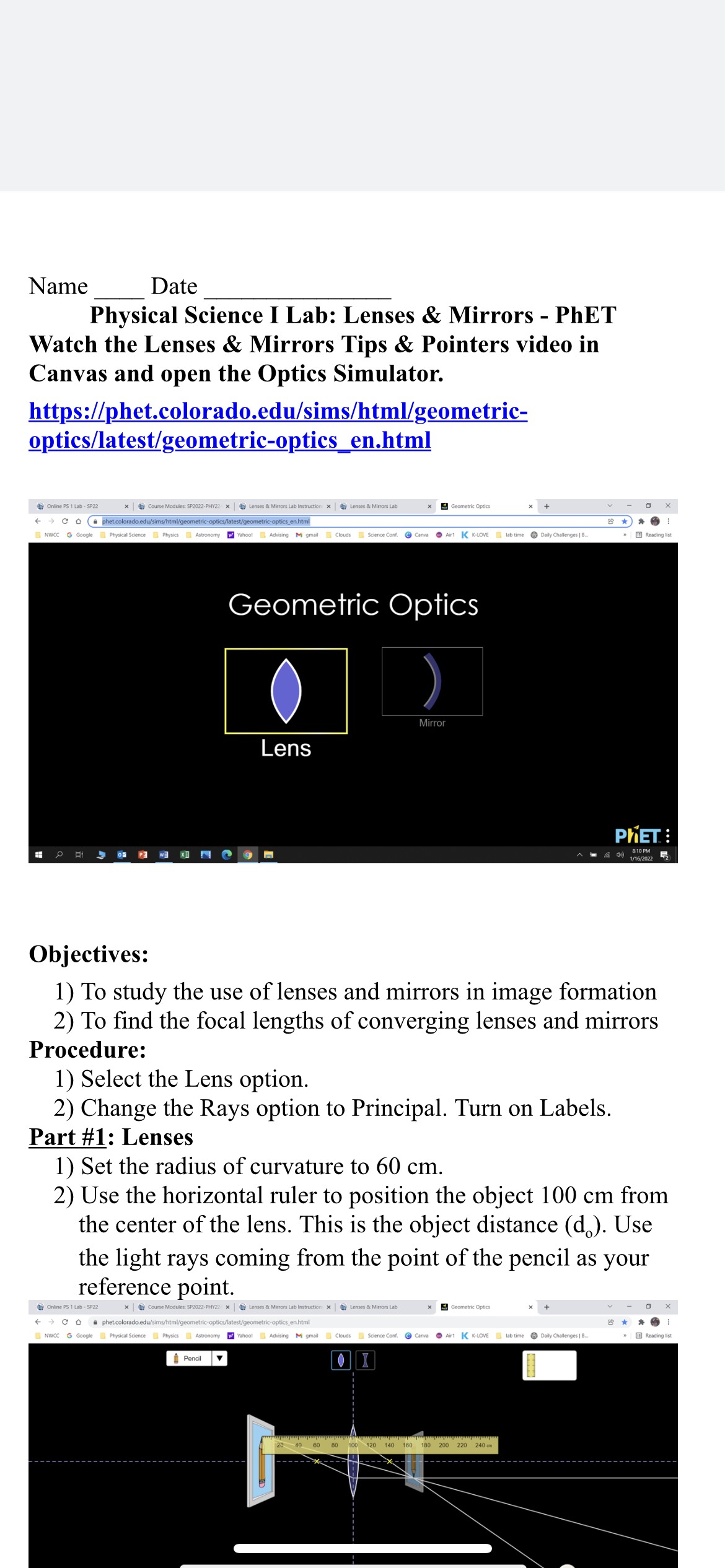
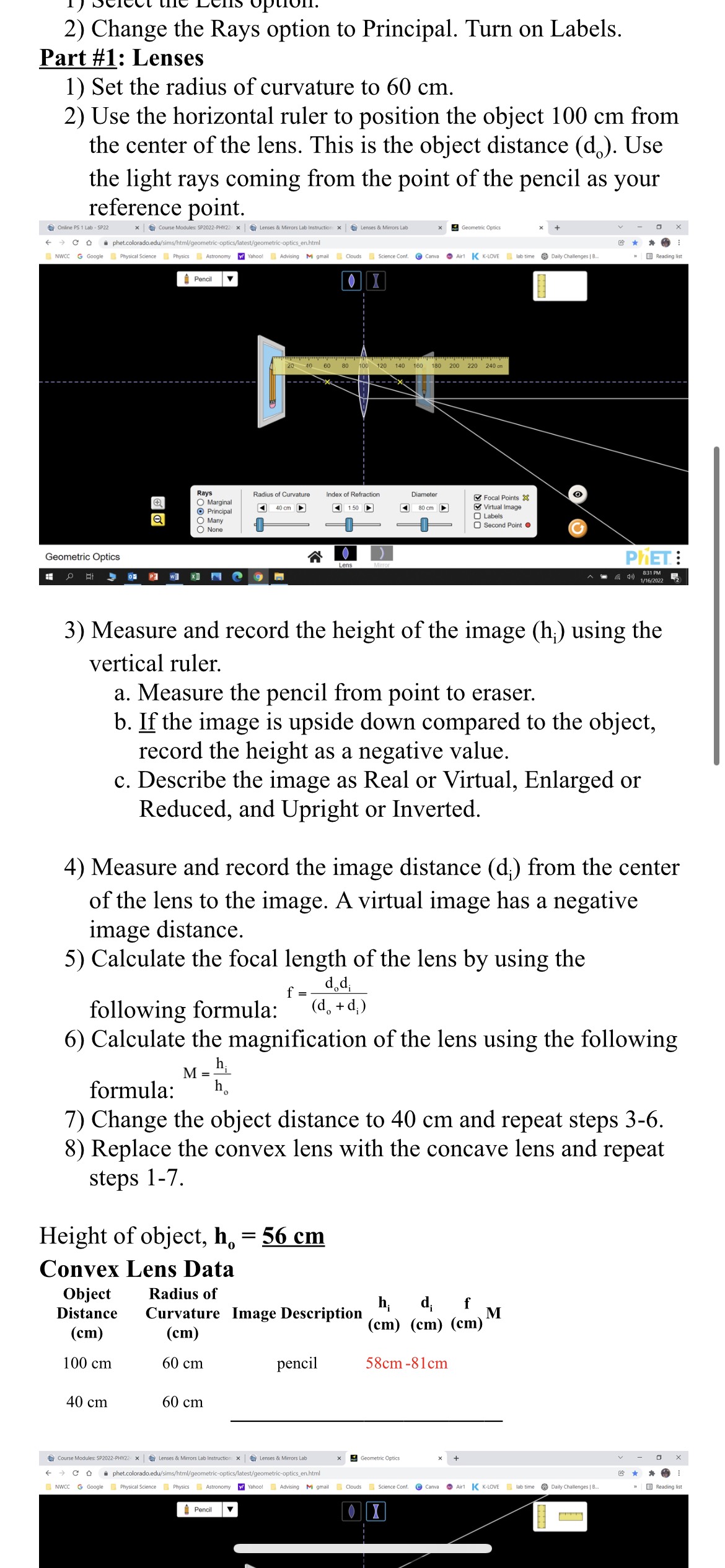
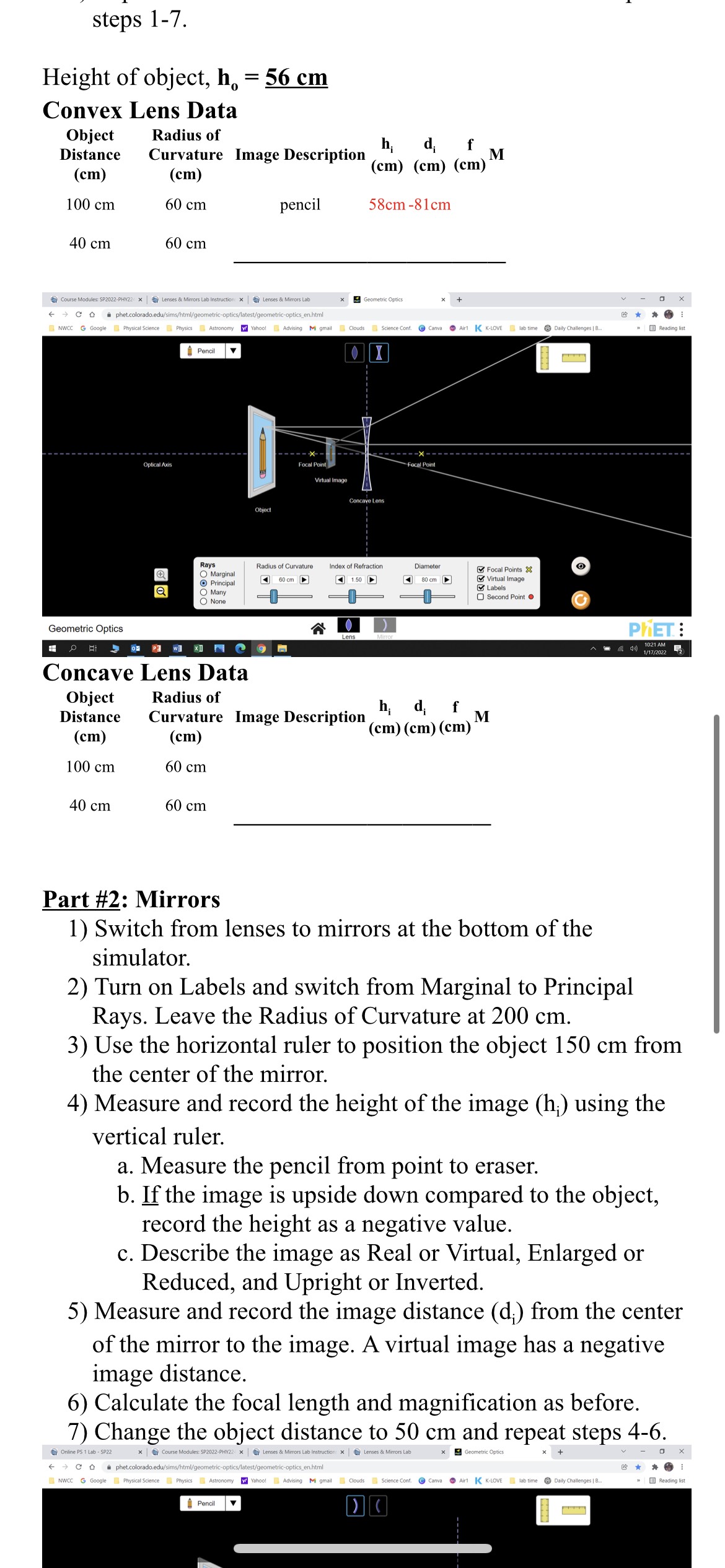
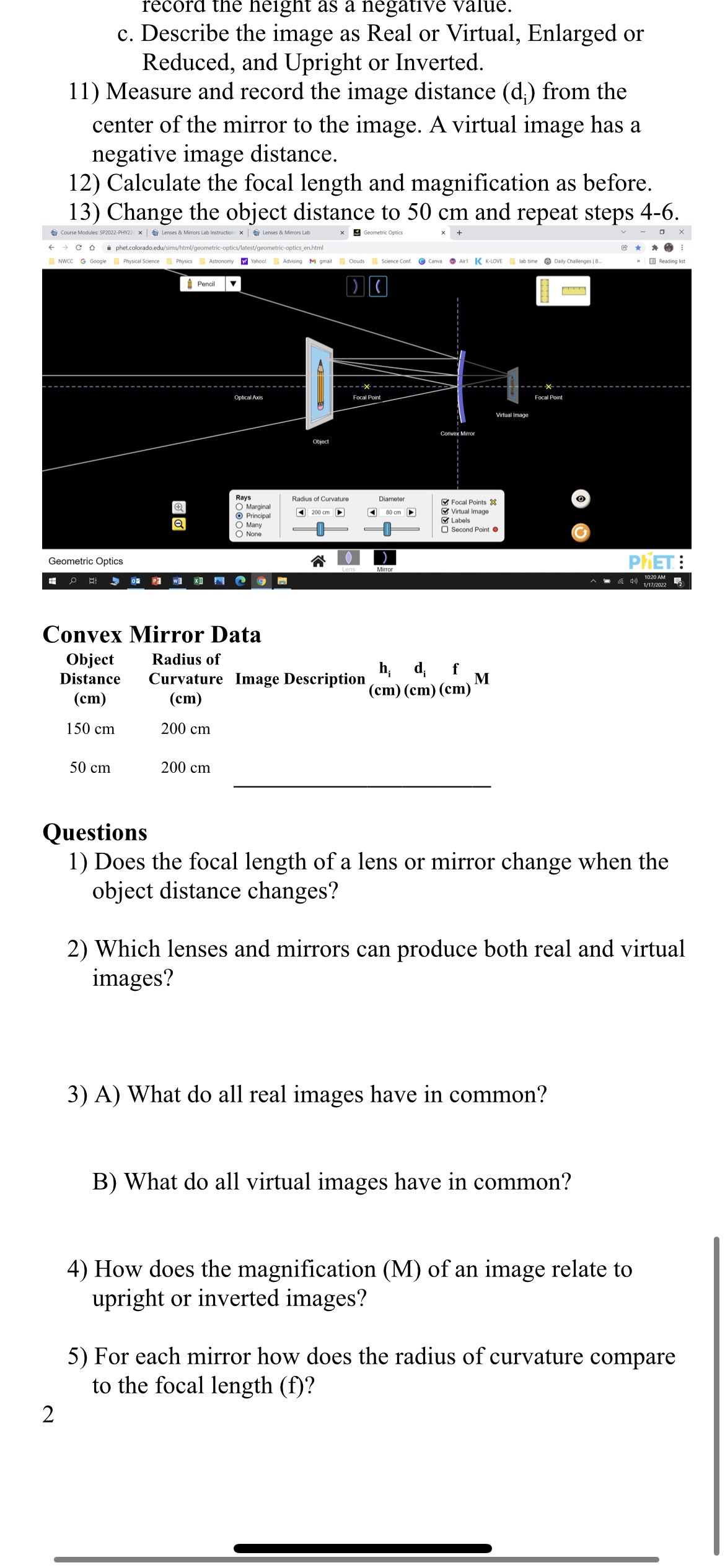
Name Date Physical Science I Lab: Lenses & Mirrors - PhET Watch the Lenses & Mirrors Tips & Pointers video in Canvas and open the Optics Simulator. https://phet.colorado.edu/sims/html/geometric- optics/latest/geometric-optics_en.html Online PS 1 Lab - SP22 X + > C a . phet colorado.edu/sims/html/geometric-optics/late NWCC G Google Physical Science Physics Astronomy wil Yahoo! Advising M gmail Clouds Science Cont. @ Canva . Air K K-LOVE lab time @ Daily Challenges | 8.. Reading list Geometric Optics Mirror Lens PNET : ( 30) 1/16/2022 Objectives: 1) To study the use of lenses and mirrors in image formation 2) To find the focal lengths of converging lenses and mirrors Procedure: 1) Select the Lens option. 2) Change the Rays option to Principal. Turn on Labels. Part #1: Lenses 1) Set the radius of curvature to 60 cm. 2) Use the horizontal ruler to position the object 100 cm from the center of the lens. This is the object distance (d.). Use the light rays coming from the point of the pencil as your reference point. Online PS 1 Lab - SP22 2 x | @ Lenses & Mirrors Lab Instruction x | Lenses & Mirrors Lab + > C D . phetcolorado.edu/sims/html/geometric-optics/latest/geometric-optics_en.html NWCC G Google Physical Science Physics Astronomy w/ Yahoo! Advising M gmail Clouds Science Cont. @ Canva . Airt K K.LOVE lab time @ Daily Chalenges | 8. Reading list Pencil 20 60 80 100 120 140 160 180 200 220 240 cm1] UCICUI L115 LCIJD UPLlUll. 2) Change the Rays option to Principal. Turn on Labels. Part #1: Lenses 1) Set the radius of curvature to 60 cm. 2) Use the horizontal ruler to position the object 100 cm from the center of the lens. This is the object distance (do). Use the light rays coming from the point of the pencil as your reference point. comps\" 92: a l immhwmz-hm' a l illmulM-rwahhlm'ni x Gluv-IhMinmhl x In ggggg cm x + u , u x i c o IWtalnmdoedww'wlvlml'gmr-n mm a . . o ; uwzr 5 am ammuu wansn vaaum Dubai: Ds-um-nl Geometric Optics 3) Measure and record the height of the image (h) using the vertical ruler. a. Measure the pencil from point to eraser. b. I_fthe image is upside down compared to the object, record the height as a negative value. c. Describe the image as Real or Virtual, Enlarged or Reduced, and Upright or Inverted. 4) Measure and record the image distance (d) from the center of the lens to the image. A virtual image has a negative image distance. 5) Calculate the focal length of the lens by using the f = dadi following formula: (do \"10 6) Calculate the magnication of the lens using the following h formula: M =3: 7) Change the object distance to 40 cm and repeat steps 3-6. 8) Replace the convex lens with the concave lens and repeat steps 1-7. Height of object, h0 = 56 cm Convex Lens Data Object Radius of h (1 Distance Curvature Image Description ' ' f (cm) (cm) (cm) (cm) (cm) 100 cm 60 cm pencil 58cm -81cm 40 cm 60 cm steps 1-7. Height of object, h. = 56 cm Convex Lens Data Object Radius of Curvature Image Description h ; Distance f (cm) (cm) (cm) M (cm) (cm) 100 cm 60 cm pencil 58cm-81cm 40 cm 60 cm Course Modules SP2022-PHY22 x | Lenses & Mirrors Lab Instruction x | Lenses & Mirrors Lab KGeometric Optics - > C 0 * phet.colorado.edu/sims/html/geometric-optics/latest/geometric-optics_en.html NWCC G Google Physical Science Physics Astronomy w/ Yahoo! Advising M gmail Clouds Science Cont. @ Canva @ Airt K
Step by Step Solution
There are 3 Steps involved in it

Get step-by-step solutions from verified subject matter experts