







Question: Name: Grade & Section: Score: School: Teacher: Subject: General Physics 2 LAS Writer: JAN JEFFREY R. CAMINA Content Editor: EMMA T. SURRITA EDA A. FALE
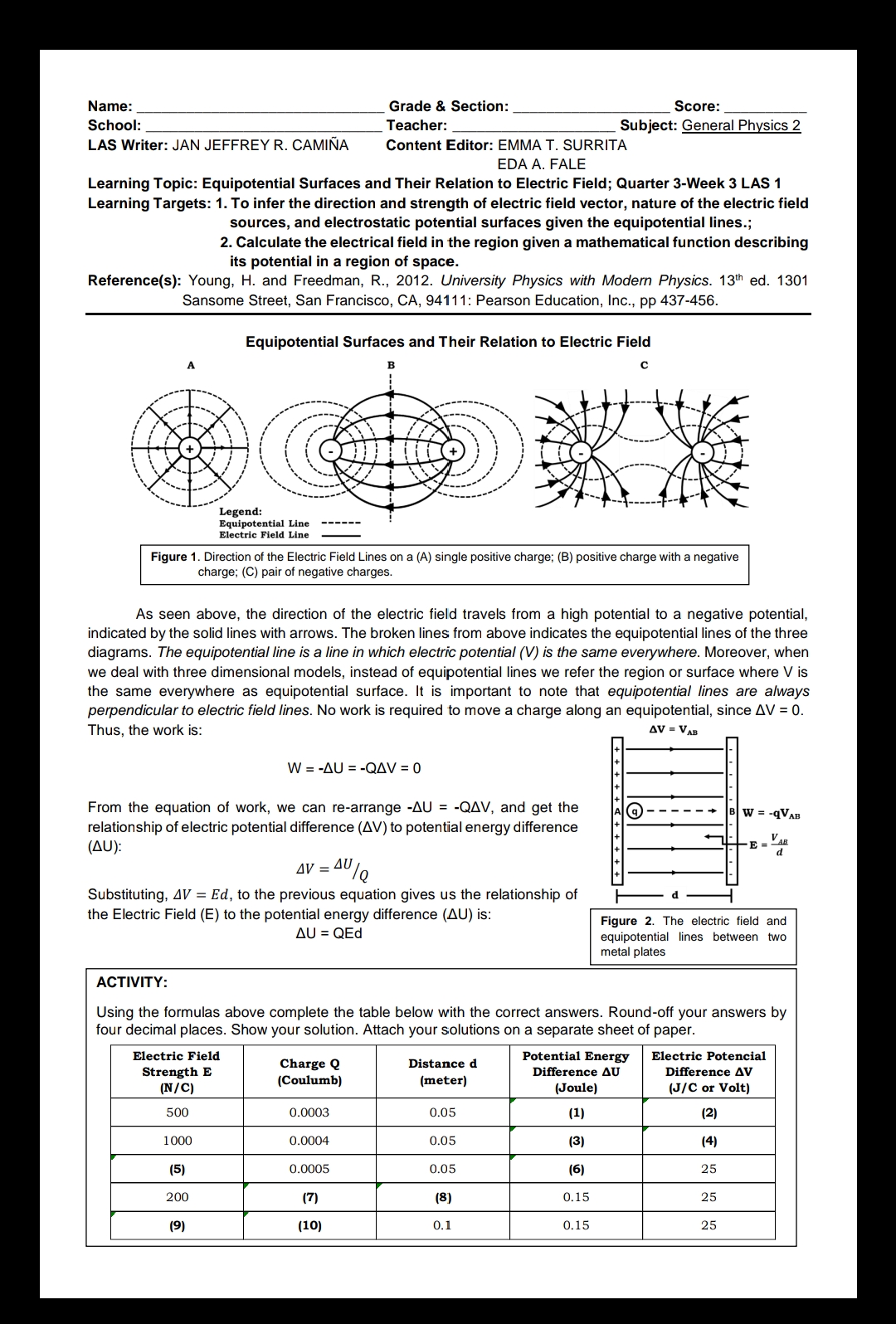
Name: Grade & Section: Score: School: Teacher: Subject: General Physics 2 LAS Writer: JAN JEFFREY R. CAMINA Content Editor: EMMA T. SURRITA EDA A. FALE Learning Topic: Equipotential Surfaces and Their Relation to Electric Field; Quarter 3-Week 3 LAS 1 Learning Targets: 1. To infer the direction and strength of electric field vector, nature of the electric field sources, and electrostatic potential surfaces given the equipotential lines.; 2. Calculate the electrical field in the region given a mathematical function describing its potential in a region of space. Reference(s): Young, H. and Freedman, R., 2012. University Physics with Modern Physics. 13th ed. 1301 Sansome Street, San Francisco, CA, 94111: Pearson Education, Inc., pp 437-456. Equipotential Surfaces and Their Relation to Electric Field Legend: Equipotential Line Electric Field Line Figure 1. Direction of the Electric Field Lines on a (A) single positive charge; (B) positive charge with a negative charge; (C) pair of negative charges. As seen above, the direction of the electric field travels from a high potential to a negative potential, indicated by the solid lines with arrows. The broken lines from above indicates the equipotential lines of the three diagrams. The equipotential line is a line in which electric potential (V) is the same everywhere. Moreover, when we deal with three dimensional models, instead of equipotential lines we refer the region or surface where V is the same everywhere as equipotential surface. It is important to note that equipotential lines are always perpendicular to electric field lines. No work is required to move a charge along an equipotential, since AV = 0. Thus, the work is: AV = VAB W = -AU = -QAV = 0 From the equation of work, we can re-arrange -AU = -QAV, and get the -qV AB relationship of electric potential difference (AV) to potential energy difference (AU): V AB AV = 40 /Q Substituting, 4V = Ed, to the previous equation gives us the relationship of the Electric Field (E) to the potential energy difference (AU) is: Figure 2. The electric field and AU = QEd equipotential lines between two metal plates ACTIVITY: Using the formulas above complete the table below with the correct answers. Round-off your answers by four decimal places. Show your solution. Attach your solutions on a separate sheet of paper. Electric Field Electric Potencial Strength E Charge Q Distance d Potential Energy Difference AU Difference AV (N/C) Coulumb) (meter) (Joule (J/C or Volt) 500 0.0003 0.05 (1) (2) 1000 ).0004 0.05 (3) (4) (5) 0.0005 0.05 (6) 25 200 (7) 8) 0.15 25 (9) (10) 0. 1 0.15 25
Step by Step Solution
There are 3 Steps involved in it

Get step-by-step solutions from verified subject matter experts
 Study Help