







Question: Name: Grade & Section: Score: School: Teacher: Subject: General Physics 2 LAS Writer: JAN JEFFREY R. CAMINA Content Editor: EMMA T. SURRITA EDA A. FALE
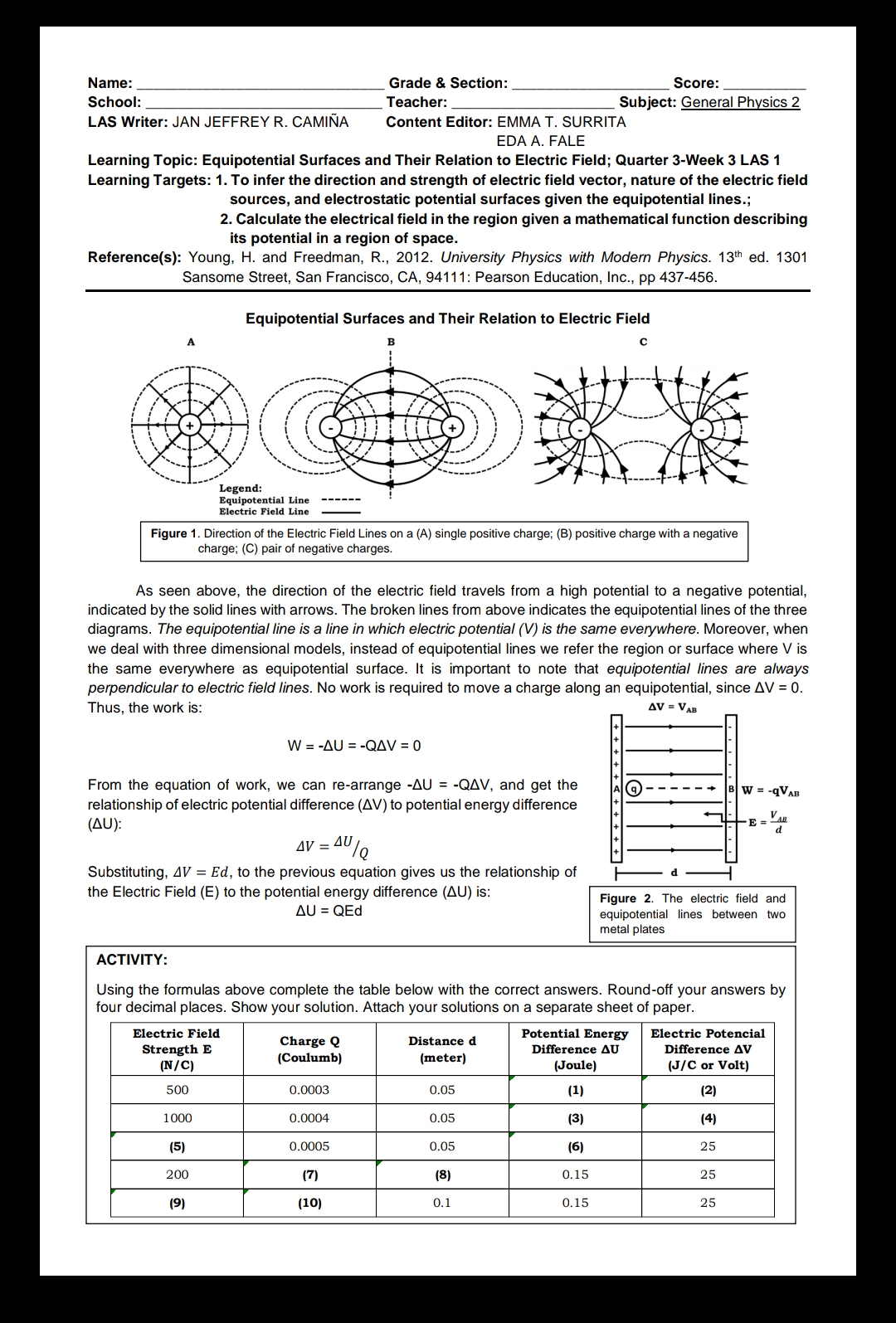
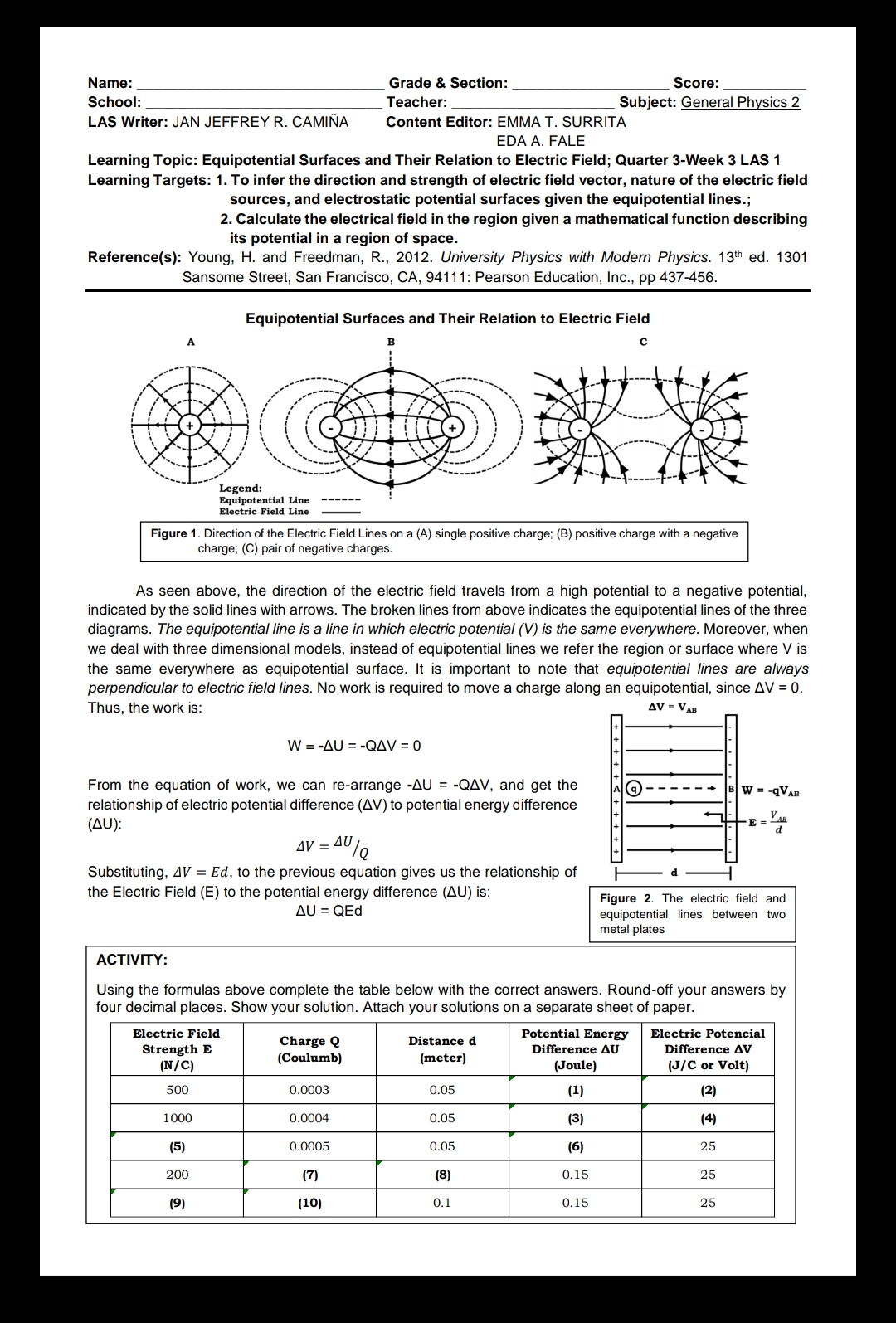
Name: Grade & Section: Score: School: Teacher: Subject: General Physics 2 LAS Writer: JAN JEFFREY R. CAMINA Content Editor: EMMA T. SURRITA EDA A. FALE Learning Topic: Equipotential Surfaces and Their Relation to Electric Field; Quarter 3-Week 3 LAS 1 Learning Targets: 1. To infer the direction and strength of electric field vector, nature of the electric field sources, and electrostatic potential surfaces given the equipotential lines. 2. Calculate the electrical field in the region given a mathematical function describing its potential in a region of space Reference(s): Young, H. and Freedman, R., 2012. University Physics with Modern Physics. 13th ed. 1301 Sansome Street, San Francisco, CA, 94111: Pearson Education, Inc., pp 437-456. Equipotential Surfaces and Their Relation to Electric Field Legend: Equipotential Line Electric Field Line Figure 1. Direction of the Electric Field Lines on a (A) single positive charge; (B) positive charge with a negative charge; (C) pair of negative charges. As seen above, the direction of the electric field travels from a high potential to a negative potential, indicated by the solid lines with arrows. The broken lines from above indicates the equipotential lines of the three diagrams. The equipotential line is a line in which electric potential (V) is the same everywhere. Moreover, when we deal with three dimensional models, instead of equipotential lines we refer the region or surface where V is the same everywhere as equipotential surface. It is important to note that equipotential lines are always perpendicular to electric field lines. No work is required to move a charge along an equipotential, since AV = 0. Thus, the work is: AV = VAB W = -AU = -QAV = 0 From the equation of work, we can re-arrange -AU = -QAV, and get the B W=-qVAB relationship of electric potential difference (AV) to potential energy difference (AU): AV = 4010 Substituting, AV = Ed, to the previous equation gives us the relationship of the Electric Field (E) to the potential energy difference (AU) is: Figure 2. The electric field and AU = QEd equipotential lines between two metal plates ACTIVITY: Using the formulas above complete the table below with the correct answers. Round-off your answers by four decimal places. Show your solution. Attach your solutions on a separate sheet of paper Electric Field Potential Energy Electric Potencial Strength E Charge Q Distance d (N / C) (Coulumb) Difference AU (meter) Difference AV Joule) J/C or Volt) 500 0.0003 0.05 (1) 12) 1000 0.0004 0.05 (3) (4) (5) 0.0005 0.05 (6) 25 200 (7) (8) 0.15 25 (9) (10) 0.1 0.15 25
Step by Step Solution
There are 3 Steps involved in it

Get step-by-step solutions from verified subject matter experts
 Study Help