







Question: need answer to 21 (continued from the previous question) Which of the following is (approximately) the present value? (note: if your answer is within $50
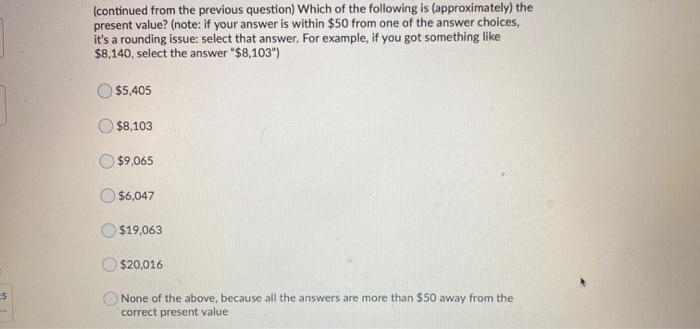
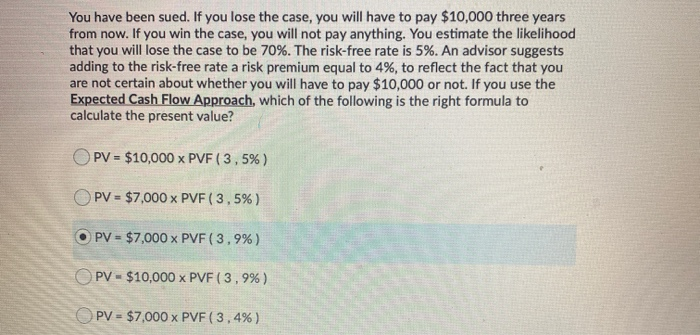
(continued from the previous question) Which of the following is (approximately) the present value? (note: if your answer is within $50 from one of the answer choices, it's a rounding issue: select that answer. For example, if you got something like $8,140, select the answer "$8,103") $5,405 $8,103 $9,065 $6,047 $19,063 $20,016 -5 None of the above, because all the answers are more than $50 away from the correct present value ! You have been sued. If you lose the case, you will have to pay $10,000 three years from now. If you win the case, you will not pay anything. You estimate the likelihood that you will lose the case to be 70%. The risk-free rate is 5%. An advisor suggests adding to the risk-free rate a risk premium equal to 4%, to reflect the fact that you are not certain about whether you will have to pay $10,000 or not. If you use the Expected Cash Flow Approach, which of the following is the right formula to calculate the present value? PV = $10,000 x PVF (3,5%) PV = $7,000 x PVF (3,5%) PV = $7,000 x PVF (3,9%) PV - $10,000 x PVF (3,9%) PV = $7,000 x PVF (3,4%)
Step by Step Solution
There are 3 Steps involved in it

Get step-by-step solutions from verified subject matter experts
 Study Help