







Question: need help and explaining. thank you. may be solvedmanually CAPEI'LA UNIVERSITY PSYC4700 - Statistics for the Behavioral Sciences u07a1 ANOVA plete the following problems within
need help and explaining. thank you. may be solvedmanually
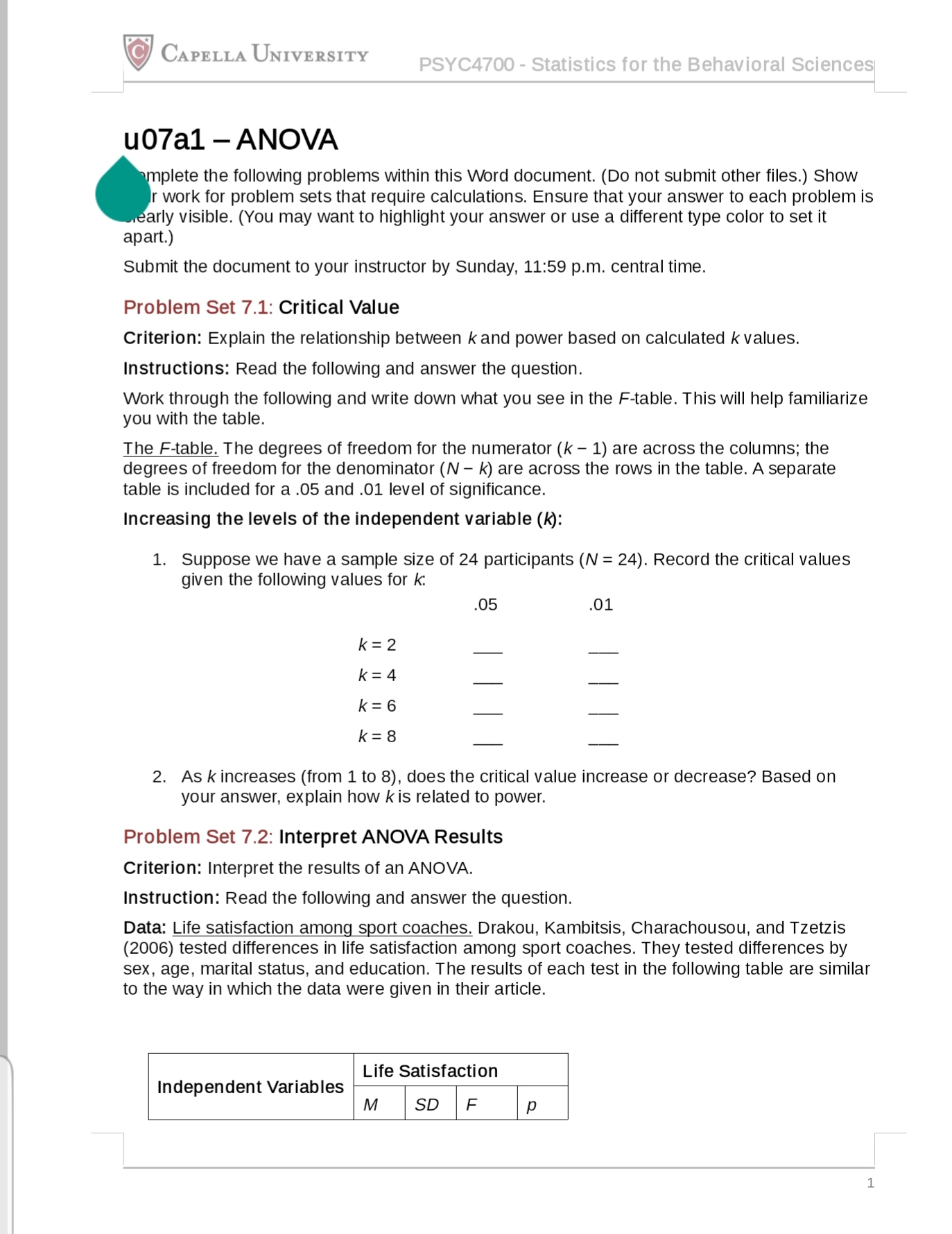
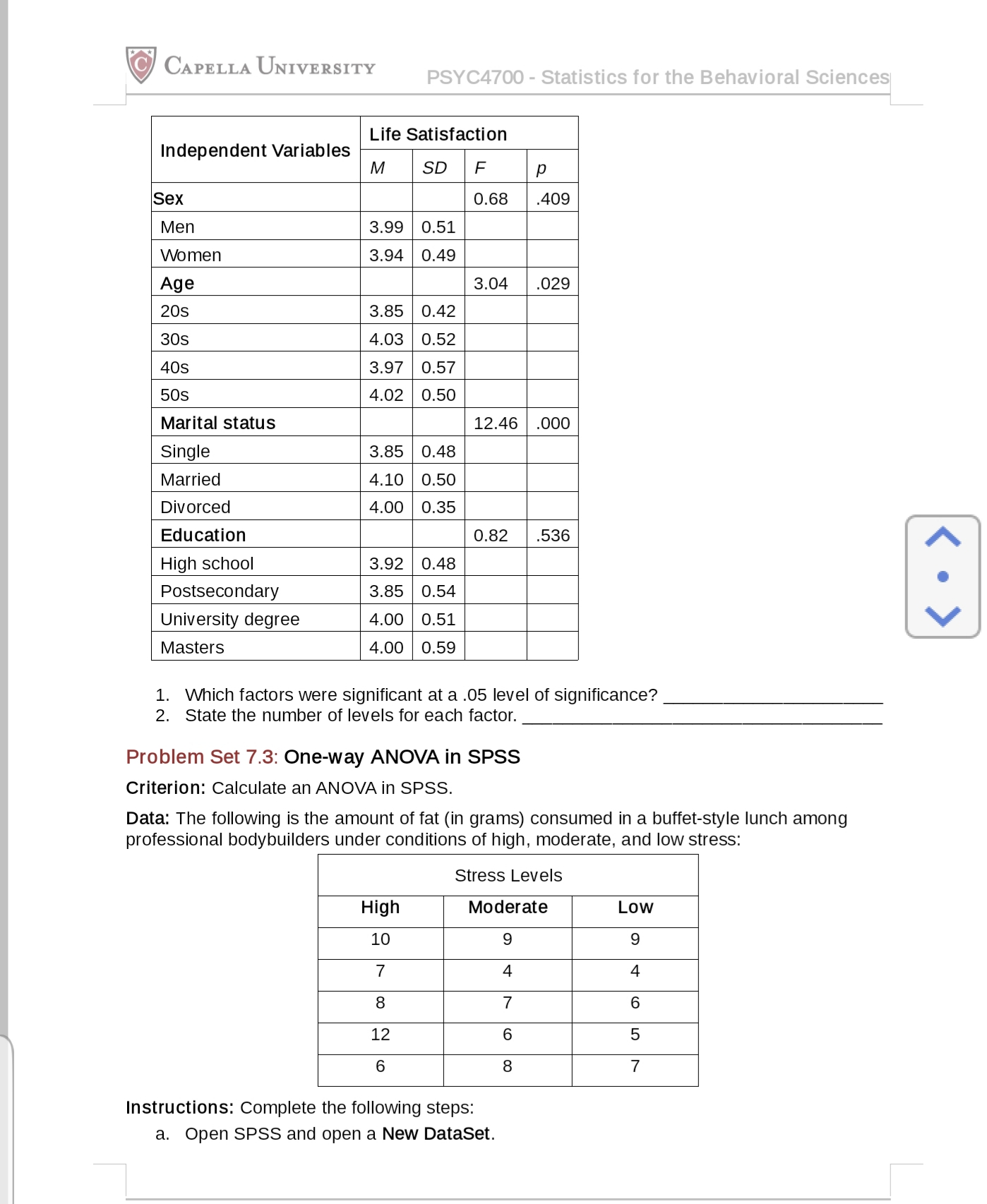
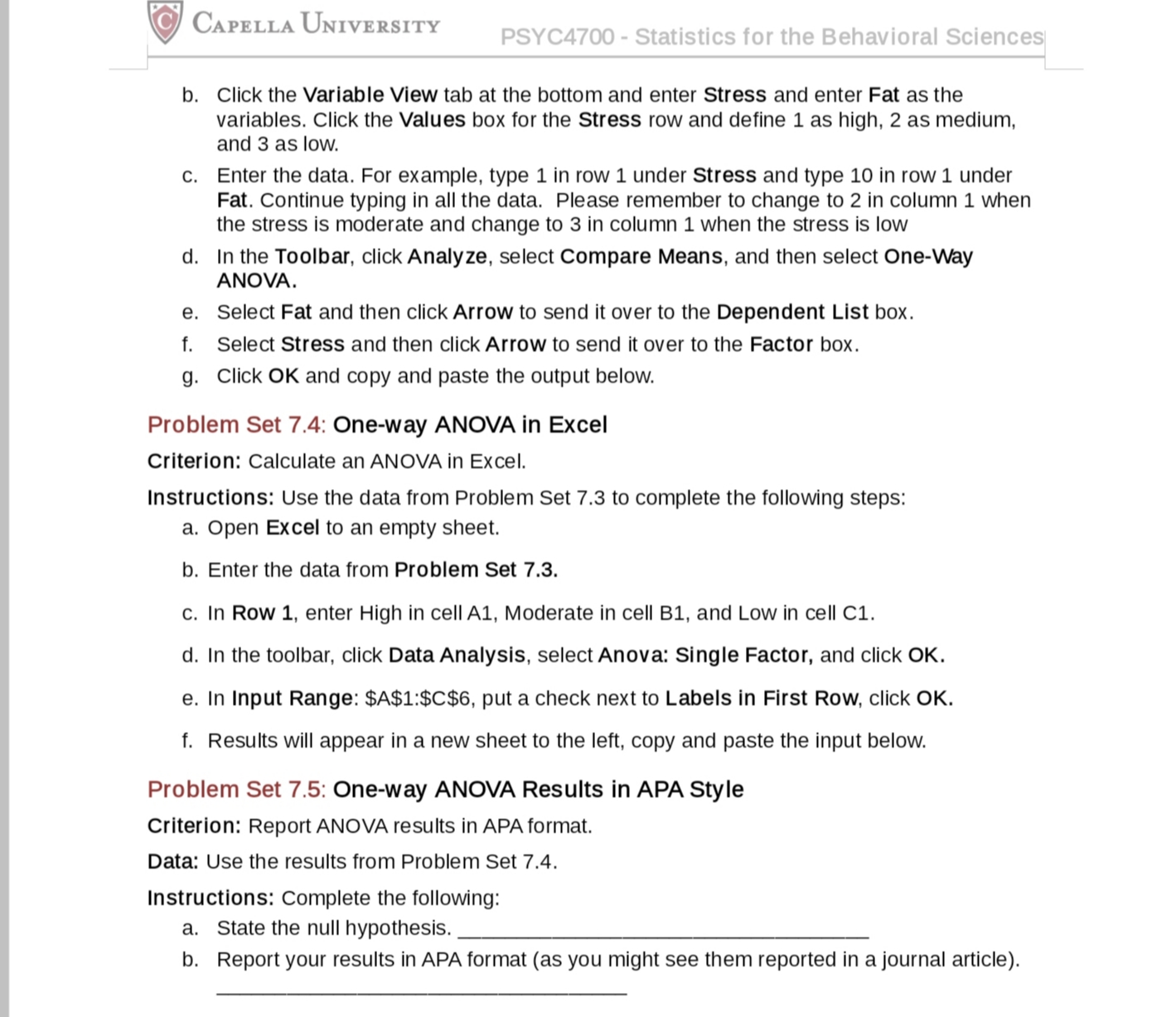
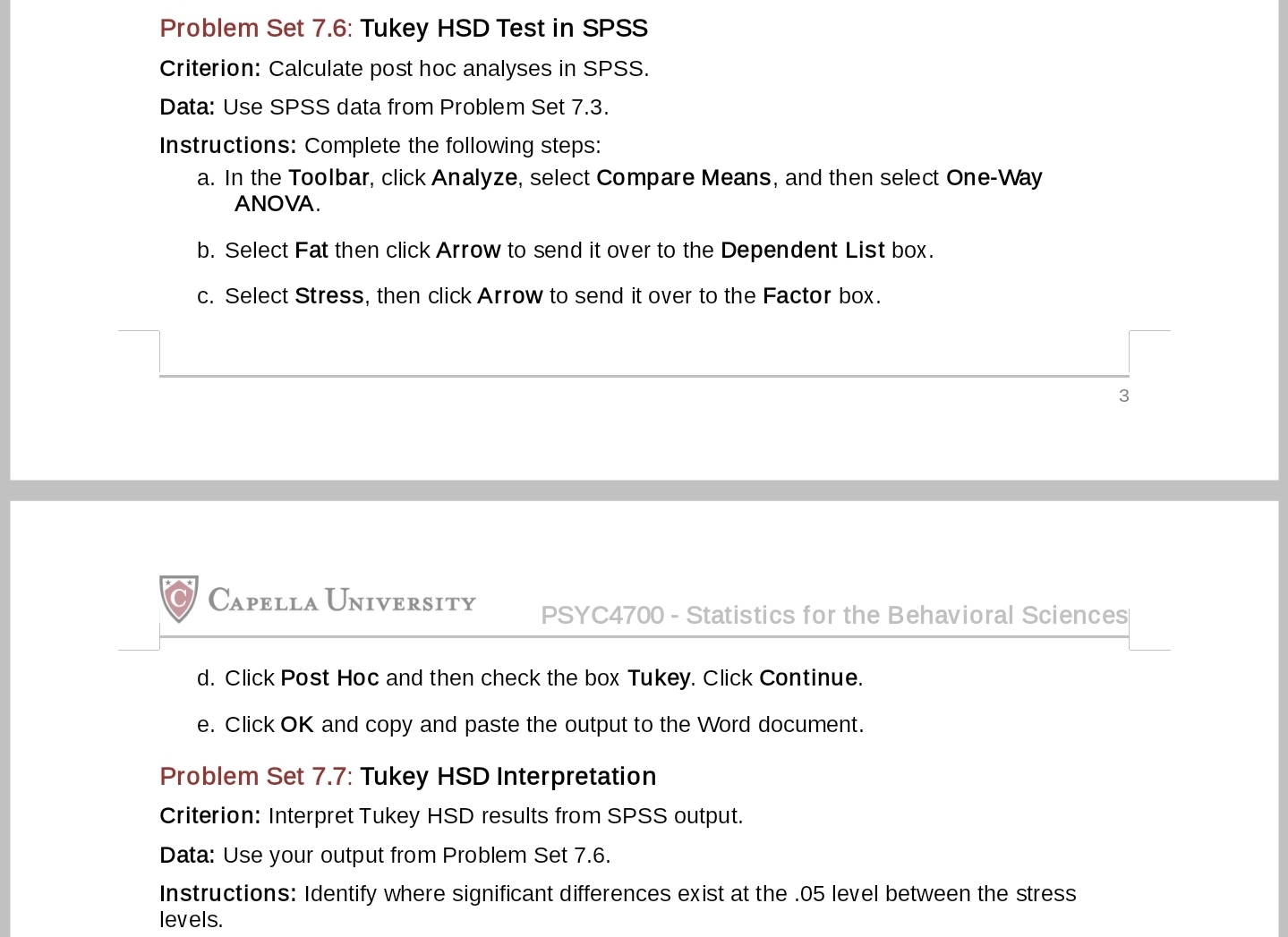
CAPEI'LA UNIVERSITY PSYC4700 - Statistics for the Behavioral Sciences u07a1 ANOVA plete the following problems within this word document. (Do not submit other files.) Show rwork for problem sets that require calculations. Ensure that your answer to each problem is arly visible. (You may want to highlight your answer or use a different type color to set it apart.) Submit the document to your instructor by Sunday, 11:59 pm. central time. Problem Set 7.1: Critical Value Criterion: Explain the relationship between k and power based on calculated k values. Instructions: Read the following and answer the question. Work through the following and write down what you see in the Ftable. This will help familiarize you with the table. The Ftable. The degrees of freedom for the numerator (k 1) are across the columns; the degrees of freedom for the denominator (N k) are across the rows in the table. A separate table is included for a .05 and .01 level of significance. Increasing the levels of the independent variable (k): 1. Suppose we have a sample size of 24 participants (N = 24). Record the critical values given the following values for [C .05 .01 x-x-x-x- II coca-hm 2. As k increases (from 1 to 8), does the critical value increase or decrease? Based on your answer, explain how k is related to power. Problem Set 7.2: Interpret ANOVA Results Criterion: Interpret the results of an ANOVA. Instruction: Read the following and answer the question. Data: Life satisfaction among sport coaches. Drakou, Kambitsis, Charachousou, and Tzetzis (2006) tested differences in life satisfaction among sport coaches. They tested differences by sex, age, marital status, and education. The results of each test in the following table are similar to the way in which the data were given in their article. Life Satisfaction M |SD|F 'p' Independent Variables CAPELLA UNIVERSITY PSYC4700 - Statistics for the Behavioral Sciences Independent Variables Life Satisfaction M SD F p Sex ).68 .409 Men 3.99 0.51 Women 3.94 0.49 Age 3.04 029 20s 3.85 0.42 30s 4.03 0.52 40s 3.97 0.57 50s 4.02 0.50 Marital status 12.46 .000 Single 3.85 0.48 Married 4.10 0.50 Divorced 4.00 0.35 Education 0.82 536 High school 3.92 0.48 Postsecondary 3.85 0.54 University degree 4.00 0.51 . Masters 4.00 0.59 1. Which factors were significant at a .05 level of significance? 2. State the number of levels for each factor. Problem Set 7.3: One-way ANOVA in SPSS Criterion: Calculate an ANOVA in SPSS Data: The following is the amount of fat (in grams) consumed in a buffet-style lunch among professional bodybuilders under conditions of high, moderate, and low stress: Stress Levels High Moderate Low 10 9 9 7 4 4 8 7 6 12 6 5 6 8 7 Instructions: Complete the following steps: a. Open SPSS and open a New DataSet.CAPELLA UNIVERSITY PSYC4700 - Statistics for the Behavioral Sciences b. Click the Variable View tab at the bottom and enter Stress and enter Fat as the variables. Click the Values box for the Stress row and define 1 as high. 2 as medium. and 3 as low. 0. Enter the data. For example. type 1 in row 1 under Stress and type 10 In row 1 under Fat. Continue typing in all the data. Please remember to change to 2 In column 1 when the stress is moderate and change to 3 in column 1 when the stress Is low (1. In the Toolbar. click Analyze. select Compare Means. and then select One-Way ANOVA. e. Select Fat and then click Arrow to send it over to the Dependent Llst box. I. Select Stress and then click Arrow to send it over to the Factor box. 9. Click OK and copy and paste the output below. Problem Set 7.4: One-way ANOVA In Excel Criterion: Calculate an ANOVA In Excel. Instructions: Use the data from Problem Set 7.3 to complete the following steps: a. Open Excel to an empty sheet. b. Enter the data from Problem Set 7.3. c. In Row 1. enter High in cell A1. Moderate In cell 31. and Low in cell C1. d. In the toolbar. click Data Analysis. select Anovat Single Factor. and click OK. e. In Input Range: $A$1:$C$6. put a check next to Labels In First Row. click OK. I. Results will appear In a new sheet to the left. copy and paste the Input below. Problem Set 7.5: One-way ANOVA Results in APA Style Criterion: Report ANOVA results In APA format. Data: Use the results from Problem Set 7.4. Instructions: Complete the following: a. State the null hypothesis. b. Report your results in APA format (as you might see them reported in a journal article). Problem Set 7.6: Tukey HSD Test in SPSS Criterion: Calculate post hoc analyses in SPSS. Data: Use SPSS data from Problem Set 7.3. Instructions: Complete the following steps: a. In the Toolbar, click Analyze, select Compare Means, and then select One-Way ANOVA. b. Select Fat then click Arrow to send it over to the Dependent List box. c. Select Stress, then click Arrow to send it over to the Factor box. 3 C CAPELLA UNIVERSITY PSYC4700 - Statistics for the Behavioral Sciences d. Click Post Hoc and then check the box Tukey. Click Continue. e. Click OK and copy and paste the output to the Word document. Problem Set 7.7: Tukey HSD Interpretation Criterion: Interpret Tukey HSD results from SPSS output. Data: Use your output from Problem Set 7.6. Instructions: Identify where significant differences exist at the .05 level between the stress levels
Step by Step Solution
There are 3 Steps involved in it

Get step-by-step solutions from verified subject matter experts
 Study Help