







Question: Need help answer question at the end Sorry this was the actual part i was suppose to be answering CASE STUDIES Southwestern University: (B)* Southwestern
Need help answer question at the end 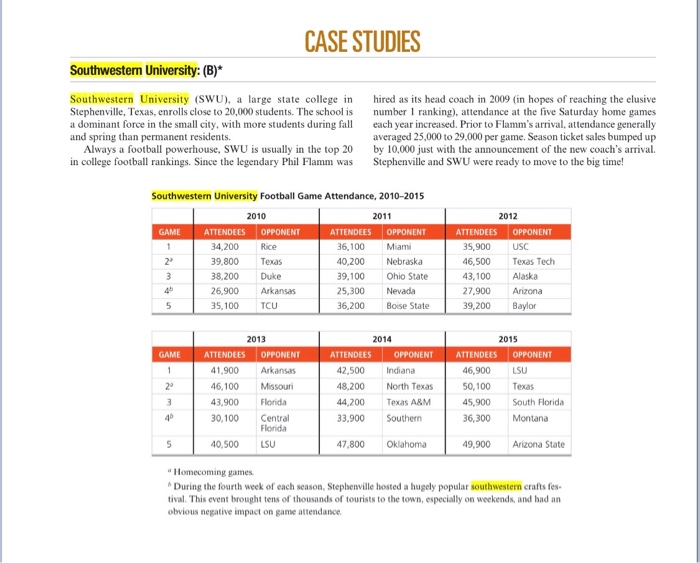
Sorry this was the actual part i was suppose to be answering 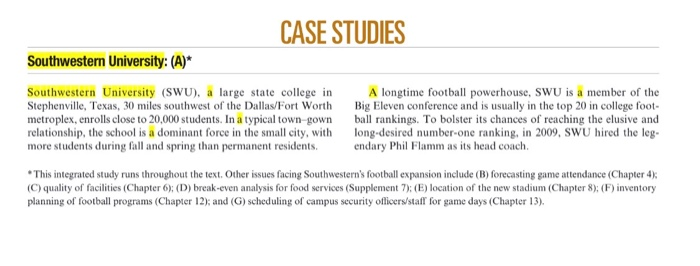
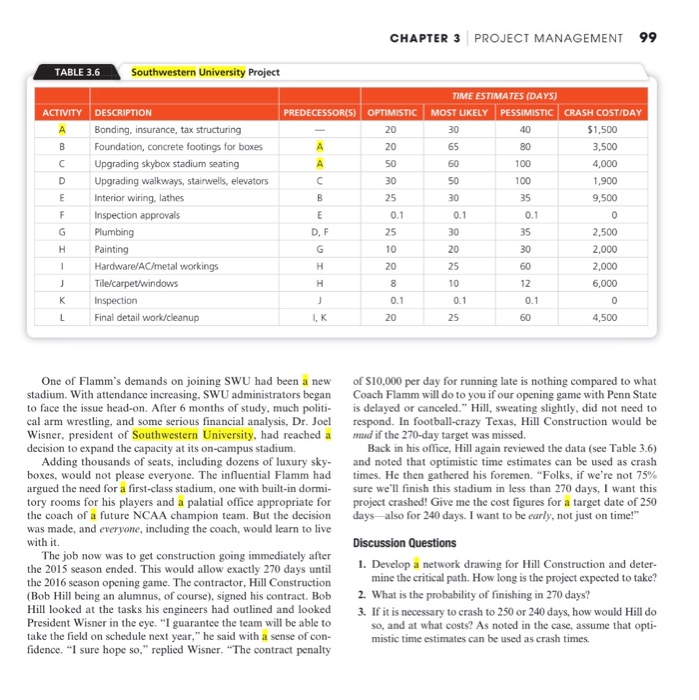
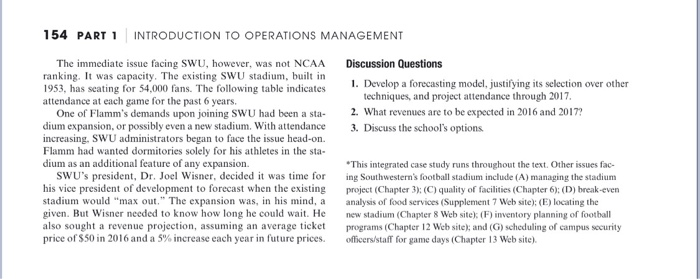
CASE STUDIES Southwestern University: (B)* Southwestern University (SWU), a large state college in Stephenville, Texas, enrolls close to 20,000 students. The school is a dominant force in the small city, with more students during fall and spring than permanent residents. Always a football powerhouse, SWU is usually in the top 20 in college football rankings. Since the legendary Phil Flamm was hired as its head coach in 2009 (in hopes of reaching the elusive number 1 ranking), attendance at the five Saturday home games each year increased. Prior to Flamm's arrival, attendance generally averaged 25,000 to 29,000 per game. Season ticket sales bumped up by 10,000 just with the announcement of the new coach's arrival. Stephenville and SWU were ready to move to the big time! Southwestern University Football Game Attendance, 2010-2015 GAME 2010 ATTENDEES OPPONENT 34 200 Rice 39,800 Texas 38.200 Duke 26,900 Arkansas 35,100 TCU 2011 ATTENDEES OPPONENT 36,100 Miami 40,200 Nebraska 39.100 Ohio State 25,300 Nevada 36,200 Boise State 2012 ATTENDEES OPPONENT 35,900 USC 46,500 Texas Tech 43,100 Alaska 27.900 Arizona 39,200 Baylor 2013 2014 2015 GAME ATTENDEES 41,900 46,100 43,900 30,100 OPPONENT Arkansas Missouri Florida Central Florida ATTENDEES 42,500 48,200 44,200 33,900 OPPONENT Indiana North Texas Texas A&M Southern ATTENDEES 46,900 50,100 45,900 36,300 OPPONENT LSU Texas South Florida Montana 40,500 LSU 47,800 Oklahoma 49,900 Arizona State Homecoming games During the fourth week of each season, Stephenville hosted a hugely popular southwestern crafts fes tival. This event brought tens of thousands of tourists to the town, especially on weekends, and had an obvious negative impact on game attendance 154 PART 1 INTRODUCTION TO OPERATIONS MANAGEMENT Discussion Questions 1. Develop a forecasting model, justifying its selection over other techniques, and project attendance through 2017 2. What revenues are to be expected in 2016 and 2017? 3 . Discuss the school's options The immediate issue facing SWU, however, was not NCAA ranking. It was capacity. The existing SWU stadium, built in 1953, has seating for 54,000 fans. The following table indicates attendance at each game for the past 6 years. One of Flamm's demands upon joining SWU had been a sta- dium expansion, or possibly even a new stadium. With attendance increasing, SWU administrators began to face the issue head-on. Flamm had wanted dormitories solely for his athletes in the sta- dium as an additional feature of any expansion SWU's president, Dr. Joel Wisner, decided it was time for his vice president of development to forecast when the existing stadium would "max out." The expansion was, in his mind, a given. But Wisner needed to know how long he could wait. He also sought a revenue projection, assuming an average ticket price of $50 in 2016 and a 5% increase each year in future prices. *This integrated case study runs throughout the text. Other issues fac- ing Southwestern's football stadium include (A) managing the stadium project (Chapter 3); (C) quality of facilities (Chapter 6); (D) break-even analysis of food services (Supplement 7 Web site); (E) locating the new stadium (Chapter 8 Web site) (F) inventory planning of football programs (Chapter 12 Web site); and (G) scheduling of campus security officers/staff for game days (Chapter 13 Web site) CASE STUDIES Southwestern University: (A)* Southwestern University (SWU), a large state college in Stephenville, Texas, 30 miles southwest of the Dallas/Fort Worth metroplex, enrolls close to 20,000 students. In a typical town gown relationship, the school is a dominant force in the small city, with more students during fall and spring than permanent residents. Alongtime football powerhouse, SWU is a member of the Big Eleven conference and is usually in the top 20 in college foot ball rankings. To bolster its chances of reaching the elusive and long desired number one ranking, in 2009, SWU hired the leg endary Phil Flamm as its head coach. This integrated study runs throughout the text. Other issues facing Southwestern's football expansion include(B) forecasting game attendance (Chapter 4) (C) quality of facilities (Chapter 6); (D) break-even analysis for food services (Supplement 7): (E) location of the new stadium (Chapter 8); (F) inventory planning of football programs (Chapter 12); and (G) scheduling of campus security officers/stall for game days (Chapter 13). CHAPTER 3 PROJECT MANAGEMENT 99 TABLE 3.6 Southwestern University Project TIME ESTIMATES (DAYS) MOST LIKELY PESSIMISTIC ACTIVITY PREDECESSOR(S) OPTIMISTIC CRASH COST/DAY $1,500 3,500 4,000 1,900 9,500 DESCRIPTION Bonding, insurance, tax structuring Foundation, concrete footings for boxes Upgrading skybox stadium seating Upgrading walkways, stairwells, elevators Interior wiring, lathes Inspection approvals Plumbing Painting Hardware/AC/metal workings Tile/carpet/windows Inspection Final detail work/cleanup 2.500 2,000 2,000 6,000 L IK 25 4,500 One of Flamm's demands on joining SWU had been a new stadium. With attendance increasing. SWU administrators began to face the issue head-on. After 6 months of study, much politi- cal arm wrestling, and some serious financial analysis, Dr. Joel Wisner, president of Southwestern University, had reached a decision to expand the capacity at its on-campus stadium. Adding thousands of seats, including dozens of luxury sky boxes, would not please everyone. The influential Flamm had argued the need for a first-class stadium, one with built-in dormi- tory rooms for his players and a palatial office appropriate for the coach of a future NCAA champion team. But the decision was made, and everyone, including the coach, would learn to live with it. The job now was to get construction going immediately after the 2015 season ended. This would allow exactly 270 days until the 2016 season opening game. The contractor, Hill Construction (Bob Hill being an alumnus, of course), signed his contract. Bob Hill looked at the tasks his engineers had outlined and looked President Wisner in the eye. "I guarantee the team will be able to take the field on schedule next year," he said with a sense of con- fidence. "I sure hope so," replied Wisner. "The contract penalty of $10,000 per day for running late is nothing compared to what Coach Flamm will do to you if our opening game with Penn State is delayed or canceled." Hill, sweating slightly, did not need to respond. In football-crazy Texas, Hill Construction would be mad if the 270-day target was missed. Back in his office, Hill again reviewed the data (see Table 3.6) and noted that optimistic time estimates can be used as crash times. He then gathered his foremen. "Folks, if we're not 75% sure we'll finish this stadium in less than 270 days, I want this project crashed! Give me the cost figures for a target date of 250 days-also for 240 days. I want to be early, not just on time!" Discussion Questions 1. Develop a network drawing for Hill Construction and deter- mine the critical path. How long is the project expected to take? 2. What is the probability of finishing in 270 days? 3. If it is necessary to crash to 250 or 240 days, how would Hill do So, and at what costs? As noted in the case, assume that opti- mistic time estimates can be used as crash times Step by Step Solution
There are 3 Steps involved in it
1 Expert Approved Answer
Step: 1 Unlock

Question Has Been Solved by an Expert!
Get step-by-step solutions from verified subject matter experts
Step: 2 Unlock
Step: 3 Unlock
 Study Help