







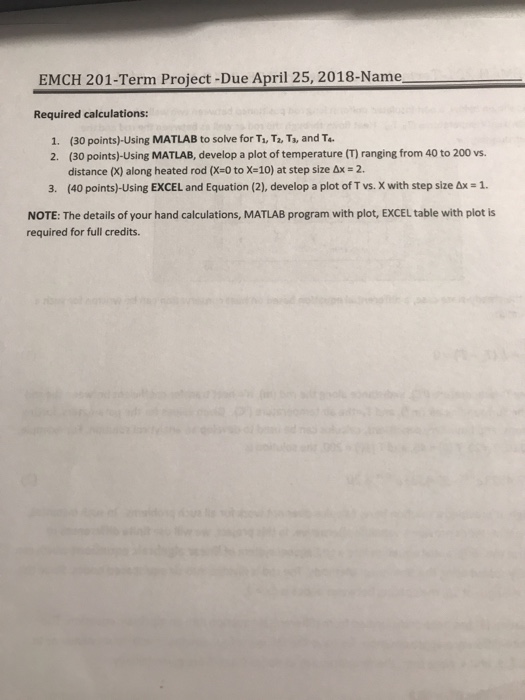
Question: Need help, dont know how to write the code for 1. And 2. As shown below, a non-insolated uniform long rod positioned between two walls
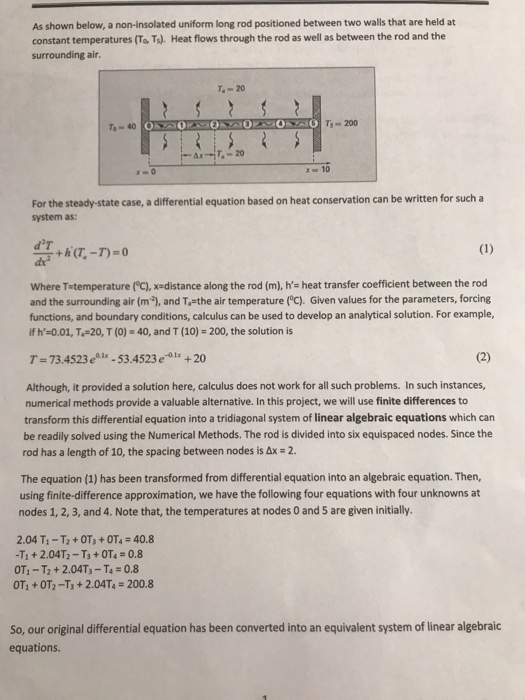
As shown below, a non-insolated uniform long rod positioned between two walls that are held at constant temperatures (To Ts). Heat flows through the rod as well as between the rod and the surrounding air. T-20 T5-200 r 10 For the steady-state case, a differential equation based on heat conservation can be written for such a system as: d T Where Tatemperature (C), xedistance along the rod (m), h's heat transfer coefficient between the rod and the surrounding air (m2), and T,-the air temperature (C). Given values for the parameters, forcing functions, and boundary conditions, calculus can be used to develop an analytical solution. For example if h'-0.01, T.-20, T (0) 40, and T (10)- 200, the solution is T-73.4523e -53.4523e+20 Although, it provided a solution here, calculus does not work for all such problems. In such instances, numerical methods provide a valuable alternative. In this project, we will use finite differences to transform this differential equation into a tridiagonal system of linear algebraic equations which can be readily solved using the Numerical Methods. The rod is divided into six equispaced nodes. Since the rod has a length of 10, the spacing between nodes is Ax 2 The equation (1) has been transformed from differential equation into an algebraic equation. Then, using finite-difference approximation, we have the following four equations with four unknowns at nodes 1, 2, 3, and 4. Note that, the temperatures at nodes 0 and 5 are given initially. 2.04 T1-T2 + OT3 + 0T4 = 40.8 -T1 + 2.04T2-T, + 01.0.8 ???-T2 + 2.04T3-1.0.8 0T1 + OT2-T3 + 2.04Ta = 200.8 So, our original differential equation has been converted into an equivalent system of linear algebraic equations
Step by Step Solution
There are 3 Steps involved in it

Get step-by-step solutions from verified subject matter experts
 Study Help