







Question: need help for questions 2-4! Please answer these questions to the best of your ability using the information that you gathered from reading the chapter,
need help for questions 2-4! 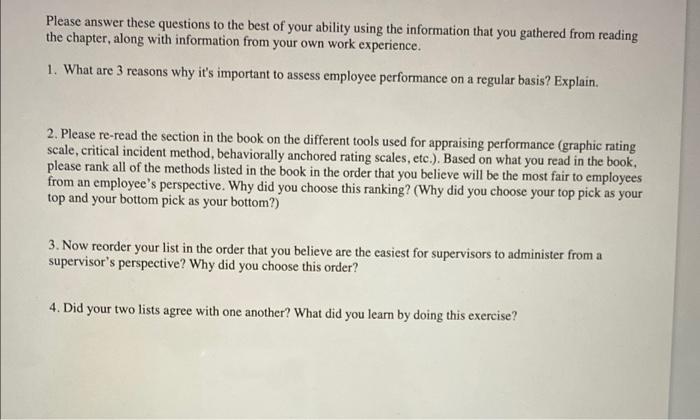
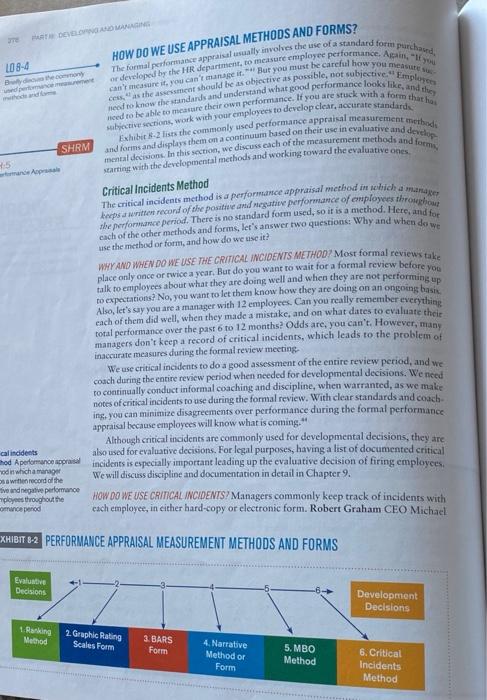
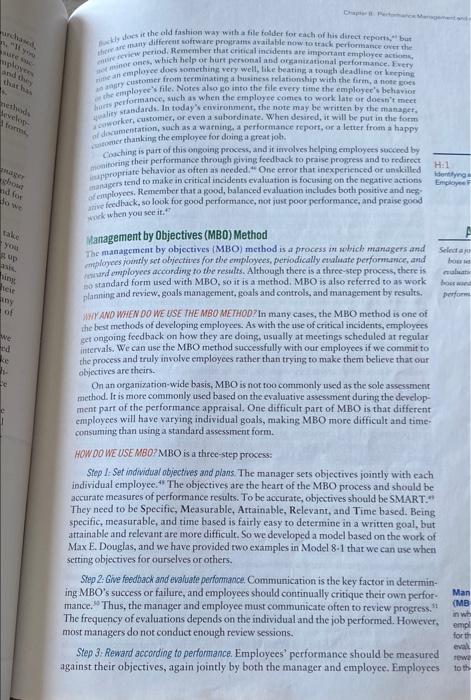
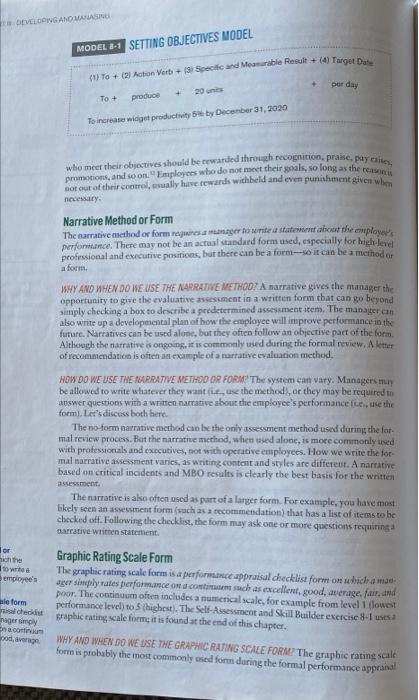
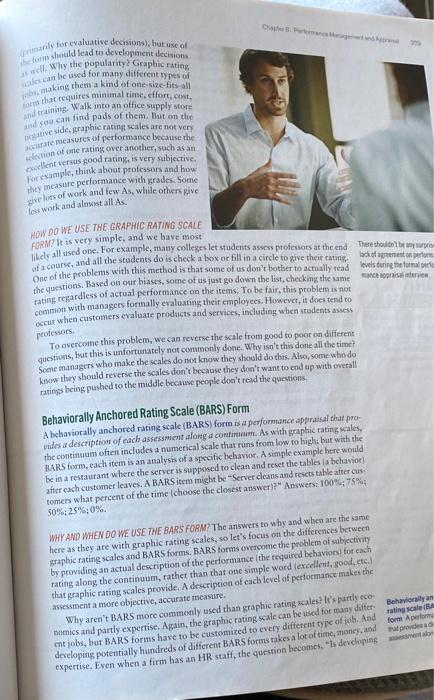
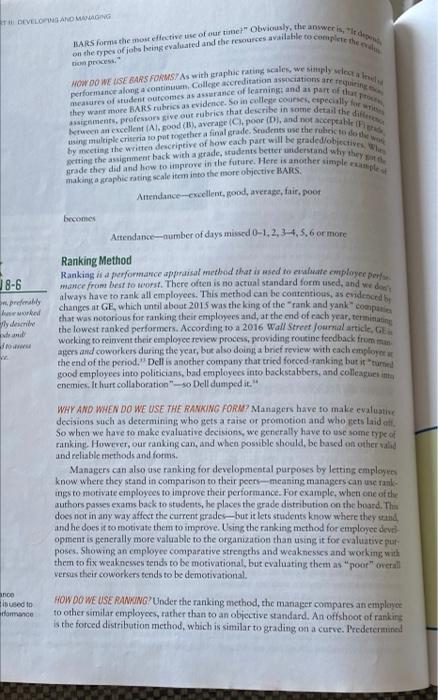
Please answer these questions to the best of your ability using the information that you gathered from reading the chapter, along with information from your own work experience. 1. What are 3 reasons why it's important to assess employee performance on a regular basis? Explain. 2. Please re-read the section in the book on the different tools used for appraising performance (graphic rating scale, critical incident method, behaviorally anchored rating scales, etc.). Based on what you read in the book, please rank all of the methods listed in the book in the order that you believe will be the most fair to employees from an employee's perspective. Why did you choose this ranking? (Why did you choose your top pick as your top and your bottom pick as your bottom?) 3. Now reorder your list in the order that you believe are the easiest for supervisors to administer from a supervisor's perspective? Why did you choose this order? 4. Did your two lists agree with one another? What did you learn by doing this exercise? DELONGAD ANG HOW DO WE USE APPRAISAL METHODS AND FORMS? L08-4 The formal performance appraisal usually involves the use of a standard for purchaud, Cansu can't mange. But you must be careful how you can or developed by the HR department to measure employee performance. Aan med to know the standards and understand what good performance looks like, and they Weed to be able to more that own performance. If you are stuck with a form that has as the assessment should be as objective as possible, not subjective Employees subjective ions, work with your employees to develop clear, accurate standards and and displays them on a continuum based on their use in evaluative and det Exhibit 2 lists the commonly used performance appraisal measurement methods Mental decisions. In this section, we discuss cach of the measurement methods and form SHRM 25 de Apr starting with the developmental methods and working toward the evaluative ones Critical Incidents Method The critical incidents method is a performance appraisal method in which a manager the performance period. There is no standard form used, so it is a method. Here, and for Perprecord of the past and to performance of employees throughout cach of the other methods and forms, let's answer two questions Why and when do use the method or form, and how do we use it? WHY AND WHEN DO WE USE THE CRITICAL INCIDENTS METHOD? Most formal reviews take talk to employees about what they are doing well and when they are not performing up place only once or twice a year. But do you want to wait for a formal review before you to expectations? No, you want to let them know how they are doing on an ongoing basik Also, let's say you are a manager with 12 employees. Can you really remember everything each of them did well, when they made a mistake, and on what dates to evaluate their total performance over the past 6 to 12 months? Odds are, you can't. However, many managers don't keep a record of critical incidents, which leads to the problem of inaccurate measures during the formal review meeting We use critical incidents to do a good assessment of the entire review period, and we coach during the entire review period when needed for developmental decisions. We need to continually conduct informal coaching and discipline, when warranted, as we make notes of critical incidents to use during the formal review. With clear standards and coach ing, you can minimize disagreements over performance during the formal performance appraisal because employees will know what is coming." Although critical incidents are commonly used for developmental decisions, they are cal incidents also used for evaluative decisions. For legal purposes, having a list of documented critical hod A performance stored incidents is especially important leading up the evaluative decision of firing employees od in which mig with record of the We will discuss discipline and documentation in detail in Chapter 9. ve and negative performance ployees throughout the HOW DO WE USE CRITICAL INCIDENTS/ Managers commonly keep track of incidents with omance period cach employee, in cither hard-copy or electronic form. Robert Graham CEO Michael XHIBIT 8-2 PERFORMANCE APPRAISAL MEASUREMENT METHODS AND FORMS Evaluative Decisions Development Decisions Ranking Method 2. Gruphic Rating Scales Form 3. BARS Form 4. Narrative Method or Form 5. MBO Method 6. Critical Incidents Method archase . wployees and they Nht H Buckles the old fashion way with a file folder for each of his director, but any different soare program available now to perform the Wriod. Remember that critical incidents remportant employees O, which help or hurt personal and organational performance. It an employee does something very well, like heating a touch deadline or keeping the employee's file. Notes also go into the file every time the employee's behavior y customer from terminating a business relationship with the format hans erformance, such as when the employee comes to work late or doesn't meet by standards. In today's environment, the note may be written by the manager, worker, customer, or even a subordinate. When desired, it will be put in the for of mentation, such as a warning a performance report, or a letter from a happy comer thanking the employee for doing a great job. brethods evelop that for Coaching is part of this ongoing process, and it involves helping employees succeed by monitoring their performance through wing feedback to praise progress and to redirect appropriate behavior as often as needed. One error that inexperienced or unskilled managers tend to make in critical incidents evaluation is focusing on the negative actions of employees. Remember that a good, balanced evaluation includes both positive and neg ative feedback, so look for good performance, not just poor performance, and praise good H:1 dening Employee Howe wack when you see it." take you up Sleda bor net im Breve ny perform of Management by Objectives (MBO) Method The management by objectives (MBO) method is a process in soboch managers and employees ootly set objectives for the employees, periodically evaluate performance, and aard employees according to the results. Although there is a three-step process, there is po standard form used with MBO, so it is a method. MBO is also referred to as work planning and review.goals management, goals and controls, and management by results. WWY AND WHEN DO WE USE THE MBO METHOD? In many cases, the MBO method is one of the best methods of developing employees. As with the use of critical incidents, employees get ongoing feedback on how they are doing, usually at meetings scheduled at regular intervals. We can use the MBO method successfully with our employees if we commit to the process and truly involve employees rather than trying to make them believe that our objectives are theirs. On an organization-wide basis, MBO is not too commonly used as the sole assessment method. It is more commonly used based on the evaluative assessment during the develop- ment part of the performance appraisal. One difficult part of MBO is that different employees will have varying individual goals, making MBO more difficult and time: consuming than using a standard assessment form. We ca HOW DO WE USE MBO/MBO is a three-step process: Step 1: Set individual objectives and plans. The manager sets objectives jointly with each individual employee." The objectives are the heart of the MBO process and should be accurate measures of performance results. To be accurate, objectives should be SMART. They need to be Specific, Measurable, Attainable, Relevant, and Time based. Being specific, measurable, and time based is fairly easy to determine in a written goal, but attainable and relevant are more difficult. So we developed a model based on the work of Max E. Douglas, and we have provided two examples in Model 8-1 that we can use when setting objectives for ourselves or others. Step 2: Give feedback and evaluate performance Communication is the key factor in determin ing MBO's success or failure, and employees should continually critique their own perfor Man mance. Thus, the manager and employee must communicate often to review progress." The frequency of evaluations depends on the individual and the job performed. However, most managers do not conduct enough review sessions. Step 3: Reward according to performance. Employees' performance should be measured against their objectives, again jointly by both the manager and employee. Employees to the (MB in wh amp forth eval Tew DEVELONGANMARAS MODEL 8-1 SETTING OBJECTIVES MODEL (1) To+ (2) Acton Vert + 13 Specific and Meanurable Result+ (4) Target Dat per day To + produce To increase widget productivity by December 31, 2020 who meet their objectives should be rewarded through recognition, praise, payetang not out of their control, wally have towards withheld and even punishment given we promotions, and so on. Employees who do not meet their goals, so long as the reason necessary Narrative Method or Form The narrative method or form requires manager to write a statement about the employees performance. There may not be an actual standard form used, especially for high levd professional and executive positions, but there can be a form--so it can be a method or a form WWY AND WHEN DO WE USE THE NARRATIVE METHOD? A narrative gives the manager the opportunity to give the evaluative assessment in a written form that can go beyond simply checking a box to describe a peedetermined assessment item. The manager can also write up a developeintal plan of how the employee will improve performance in the future. Narratives can be used alone, but they often follow an objective part of the form Although the narrative is ongoing, it is commonly used during the formal review. A letter of recommendation is often an example of a narrative evaluation method. HOW DO WE USE THE NARRATIVE METHOD OR FORM"The system can vary. Managers muy be allowed to write whatever they want is the methods, or they may be required to answer questions with a written narrative about the employee's performance fic, use the form. Let's discuss both here The no form narrative method can be the only assessment method used during the for mal review process. But the narrative method, when used alone, is more commonly used with professionals and executives, not with operative employees. How we write the for mal narrative assessment varies, as writing content and styles are different. A narrative based on critical incidents and MBO results is clearly the best basis for the written assessment The narrative is also often used as part of a larger form. For example, you have most likely seen an assessment form (such as a recommendation) that has a list of items to be checked off. Following the checklist, the form may ask one or more questions requiring a narrative written statement or hich the employee's Graphic Rating Scale Form The graphic rating scale form is a performance appraisal checklist form on kichama ger simply rates performance on content such as excellent, good, average, fair, and poor. The continuum often includes a numerical scale, for example from level 1 (lowest performance level) to 5 highest). The Self Assessment and Skill Builder exercise 8-1 uses graphic eating scale form it is found at the end of this chapter. le form chest nager Simply enco pode WHY AND WHEN DO WE USE THE GRAPHIC RATING SCALE FORM? The graphic rating scale form is probably the most commonly used form during the formal performance appraisal only for evaluative decisions, but use of the form should lead to development decisions well. Why the popularity? Graphic rating can be used for many different types of by making them a kind of one-size-fits-all that requires minimal time. cffort, cost, and walk into an office supply store ou can find pads of them. But on the Desideraphic rating scales are not very are measures of performance because the Section of one rating over another, such as an cellent versus good rating is very subjective For example, think about professors and how they measure performance with grades. Some She lots of work and few As, while others give los work and almost all As. HOW DO WE USE THE GRAPHIC RATING SCALE FORM? It is very simple, and we have most likely all used one. For example, many colleges let students awess professors at the endThere should be of a course, and all the students do is check a box or fill in a circle to give their rating lack of een One of the problems with this method is that some of us don't bother to actually read levels during the tumal per the questions. Based on our biases, some of us just go down the list, checking the same narisal intervien rating regardless of actual performance on the items. To be fair, this problem is not common with managers formally evaluating their employees. However, it does tend to occur when customers evaluate products and services, including when students assen professors To overcome this problem, we can reverse the scale from good to poor on different questions, but this is unfortunately not commonly done. Why isn't this done all the time? Some managers who make the scales do not know they should do this. Also, some who do know they should reverse the scales don't because they don't want to end up with overall ratings being pushed to the middle because people don't read the questions, Behaviorally Anchored Rating Scale (BARS) Form A behaviorally anchored rating scale (BARS) form is a performance appraisal that pro vides a description of each assessment along a continuum. As with graphic rating sales, the continuum often includes a numerical scale that runs from low to high but with the BARS form, each item is an analysis of a specific behavior. A simple example here would be in a restaurant where the server is supposed to clean and reset the tables ia behavior) after each customer leaves. A BARS item might be "Server cleans and resets table after cus tomers what percent of the time (choose the closest answer)?" Answers: 100%;75%; 50% 25% 0% WHY AND WHEN DO WE USE THE BARS FORM? The answers to why and when are the same here as they are with graphic rating scales, so let's focus on the differences between graphic rating scales and BARS forms. BARS forms overcome the problem of subjectivity by providing an actual description of the performance (the required behavios for each rating along the continuum, rather than that one simple word excellent, good, etc.) that graphic rating sales provide. A description of each level of performance makes the assment a more objective, accurate measure. Why aren't BARS more commonly used than graphic rating sales? It's partly eco nomics and partly expertise. Again, the graphic rating scale can be used for many differ Behaviorally an snt jobs, bur BARS forms have to be customized to every different type of job. And rating scale form Aperto developing potentially hundreds of different BARS forms takes a lot of time, money, and dead expertise. Even when a firm has an HR staff, the question becomes, "Is developing and DEVELOPING AND MANAG HLARS form the sout effective use of our tuer Obviously, the answers, the types of jobs in evaluated and the resources available to complete the tie process HOW DO WE USE BARS FORMS As with graphic rating scales, we simply when Drs of student outcomes assurance of caring and as part of performance alon a continuu College accreditation associations are aments, professor voor rubrics that describe in some detail the dy they want more BARS rubrics as evidence. So in college coursespecially for Derwen an excellent Alodavapoor (D. and not corab ng multiple criteria to put the anal grade. Students are the recto de by meeting the written descriptive of how each part will be graded objective in the assignment back with a grade, students better understand why they the grade they did and how to improve in the future. Here is another simple et making a graphic rating scale item into the more objective BARS. Anendance-excellent, good, average, fair, poor becomes Attendance-number of days missed 0-1,2,3,4,5,6 or more 8-6 pribly ser ilyen Ranking Method Ranking is a performance appraisal method that is used forlate employee per mance from best to worst. There often is to actual standard form used, and we always have to rank all employees. This method can be contentious, as evidenced by changes at GE which until about 2015 was the king of the rank and yank" computer that was notorious for ranking their employees and, at the end of each year, terminating the lowest ranked performers. According to a 2016 Wall Street Journal article, GER working to reinvent their employee review process, providing routine feedback from man agers and coworkers during the year, but also doing a brief review with each employee the end of the period." Dell is another company that tried forced ranking but it turel good employees into politicians, bad employees into backstabbers, and colleagues enemies. It hurt collaborations Dell dumped it. Bio WHY AND WHEN DO WE USE THE RANKING FORM? Managers have to make evaluative decisions such as determining who gets a rate or promotion and who gets laid att So when we have to make evaluative decisions, we generally have to use some type of ranking. However, our ranking can, and when possible should be based on other valid and reliable methods and forms Managers can also use ranking for developmental purposes by letting employees know where they stand in comparison to their peers-meaning managers can use ank ings to motivate employees to improve their performance. For example, when one of the authors passes exams back to students, he places the grade distribution on the board. This does not in any way affect the current prade--but it lets students know where they stand and he does it to motivate them to improve. Using the ranking method for employee devel opment is generally more valuable to the organization than using it for evaluative put poses. Showing an employee comparative strengths and weaknesses and working with them to fix weaknesses tends to be motivational, but evaluating them as "poor" overall versus their coworkers tends to be demotivational Once is used to romance HOW DO WE USE RANKING? Under the ranking method, the manager compares an employee to other similar employees, rather than to an objective standard. An offshoot of ranking is the forced distribution method, which is similar to grading on a curve. Predetermined
Step by Step Solution
There are 3 Steps involved in it
1 Expert Approved Answer
Step: 1 Unlock

Question Has Been Solved by an Expert!
Get step-by-step solutions from verified subject matter experts
Step: 2 Unlock
Step: 3 Unlock
 Study Help