







Question: Need help implementing these fragments of code, *ONLY using. t.child, t.data, t.max_items, t._leaves(), t.height and obviously full_nodes(T), num_leaves(T), and find_depth(T,k). ONLY* NOT USING is_leaf() or
Need help implementing these fragments of code, *ONLY using. t.child, t.data, t.max_items, t._leaves(), t.height and obviously full_nodes(T), num_leaves(T), and find_depth(T,k). ONLY*
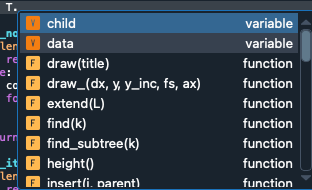
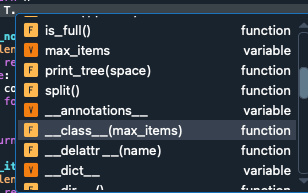 NOT USING is_leaf() or get_key, or get_child, or num_children, or num_items!.
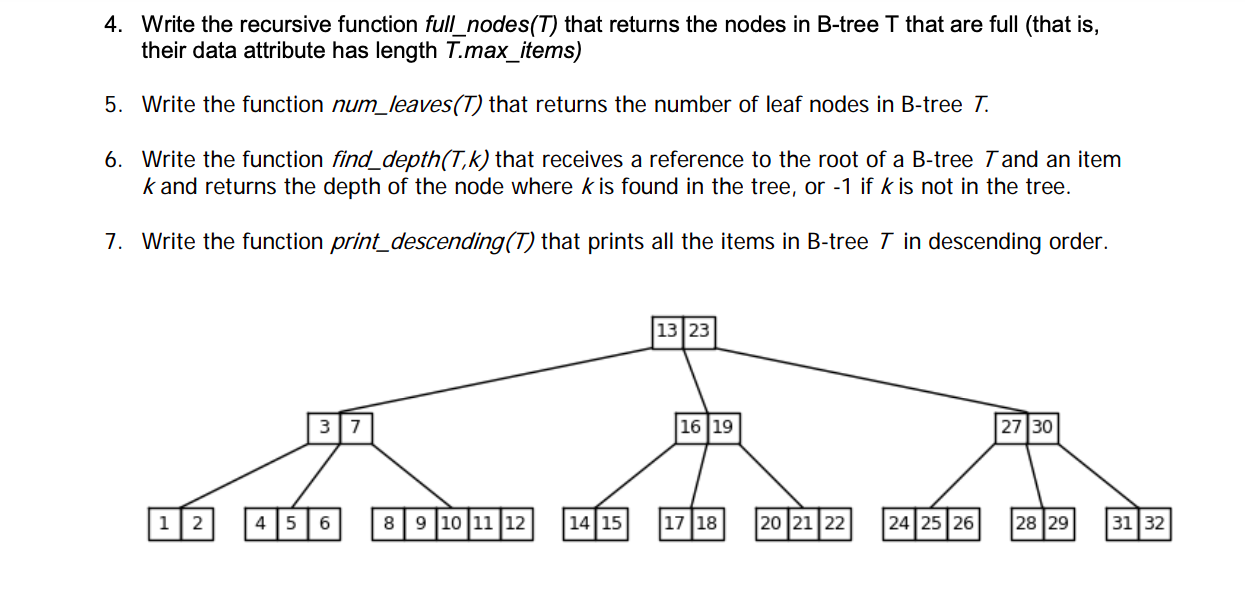
4. Write the recursive function full_nodes (T) that returns the nodes in B-tree T that are full (that is, their data attribute has length T.max_items) 5. Write the function num_leaves (T) that returns the number of leaf nodes in B-tree T. 6. Write the function find_depth (T,k) that receives a reference to the root of a B-tree T and an item k and returns the depth of the node where k is found in the tree, or 1 if k is not in the tree. 7. Write the function print_descending (T) that prints all the items in B-tree T in descending order. T. T
Step by Step Solution
There are 3 Steps involved in it

Get step-by-step solutions from verified subject matter experts
 Study Help