







Question: Need help with solving question d Consider an economy with two goods, consumption .2 and leisure I, and a representative consumer. The consumer is endowed
Need help with solving question d
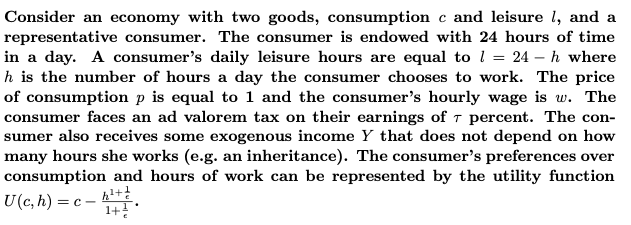
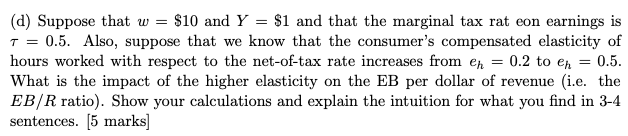
Consider an economy with two goods, consumption .2 and leisure I, and a representative consumer. The consumer is endowed with 24 hours of time in a day. A consumer's daily leisure hours are equal to l = 24 h where h. is the number of hours a day the consumer chooses to work. The price of consumption p is equal to 1 and the consumer's hourly wage is w. The consumer faces an ad valorem tax on their earnings of 1- percent. The con- sumer also receives some exogenous income 1" that does not depend on how many hours she works (e.g. an inheritance). The consumer's preferences over consumption and hours of work can he represented by the utility function _ ni- U(c,h.} _ c 1+; . -E {d} Suppose that u: = $113! and 1" = $1 and that the marginal tax rat eon earnings is \"r = [1.5. Also, suppose that we know that the consumer's compensated elasticity of hours worked 1with respect to the netoftax rate increases from eh = [1.2 to 15 2 [1.5. What is the irnpact of the higher elasticity on the EB per dollar of reuemie [i.e. the EBIR ratio]. Show your calculations and explain the intuition for what you nd in 34 sentences. [5 marks]
Step by Step Solution
There are 3 Steps involved in it

Get step-by-step solutions from verified subject matter experts
 Study Help