







Question: need help with this Grade 8. Section: Teacher: Content Editor: Score: Subject: General Physics 2 Name: School: LAS Writer: JAN JEFFREY R. CAMIFIA Learning Topic:
need help with this
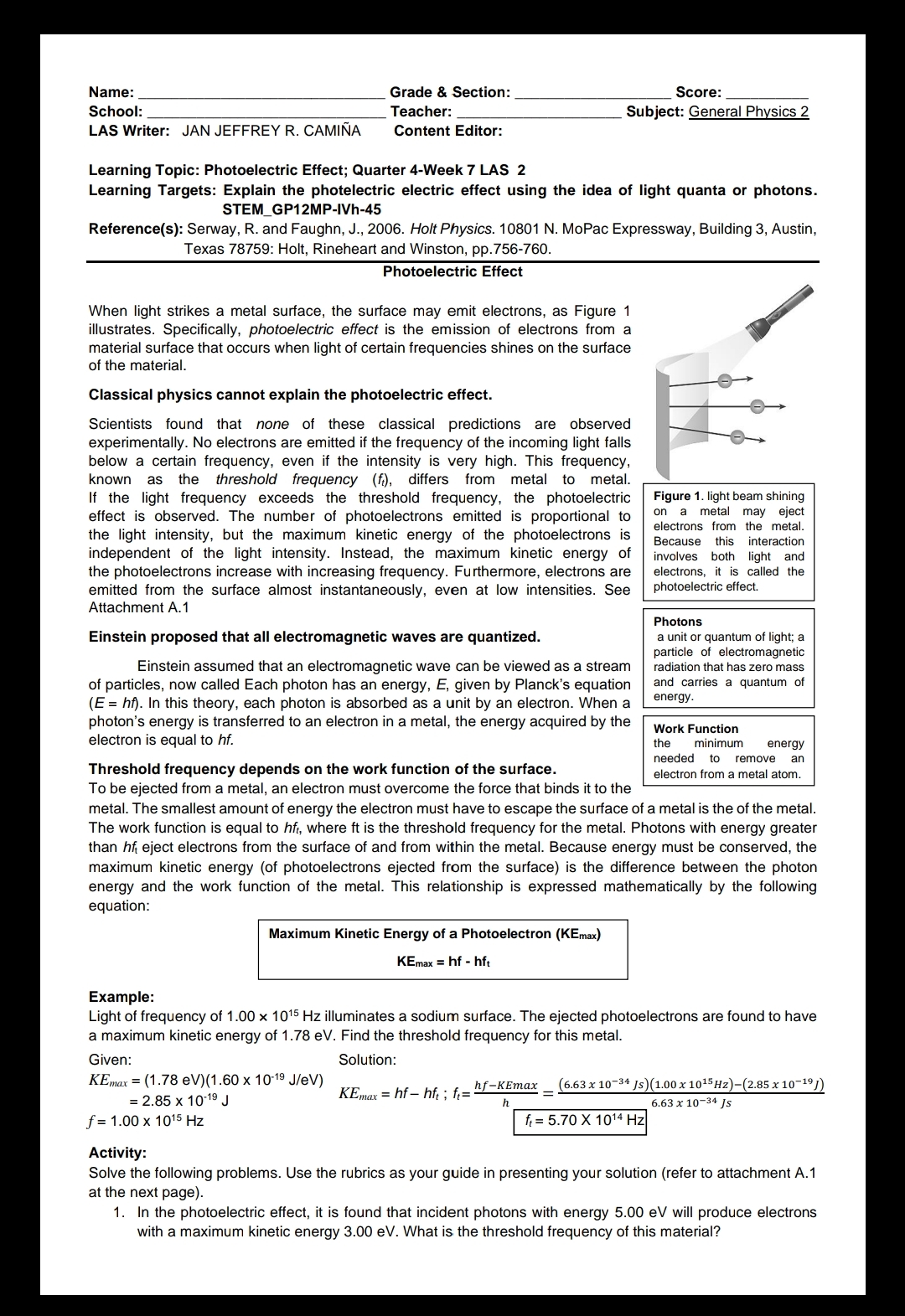
Grade 8. Section: Teacher: Content Editor: Score: Subject: General Physics 2 Name: School: LAS Writer: JAN JEFFREY R. CAMIFIA Learning Topic: Photoelectric Effect; Quarter 4-Week 7 LAS 2 Learning Targets: Explain the photelectric electric effect using the idea of light quanta or photons. STEM_GP12MP-th-45 Reference(s): Senrvay, R. and Faughn, J., 2006. HoitPhysics. 10801 N. MoPac Expressway, Building 3, Austin, Texas 78759: Holt, Rineheart and Winston, pp.756-760. Photoelectric Effect When light strikes a metal Surface, the surface may emit electrons, as Figure 1 illustrates. Specifically, photoelectric effect is the emission of electrons from a material surface that occurs when light of certain frequencies shines on the surface of the material. Classical physics cannot explain the photoelectric effect. Scientists found that none of these classical predictions are observed experimentally. No electrons are emitted if the frequency of the incoming light falls below a certain frequency, even if the intensity is very high. This frequency, known as the threshold frequency (5), differs from metal to metal. If the light frequency exceeds the threshold frequency, the photoelectric effect is observed. The number of photoelectrons emitted is proportional to the light intensity. but the maximum kinetic energy of the photoelectrons is independent of the light intensity. Instead, the maximum kinetic energy of the photoelectrons increase with increasing frequency. Furthermore, electrons are emitted from the surface almost instantaneously, even at low intensities. See Attachment A.1 Figure 1. light beam shining on a metal may eject electrons from the metal. Because this interaction involves both light and electrons, it is called the photoelectric effect. Photons a unit or quantum of light; a particle of electromagnetic radiation that has zero mass and carries a quantum of Einstein proposed that all electromagnetic waves are quantized. Einstein assumed that an electromagnetic wave can be viewed as a stream of particles, now called Each photon has an energy, E, given by Planck's equation (E = hf). In this theory, each photon is absorbed as a unit by an electron. When a photon's energy is transferred to an electron in a metal, the energy acquired by the electron is equal to hf. Threshold frequency depends on the work function of the surface. energy. Work Function the minimum energy needed to remove an electron from a metal atom. To be ejected from a metal, an electron must overcome the force that binds it to the metal. The smallest amount of energy the electron must have to escape the surface of a metal is the of the metal. The work function is equal to hf}, where ft is the threshold frequency for the metal. Photons with energy greater than hf. eject electrons from the surface of and from within the metal. Because energy must be conserved. the maximum kinetic energy (of photoelectrons ejected from the surface} is the difference between the photon energy and the work function of the metal. This relationship is expressed mathematically by the following equation: Maximum Kinetic Energy of a Photoelectron (KEmax) KEN. = hf - hfl Example: Light of frequency of 1.00 x 10¹⁵ Hz illuminates a sodium surface. The ejected photoelectrons are found to have a maximum kinetic energy of 1.78 eV. Find the threshold frequency for this metal. Given: Solution: 1(me = (1.73 eV)(1.60 x 10⁻¹⁹ JleV) = 2.85 x10\"19 J f=1.00x 10¹⁵ Hz ilf-KEmctx _ (6.63 x 1o34 js)(1.00x 10¹⁵H2)[2.85 x 1o1'3j) h _ 6.63 x 10*\" J's fr= 5.?0 X 10\" Hz Activity: Solve the following problems. Use the rubrics as your guide in presenting your solution (refer to attachment A.1 at the next page). 1. In the photoelectric effect, it is found that incident photons with energy 5.00 eV will produce electrons with a maximum kinetic energy 3.00 eV. What is the threshold frequency of this material? KE,,,,,_Ir = hf hf, ; f,=
Step by Step Solution
There are 3 Steps involved in it

Get step-by-step solutions from verified subject matter experts
 Study Help