







Question: Need to answer the part a), b), and c). Also need to draw a decision tree, according to the Gain formula, attributes with higher gain
Need to answer the part a), b), and c). Also need to draw a decision tree, according to the Gain formula, attributes with higher gain should be placed on top.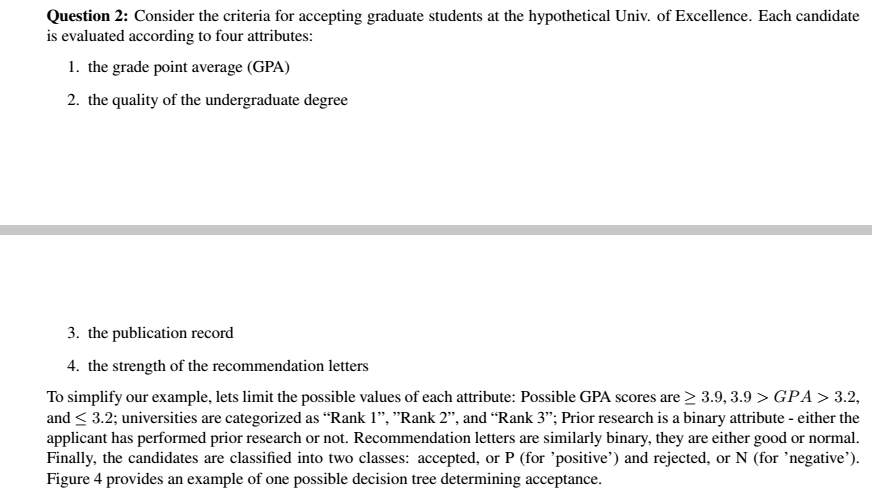
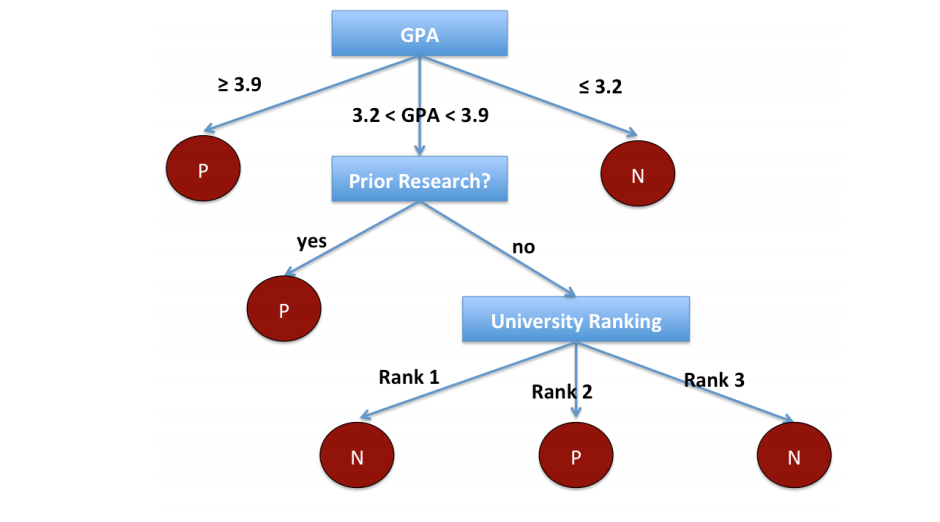
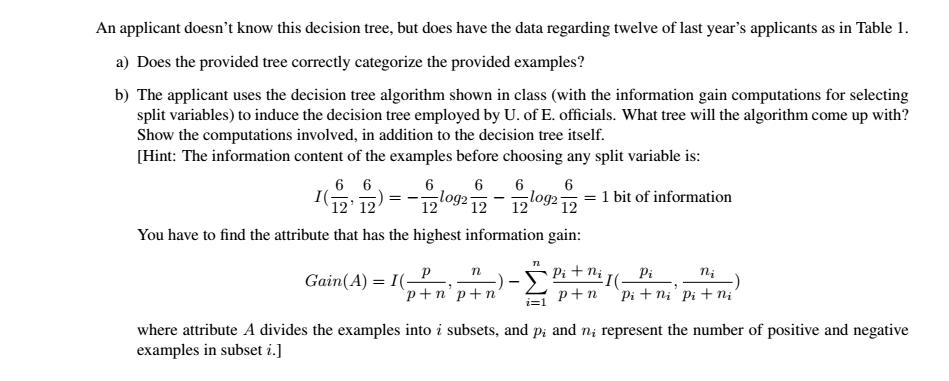
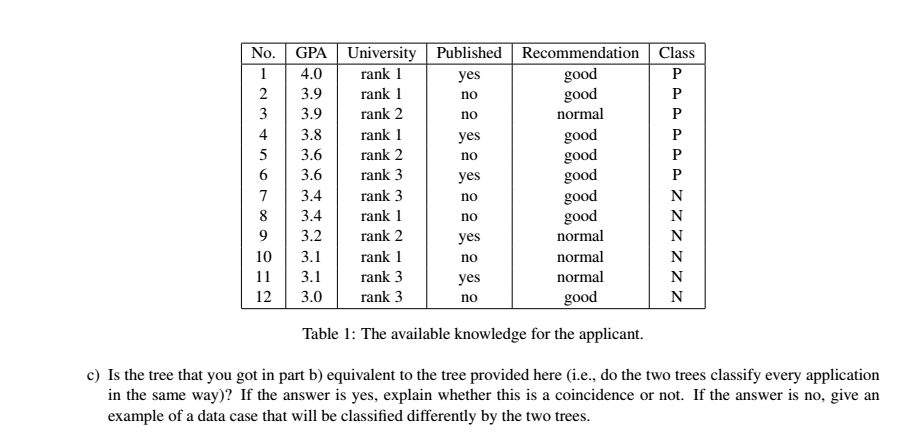
Question 2: Consider the criteria for accepting graduate students at the hypothetical Univ. of Excellence. Each candidate is evaluated according to four attributes: 1. the grade point average (GPA) 2. the quality of the undergraduate degree 3. the publication record 4. the strength of the recommendation letters To simplify our example, lets limit the possible values of each attribute: Possible GPA scores are 2 3.9,3.9 >GPA 3.2, and 3.2; universities are categorized as "Rank I", ''Rank 2", and "Rank 3", Prior research is a binary attribute-either the applicant has performed prior research or not. Recommendation letters are similarly binary, they are either good or normal. Finally, the candidates are classified into two classes: accepted, or P (for 'positive') and rejected, or N (for 'negative'). Figure 4 provides an example of one possible decision tree determining acceptance. Question 2: Consider the criteria for accepting graduate students at the hypothetical Univ. of Excellence. Each candidate is evaluated according to four attributes: 1. the grade point average (GPA) 2. the quality of the undergraduate degree 3. the publication record 4. the strength of the recommendation letters To simplify our example, lets limit the possible values of each attribute: Possible GPA scores are 2 3.9,3.9 >GPA 3.2, and 3.2; universities are categorized as "Rank I", ''Rank 2", and "Rank 3", Prior research is a binary attribute-either the applicant has performed prior research or not. Recommendation letters are similarly binary, they are either good or normal. Finally, the candidates are classified into two classes: accepted, or P (for 'positive') and rejected, or N (for 'negative'). Figure 4 provides an example of one possible decision tree determining acceptance
Step by Step Solution
There are 3 Steps involved in it

Get step-by-step solutions from verified subject matter experts
 Study Help