Question: needs answers for discussion questions from the article. Case Study 7-1 FIRING THE CEO On the morning of November 1, Paul Blackman, admin- istrator of
needs answers for discussion questions from the article.
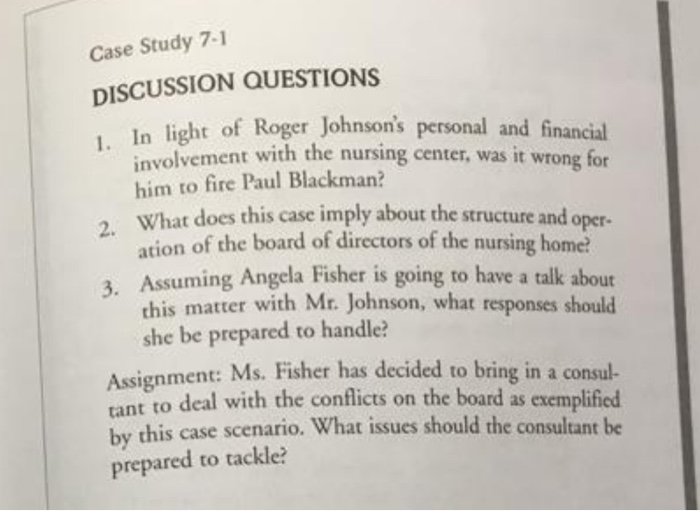
Case Study 7-1 FIRING THE CEO On the morning of November 1, Paul Blackman, admin- istrator of the Crescent City Nursing Center for the past 23 months, received a call from Roger Johnson, former president of the nursing home's board, who told him that, on behalf of the other former presidents of the board, Johnson was asking for Blackman's resignation by the end of the year. Blackman was stunned by this call and immediately telephoned Angela Fisher, the home's board president, and received assurances from her that, despite the fact that he had no employment contract, his job was secure. The Crescent City Nursing Center is a 250-bed skilled nursing home that has a reputation for being the finest in CASE STUDY 163 Case Study 7-1 the region. Since its founding shortly after World War II, founding of the home, including members of the Johnson the home has been under the direction of a 24-member self-perpetuating board of trustees. The original board com- prised a number of people who were instrumental in the family, who were not only involved in the homes founding but also provided close to $3 million of the home's total 5 million endowment. The most important of the Johnson family members were two brothers, Roger and William The 24 members of the present board consist of 7 former presidents and at least 10 other people who have been involved with the home for over 15 years. The board is now dominated by Roger's son Kenneth and William's son John. In addition, five other Johnson family members are on the board, along with several board members who have significant business involvement with the Johnson family. Since the home opened, there have been three admin- istrators. The first administrator also served as director of nursing and held the job until 1965, when she was replaced by Mac Davidson, who administered the home for the next 30 years. Davidson's training was in social work, and he came to the home at a crucial time in its evolution. He was responsible for its growth from a 100-bed old-age home to the high-quality home it is today. Davidson and his wife Leslie were intimately involved in all of its functionings Although Leslie was only a part-time receptionist, she made her presence felt throughout the home by being there a significant part of each day, visiting the residents daily, participating in the various resident shows, and socializing with many of the volunteers and board members. Mac Davidson also kept a very high profile in the home through various means, including early morning rounds of all the resident units, close contact with family members, and an (continues rectifying the problems. The first of the involved low morale among the staff largely due to Davidsons long tory of favoritism, which had resulted in the pay and fringe benefits. For example, in the food service depart ment, a cook with 20 years of schoty w pudlo than ancher cook who had been with the home only 7 years CASE STUDY 165 164 CHAPTER 7 THE BOARD OF DIRECTORS Case Study 7.1 Case Study 7-1 active series of social engagements with many of the board members, especially the Johnson clan. In contrast, Paul Blackman has spent more time in his office and less time visiting with residents or socializing with the board. Mrs. Blackman, who is an accountant with a certified public accounting firm, has also been quite uninvolved with the home, in sharp contrast to Leslie Davidson The last few years of Davidson's tenure were both pro- fessionally and personally difficult for him. On the profes sional side, he faced a broad range of challenges, including an attempted unionization at the nursing home, a decrease in the home's ability to raise funds, and a decrease in income from residents due to a declining private pay census as well as Medicaid cutbacks. On the personal side, Davidson had a series of medical problems, including a heart attack, bypass surgery, and a bout with prostate cancer. After enduring these problems for 3 years, the board prevailed on Davidson to retire. Because of Davidson's health problems, he retired in January and his long time assistant, Alvin Jones, who for 27 years was the home's personnel manager, cook over as the acting administrator The board recognized Jones's limitations and agreed among themselves to increase their supervision of the home, particularly in the area of finances. The increased supervision provided the board with some unexpected and unpleas- ant information about the facility's fiscal health, such as an undisclosed (by management) deficit of close to $1 million. They also learned that the home was overstaffed and that its salary and benefit structure was exceedingly problematic. The board decided to find a new CEO to solve the problems and bring the home's finances into line. After a 6-month search, they hired Paul Blackman, a 39-year-old experienced nursing home administrator with an MBA in health administration. On January 1 of the previous year, Blackman took over the job and set about identifying and Also, the 20-year veteran was only entitled to 3 weeks of paid vacation, whereas Davidson had negotiated a 6-week Vacation package for the new cook after 5 years of service. The food service example was not an isolated case. There were numerous inequities throughout the organization, many of which apparently resulted from Davidson's desine to control staff through a series of private negotiations The individual staff member would thus become beholde to Davidson because he had bent the personnel rules to accommodate the employee's desires. Other problems included the huge deficit resulting from overstaffing and state Medicaid cutbacks. Blackman dealt with these problems by undertaking a thorough review of personnel policies and actions as well as staffing levels. In addition, Blackman decided to replace a number of senior management personnel with people loyal to him. In one conversation with Angela Fisher, he stated that the home was still full of Davidson loyalists who ran to him with every complaint or controversy. A further problem was that many of those who were likely to lose from Blackman's policies had cordial relationships with the board. This was another legacy of the Davidson years, when the CEO often hired people at the suggestion of board members, particu larly the Johnson family In pursuing his policies, Blackman felt considerable pros sure to get things in order as soon as possible. He also felt that every change he made reflected poorly on his predecem 166 CHAPTER 7 THE BOARD OF DIRECTORS Case Study 7-1 and that frequently either Davidson or one of his friends on the board would react to a proposed change with the ques tion, "How come we never had this problem when Mac ran the home?" Blackman's analysis of the situation was that Mac Davidson was an out-of-touch and manipulative manager who ran the home by keeping the board in the dark and that the board was complicit by choosing to stay in the dark. John and Kenneth Johnson, both former board presidents, viewed Blackman as the key problem. From their perspective, Blackman was doing a respectable job of dealing with the home's fiscal problems but was mak- ing a mess of the staff situation. Specifically, they believed he was wrong to fire or force into retirement so many top management staff, including the director of nursing, the director of the physical plant, the food service director, the personnel manager, and the purchasing agent. In addition, while they applauded his efforts at developing a more equi- table system of wages and benefits, they were concerned about its costs as well as its potential for labor strife. Other matters that concerned these board members included Blackman's active participation on the state nursing home association's board of trustees and his lack of time to social- ire with the residents Angela Fisher found herself in the middle of this dis- pute. On the one hand, she personally liked Paul Blackman and respected what he was trying to accomplish. On the other hand, she felt that he should probably spend more time at the home and perhaps be more diplomatic about board relationships. Her main concern, however, was how to deal with the powerful group of former board presidents who had announced that they were firing Paul Blackman. Case Study 7.1 DISCUSSION QUESTIONS 1. In light of Roger Johnson's personal and financial involvement with the nursing center, was it wrong for him to fire Paul Blackman? 2. What does this case imply about the structure and oper- ation of the board of directors of the nursing home? 3. Assuming Angela Fisher is going to have a talk about this matter with Mr. Johnson, what responses should she be prepared to handle? Assignment: Ms. Fisher has decided to bring in a consul- tant to deal with the conflicts on the board as exemplified by this case scenario. What issues should the consultant be prepared to tackle









 Study Help