







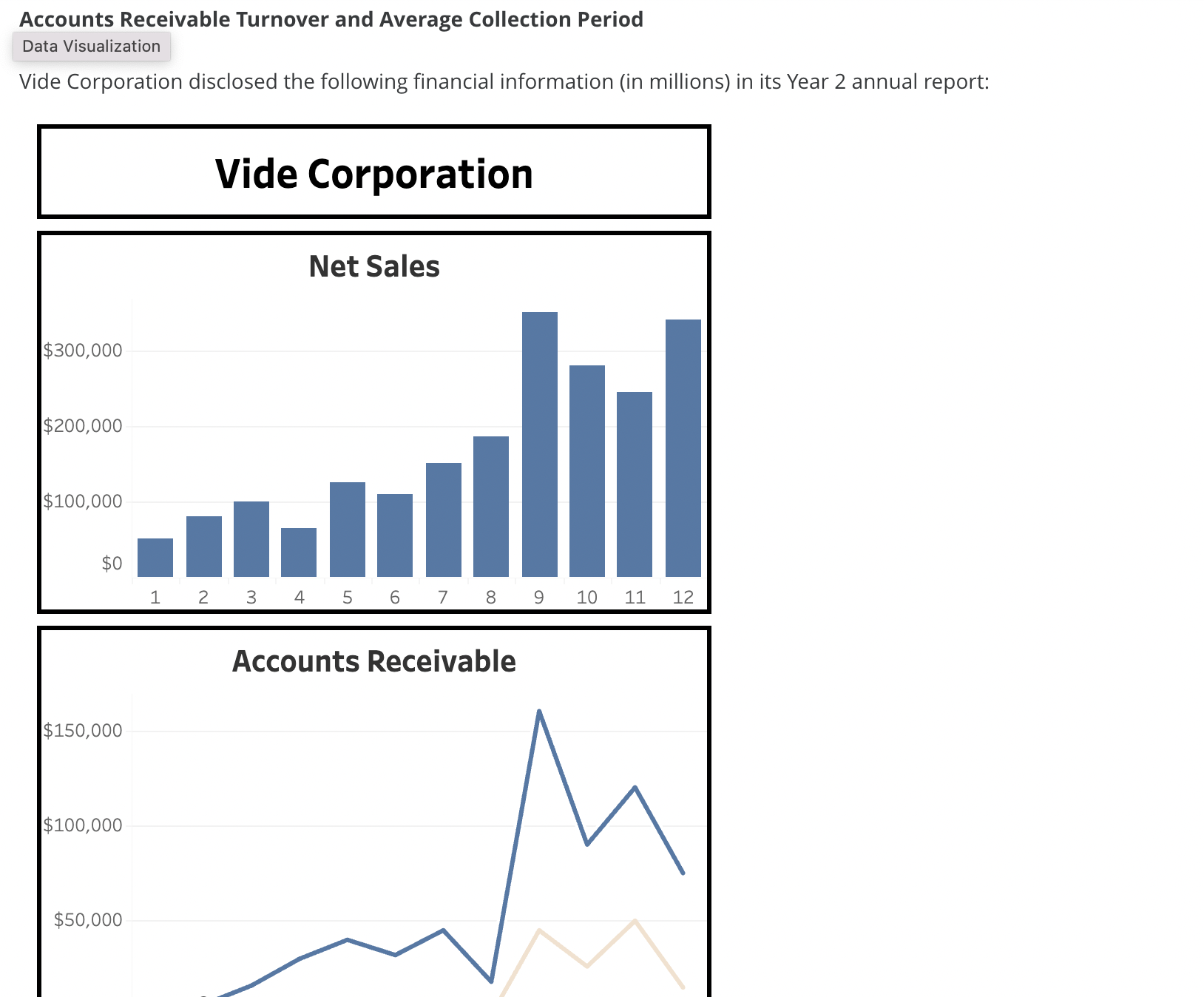
Question: Net sales in order from 1 - 1 2 : 5 0 , 0 0 0 , 8 0 , 0 0 0 , 1
Net sales in order from : Ending accounts receivable in order from : Ending allowance for doubtful accounts in order from : Accounts Receivable Turnover and Average Collection Period Vide Corporation disclosed the following financial information in millions in its Year annual report: a Calculate the accounts receivable turnover ratio for Year b Calculate the average collection period also called Days sales outstanding, Days' sales in inventory, and Average days to collect receivables for Year Note: Use the result from a EXACTLY as displayed in the calculation for b Numerator Denominator Result a Accounts Receivable TurnoverYear Answer Answer b Average Collection PeriodYear : Answer days. Feedback Partially correct Marks for this submission: Accounts Receivable Turnover and Average Collection Period
Data Visualization
Vide Corporation disclosed the following financial information in millions in its Year annual report:
Vide Corporation a Calculate the accounts receivable turnover ratio for Year
b Calculate the average collection period also called Days sales outstanding, Days' sales in inventory, and Average days to collect receivables for Year
Note: Use the result from a EXACTLY as displayed in the calculation for b
Step by Step Solution
There are 3 Steps involved in it
1 Expert Approved Answer
Step: 1 Unlock

Question Has Been Solved by an Expert!
Get step-by-step solutions from verified subject matter experts
Step: 2 Unlock
Step: 3 Unlock
 Study Help