







Question: NEWTON'S SECOND AND THIRD LAWS Mech 3 1 I. Applying Newton's laws to interacting objects; constant speed Three identical bricks are pushed across a table
NEWTON'S SECOND AND THIRD LAWS
Mech
I. Applying Newton's laws to interacting objects; constant speed
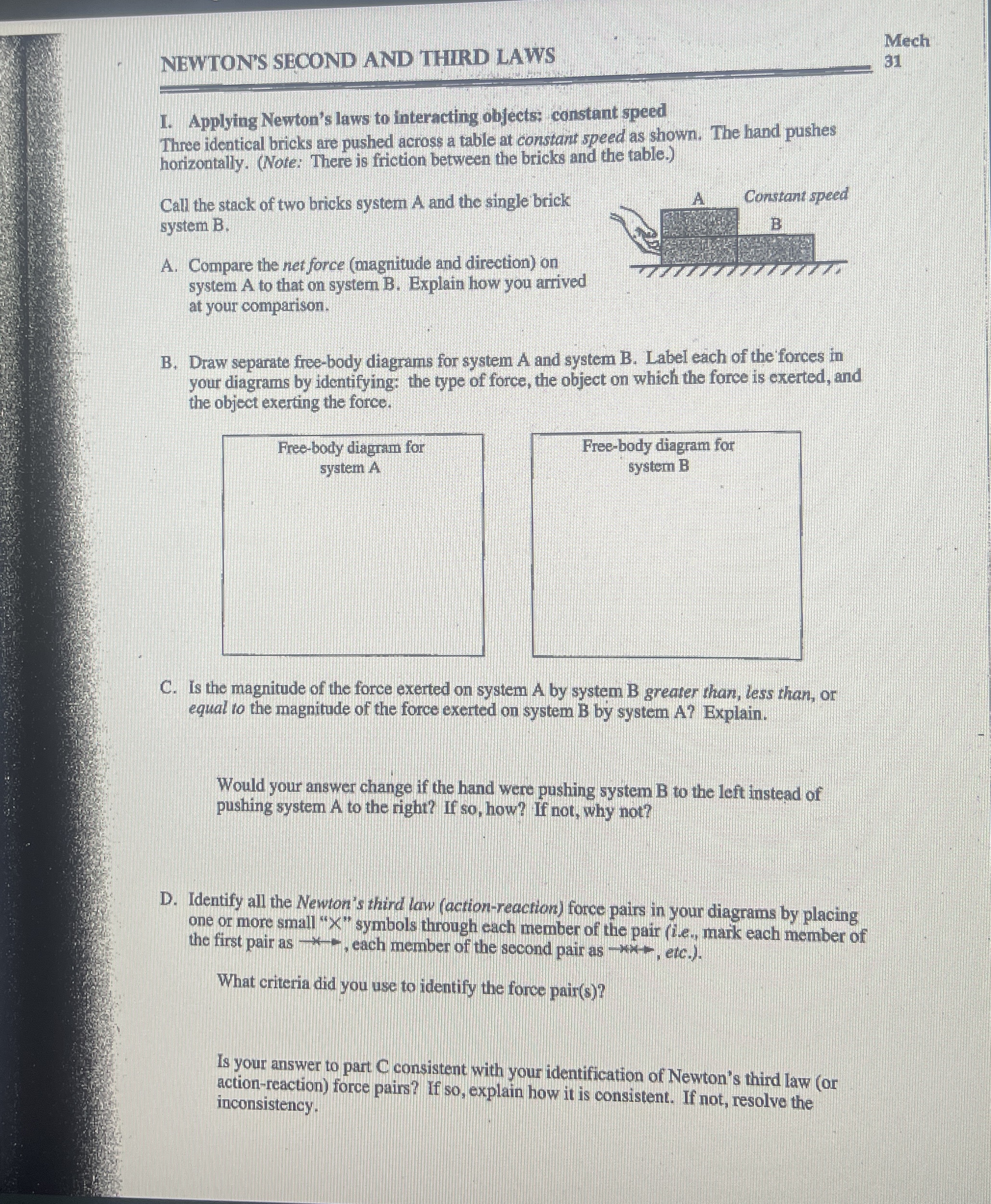
Three identical bricks are pushed across a table at constant speed as shown. The hand pushes horizontally. Note: There is friction between the bricks and the table.
Call the stack of two bricks system A and the single brick system B
A Compare the net force magnitude and direction on system A to that on system B Explain how you arrived at your comparison.
B Draw separate freebody diagrams for system A and system B Label each of the forces in your diagrams by identifying: the type of force, the object on which the force is exerted, and the object exerting the force.
C Is the magnitude of the force exerted on system A by system B greater than, less than, or equal to the magnitude of the force exerted on system B by system A Explain.
Would your answer change if the hand were pushing system B to the left instead of pushing system A to the right? If so how? If not, why not?
D Identify all the Newton's third law actionreaction force pairs in your diagrams by placing one or more small symbols through each member of the pair ie mark each member of the first pair as longrightarrow, each member of the second pair as etc.
What criteria did you use to identify the force pairs
Is your answer to part C consistent with your identification of Newton's thind law or actionreaction force pairs? If so explain how it is consistent. If not, resolve the inconsistency.
Step by Step Solution
There are 3 Steps involved in it
1 Expert Approved Answer
Step: 1 Unlock

Question Has Been Solved by an Expert!
Get step-by-step solutions from verified subject matter experts
Step: 2 Unlock
Step: 3 Unlock
 Study Help