







Question: NO COPIED ANSWER PLEASE! 1. What does Bill need to do to satisfy Harriets request and change from being a reactive sales manager to a
NO COPIED ANSWER PLEASE!
1. What does Bill need to do to satisfy Harriets request and change from being a reactive sales manager to a proactive sales manager?
2. What metrics should he start collecting and analyzing? Be very specific here.
3. What other organizational departments might have existing data to help Bill set up some metrics? What types of data might they have?
4. How do you think the sales force is going to feel about the new metrics?
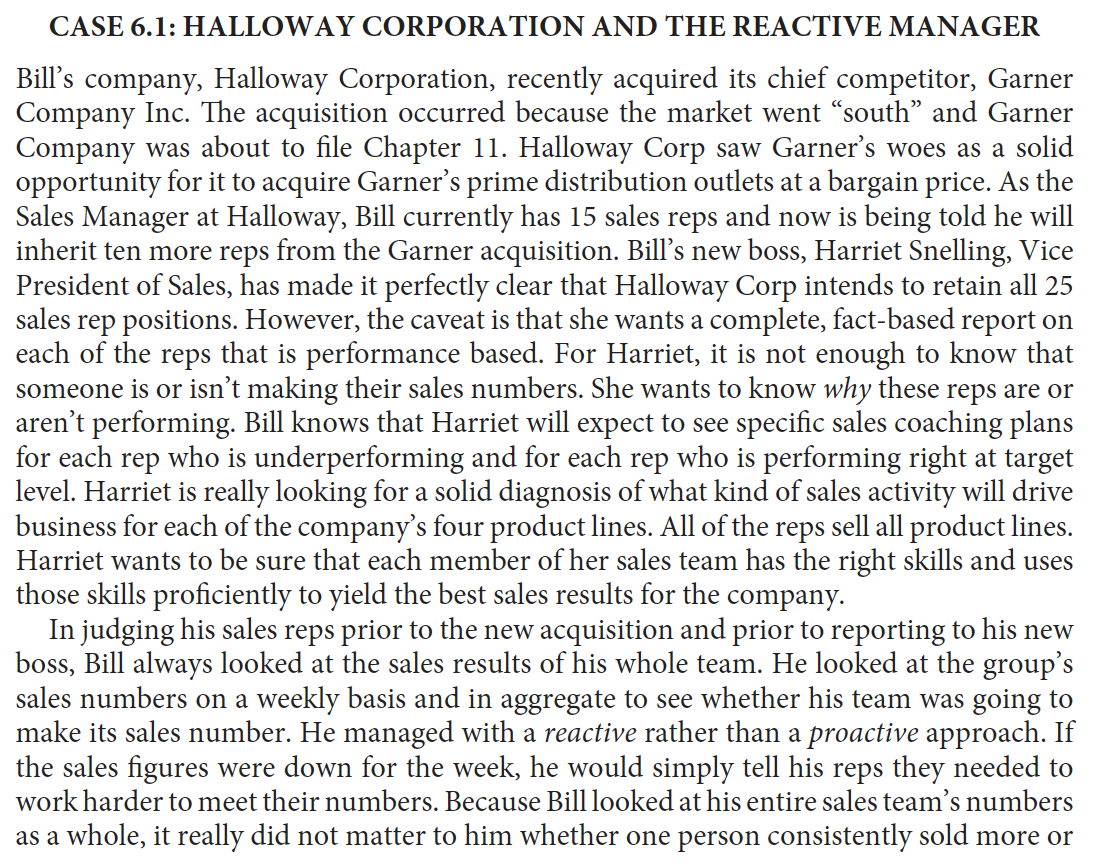
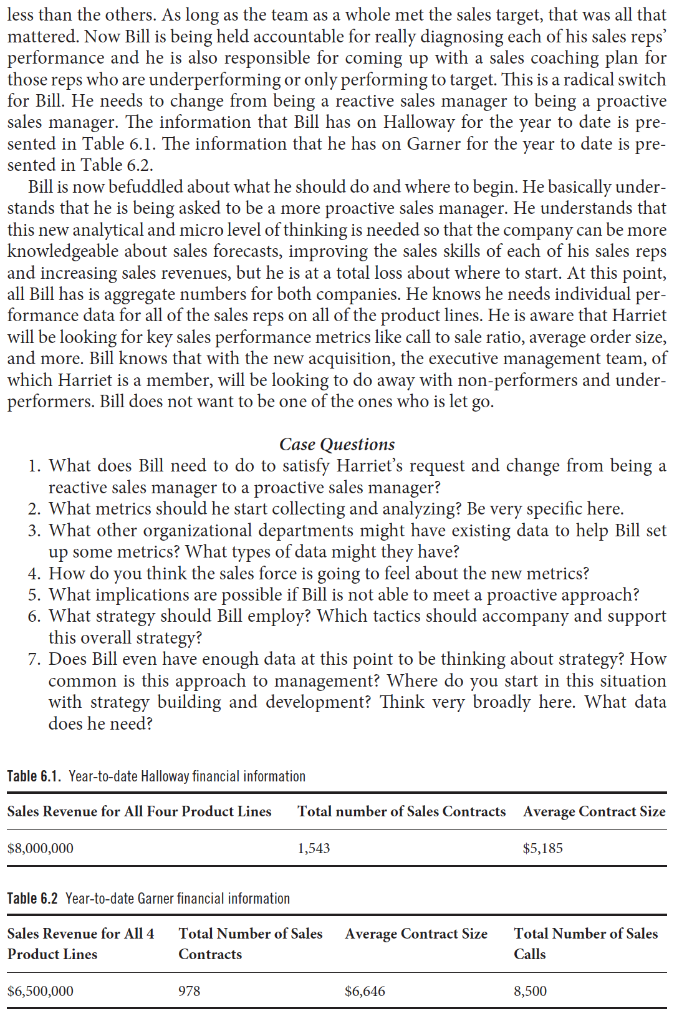
CASE 6.1: HALLOWAY CORPORATION AND THE REACTIVE MANAGER Bill's company, Halloway Corporation, recently acquired its chief competitor, Garner Company Inc. The acquisition occurred because the market went south and Garner Company was about to file Chapter 11. Halloway Corp saw Garner's woes as a solid opportunity for it to acquire Garner's prime distribution outlets at a bargain price. As the Sales Manager at Halloway, Bill currently has 15 sales reps and now is being told he will inherit ten more reps from the Garner acquisition. Bill's new boss, Harriet Snelling, Vice President of Sales, has made it perfectly clear that Halloway Corp intends to retain all 25 sales rep positions. However, the caveat is that she wants a complete, fact-based report on each of the reps that is performance based. For Harriet, it is not enough to know that someone is or isn't making their sales numbers. She wants to know why these reps are or aren't performing. Bill knows that Harriet will expect to see specific sales coaching plans for each rep who is underperforming and for each rep who is performing right at target level. Harriet is really looking for a solid diagnosis of what kind of sales activity will drive business for each of the company's four product lines. All of the reps sell all product lines. Harriet wants to be sure that each member of her sales team has the right skills and uses those skills proficiently to yield the best sales results for the company. In judging his sales reps prior to the new acquisition and prior to reporting to his new boss, Bill always looked at the sales results of his whole team. He looked at the group's sales numbers on a weekly basis and in aggregate to see whether his team was going to make its sales number. He managed with a reactive rather than a proactive approach. If the sales figures were down for the week, he would simply tell his reps they needed to work harder to meet their numbers. Because Bill looked at his entire sales team's numbers as a whole, it really did not matter to him whether one person consistently sold more or less than the others. As long as the team as a whole met the sales target, that was all that mattered. Now Bill is being held accountable for really diagnosing each of his sales reps' performance and he is also responsible for coming up with a sales coaching plan for those reps who are underperforming or only performing to target. This is a radical switch for Bill. He needs to change from being a reactive sales manager to being a proactive sales manager. The information that Bill has on Halloway for the year to date is pre- sented in Table 6.1. The information that he has on Garner for the year to date is pre- sented in Table 6.2. Bill is now befuddled about what he should do and where to begin. He basically under- stands that he is being asked to be a more proactive sales manager. He understands that this new analytical and micro level of thinking is needed so that the company can be more knowledgeable about sales forecasts, improving the sales skills of each of his sales reps and increasing sales revenues, but he is at a total loss about where to start. At this point, all Bill has is aggregate numbers for both companies. He knows he needs individual per- formance data for all of the sales reps on all of the product lines. He is aware that Harriet will be looking for key sales performance metrics like call to sale ratio, average order size, and more. Bill knows that with the new acquisition, the executive management team, of which Harriet is a member, will be looking to do away with non-performers and under- performers. Bill does not want to be one of the ones who is let go. Case Questions 1. What does Bill need to do to satisfy Harriet's request and change from being a reactive sales manager to a proactive sales manager? 2. What metrics should he start collecting and analyzing? Be very specific here. 3. What other organizational departments might have existing data to help Bill set up some metrics? What types of data might they have? 4. How do you think the sales force is going to feel about the new metrics? 5. What implications are possible if Bill is not able to meet a proactive approach? 6. What strategy should Bill employ? Which tactics should accompany and support this overall strategy? 7. Does Bill even have enough data at this point to be thinking about strategy? How common is this approach to management? Where do you start in this situation with strategy building and development? Think very broadly here. What data does he need? Table 6.1. Year-to-date Halloway financial information Sales Revenue for All Four Product Lines Total number of Sales Contracts Average Contract Size $8,000,000 1,543 $5,185 Table 6.2 Year-to-date Garner financial information Sales Revenue for All 4 Product Lines Total Number of Sales Contracts Average Contract Size Total Number of Sales Calls $6,500,000 978 $6,646 8,500Step by Step Solution
There are 3 Steps involved in it
1 Expert Approved Answer
Step: 1 Unlock

Question Has Been Solved by an Expert!
Get step-by-step solutions from verified subject matter experts
Step: 2 Unlock
Step: 3 Unlock
 Study Help