







Question: Noise cancelation We shall now use the LMS algorithm for canceling an additive noise from a signal. Denote by () a signal and () a
Noise cancelation
We shall now use the LMS algorithm for canceling an additive noise from a signal. Denote by () a signal and () a noise. The input
signal is () = () + ().
We will want to build a filter that restores only () from () according to the following configuration The delay is chosen sufficiently large so that the signal noise () and ( ) are uncorrelated.
The output of the adaptive filter is the estimate
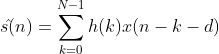
The error signal that is used in optimizing the filter coefficients is () = () ().
Due to the delay , the algorithm for adjusting the coefficients recursively becomes

for 0 1, = 1,2 .
Write in Python a function lmsdelay, which implements this modified algorithm.
Test your function on the following input: 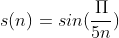
a Gaussian noise with zero mean and standard deviation equals to 0.2 (use the function np.random.normal), = 11, = 1000
Does the computed filter have a linear phase? Numerically draw the of its impulse response with resolution of 200 samples. Is it a low-pass filter, high-pass filter,? Compute the zeros of its -transform.
Step by Step Solution
There are 3 Steps involved in it

Get step-by-step solutions from verified subject matter experts
 Study Help