







Question: Q:1 (a) Define the Fourier's Theorem. (b) What are the Dirichlet conditions? (c) How can we find the convergence of Fourier series at a
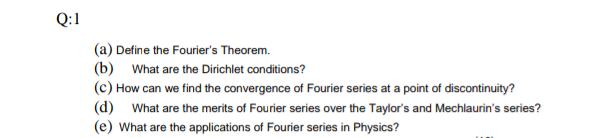
Q:1 (a) Define the Fourier's Theorem. (b) What are the Dirichlet conditions? (c) How can we find the convergence of Fourier series at a point of discontinuity? (d) What are the merits of Fourier series over the Taylor's and Mechlaurin's series? (e) What are the applications of Fourier series in Physics?
Step by Step Solution
There are 3 Steps involved in it
1 Expert Approved Answer
Step: 1 Unlock

Answer a Fourier Theorem The theorem stating that a PERIODIC function fx which is reasonably continuous may be expressed as the sum of a series of sin... View full answer
Question Has Been Solved by an Expert!
Get step-by-step solutions from verified subject matter experts
Step: 2 Unlock
Step: 3 Unlock
 Study Help