







Question: numerical analysis Do question 2, the matrix of the differential equation is shown above in 1 1. (40 points) When discretizing the differential equation =
 numerical analysis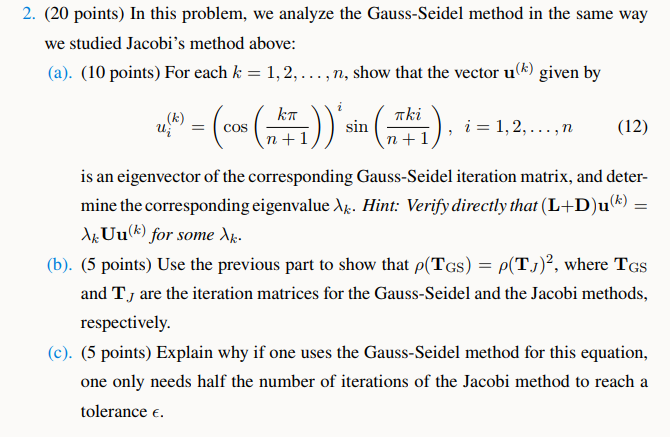
Do question 2, the matrix of the differential equation is shown above in 1
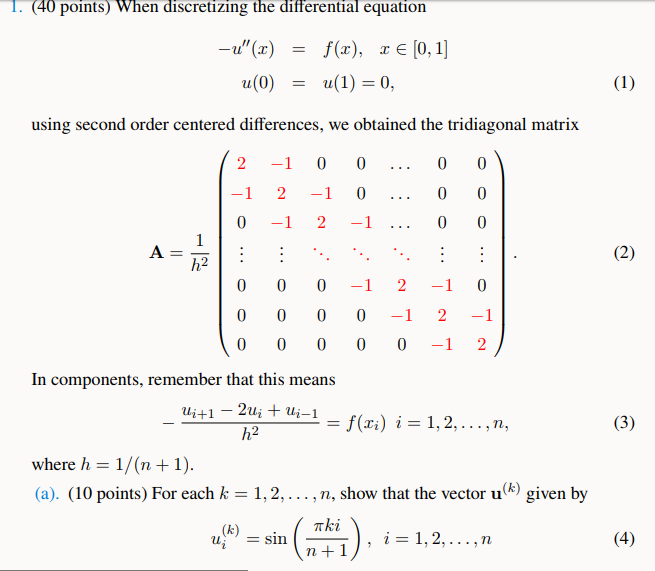
1. (40 points) When discretizing the differential equation = -u" (2) u(0) f(x), re [0,1 u(1) = 0, = (1) using second order centered differences, we obtained the tridiagonal matrix -1 0 0 0 0 N -1 2 -1 0 0 0 -1 2 -1 0 0 A= 1 h2 ... ... ... ... (2) 0 0 0 -1 2 -1 0 0 0 0 0 -1 2 -1 0 0 0 0 0 -1 2 (3) In components, remember that this means Ui+1 - 2u; + wi-1 h2 f(xi) i = 1,2,...,n, where h = 1/(n + 1). (a). (10 points) For each k = 1, 2, ..., n, show that the vector u(k) given by (k) ki u i = 1, 2, ..., n+1 = sin (n+1) (4) 2. (20 points) In this problem, we analyze the Gauss-Seidel method in the same way we studied Jacobi's method above: (a). (10 points) For each k 1,2,..., n, show that the vector u(k) given by (cos ( +1)) sin iki n+1 i=1,2,...,n (12) is an eigenvector of the corresponding Gauss-Seidel iteration matrix, and deter- mine the corresponding eigenvalue lk. Hint: Verify directly that (L+D)u(k) = \Uu(k) for some kk (b). (5 points) Use the previous part to show that p(TGS) = p(T)?, where TGS and T, are the iteration matrices for the Gauss-Seidel and the Jacobi methods, respectively. (c). (5 points) Explain why if one uses the Gauss-Seidel method for this equation, one only needs half the number of iterations of the Jacobi method to reach a tolerance e. 1. (40 points) When discretizing the differential equation = -u" (2) u(0) f(x), re [0,1 u(1) = 0, = (1) using second order centered differences, we obtained the tridiagonal matrix -1 0 0 0 0 N -1 2 -1 0 0 0 -1 2 -1 0 0 A= 1 h2 ... ... ... ... (2) 0 0 0 -1 2 -1 0 0 0 0 0 -1 2 -1 0 0 0 0 0 -1 2 (3) In components, remember that this means Ui+1 - 2u; + wi-1 h2 f(xi) i = 1,2,...,n, where h = 1/(n + 1). (a). (10 points) For each k = 1, 2, ..., n, show that the vector u(k) given by (k) ki u i = 1, 2, ..., n+1 = sin (n+1) (4) 2. (20 points) In this problem, we analyze the Gauss-Seidel method in the same way we studied Jacobi's method above: (a). (10 points) For each k 1,2,..., n, show that the vector u(k) given by (cos ( +1)) sin iki n+1 i=1,2,...,n (12) is an eigenvector of the corresponding Gauss-Seidel iteration matrix, and deter- mine the corresponding eigenvalue lk. Hint: Verify directly that (L+D)u(k) = \Uu(k) for some kk (b). (5 points) Use the previous part to show that p(TGS) = p(T)?, where TGS and T, are the iteration matrices for the Gauss-Seidel and the Jacobi methods, respectively. (c). (5 points) Explain why if one uses the Gauss-Seidel method for this equation, one only needs half the number of iterations of the Jacobi method to reach a tolerance e
Step by Step Solution
There are 3 Steps involved in it

Get step-by-step solutions from verified subject matter experts
 Study Help