







Question: please help me solve all the practice questions in the images! Thank you so much! This is for a calculus class. All are for practice
please help me solve all the practice questions in the images! Thank you so much! This is for a calculus class. All are for practice but I'm just confused and plan on using it for study material! I'm in desperate need of answers to these so please help me! Just do your best to try and read the graphs/tables!
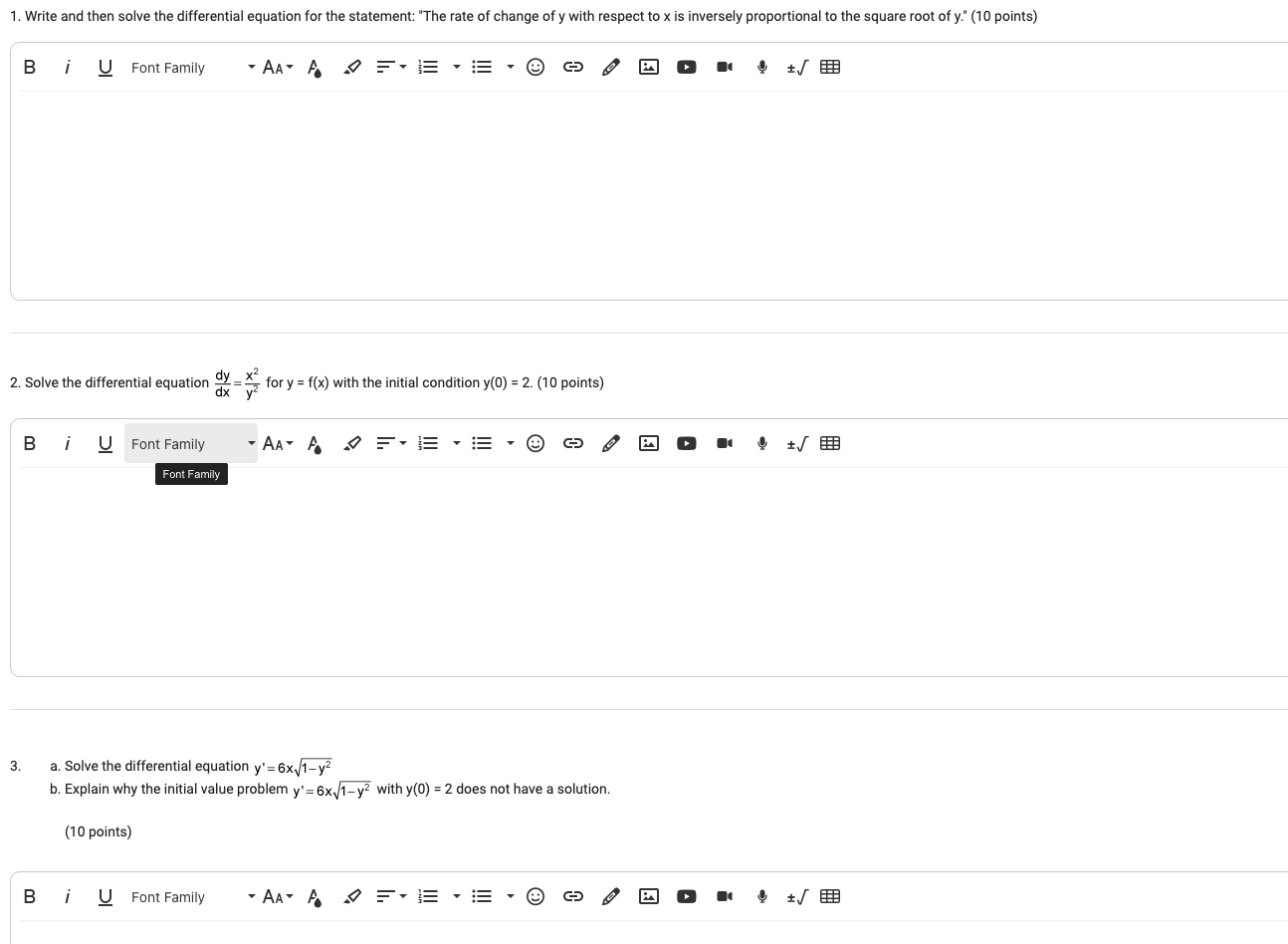
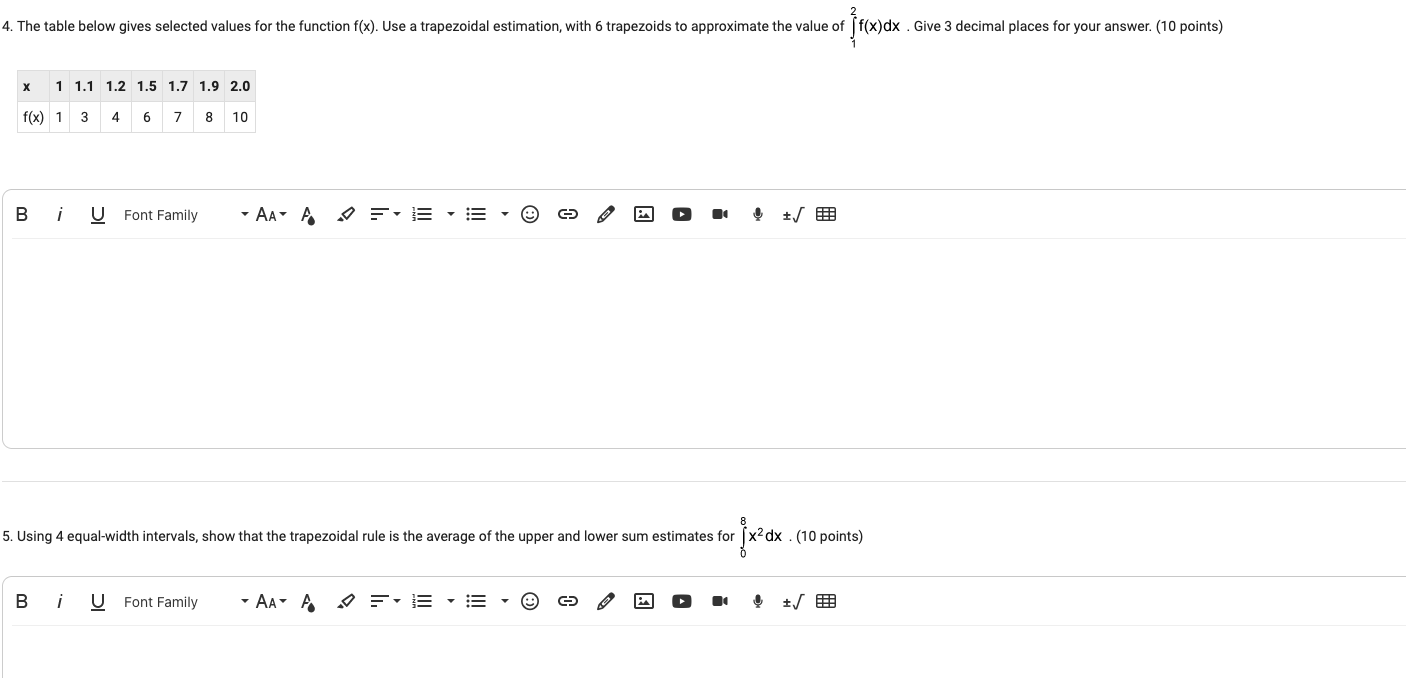
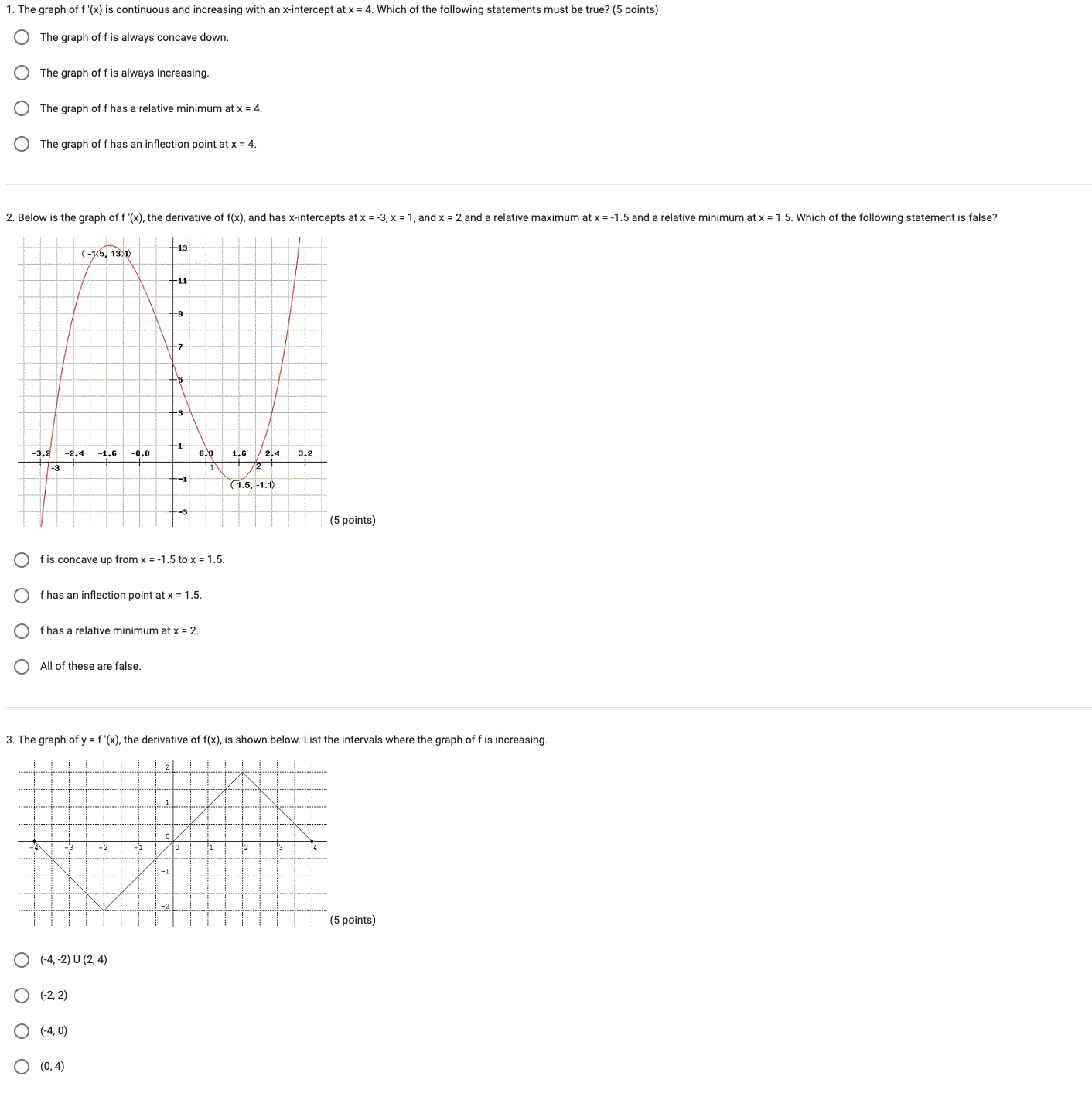

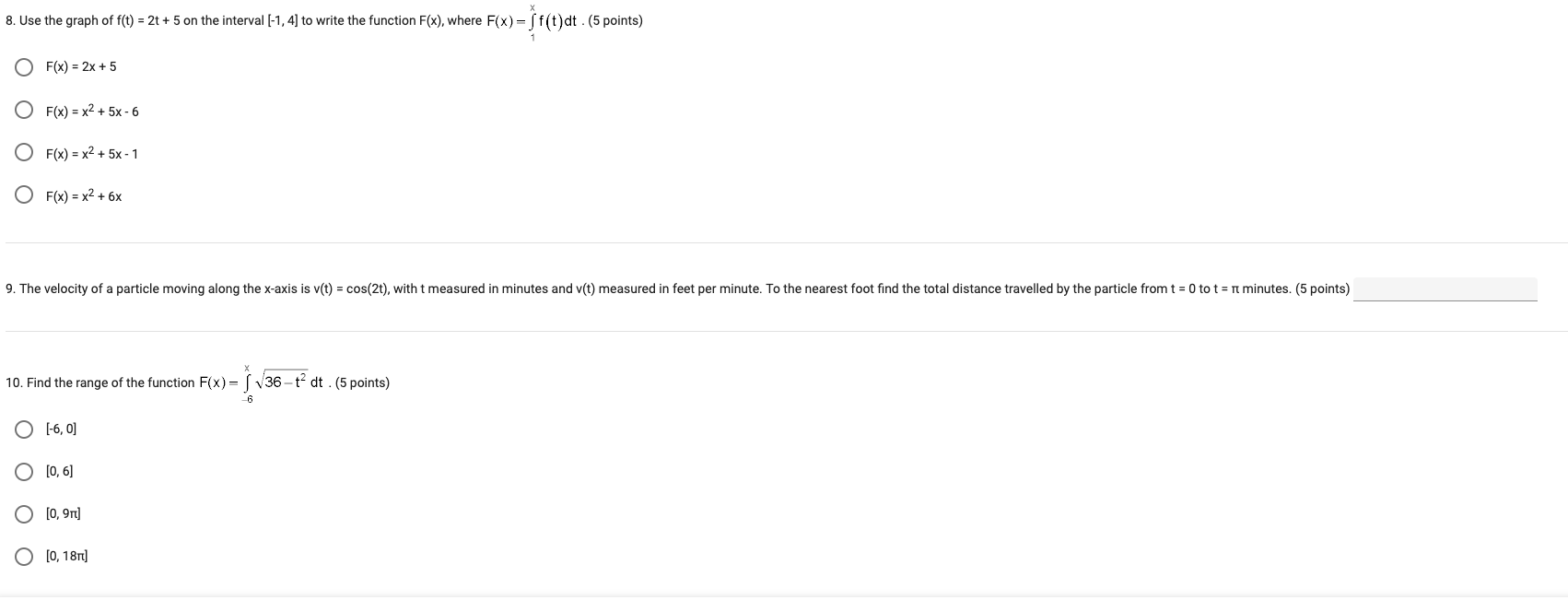
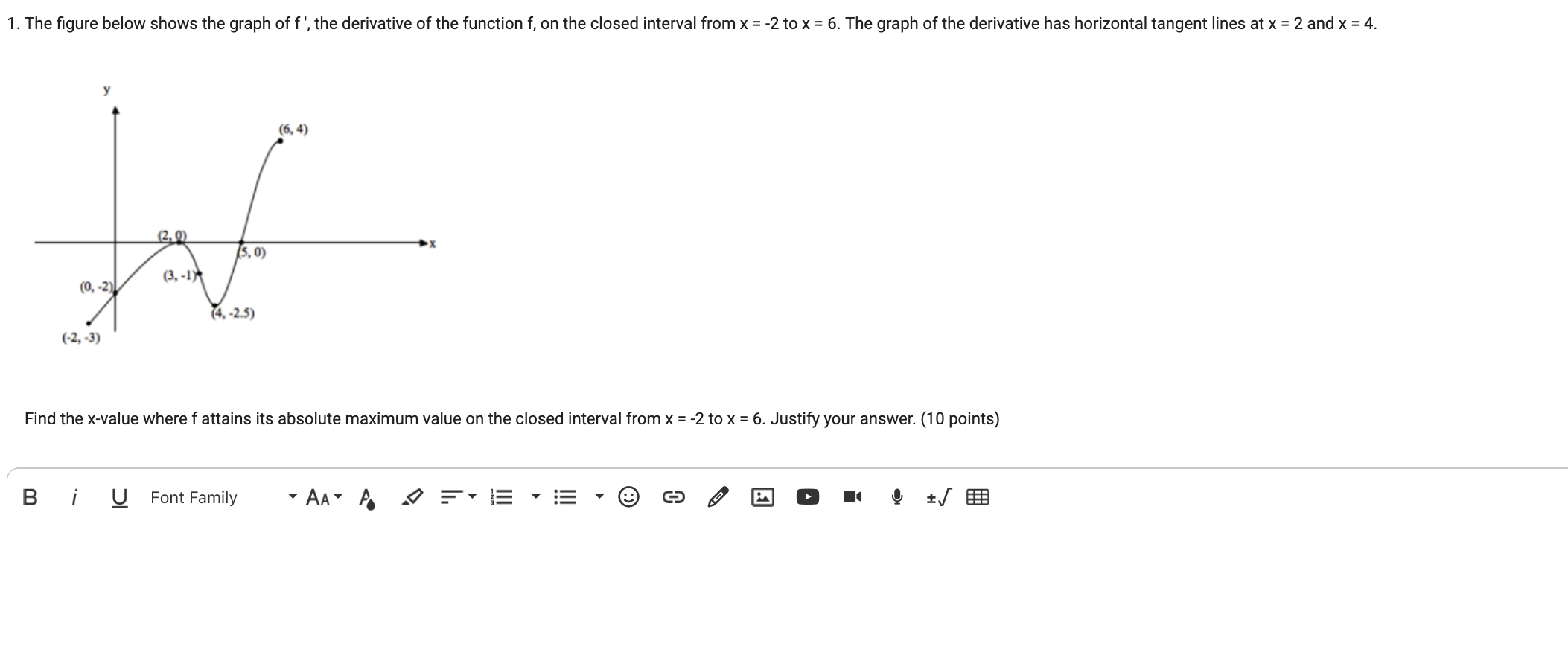
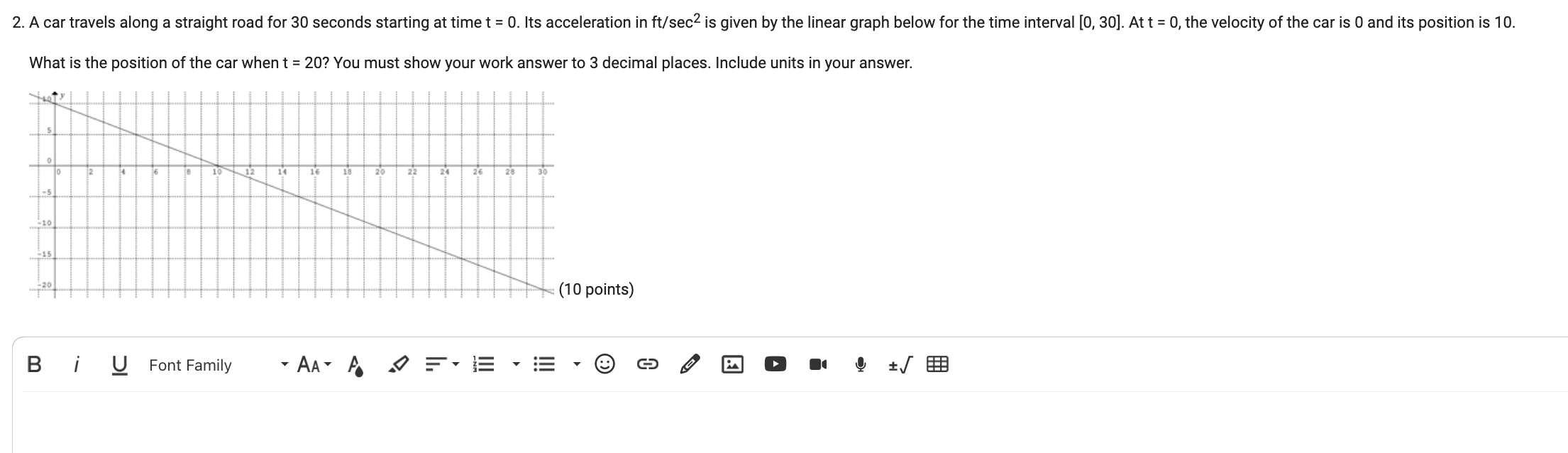
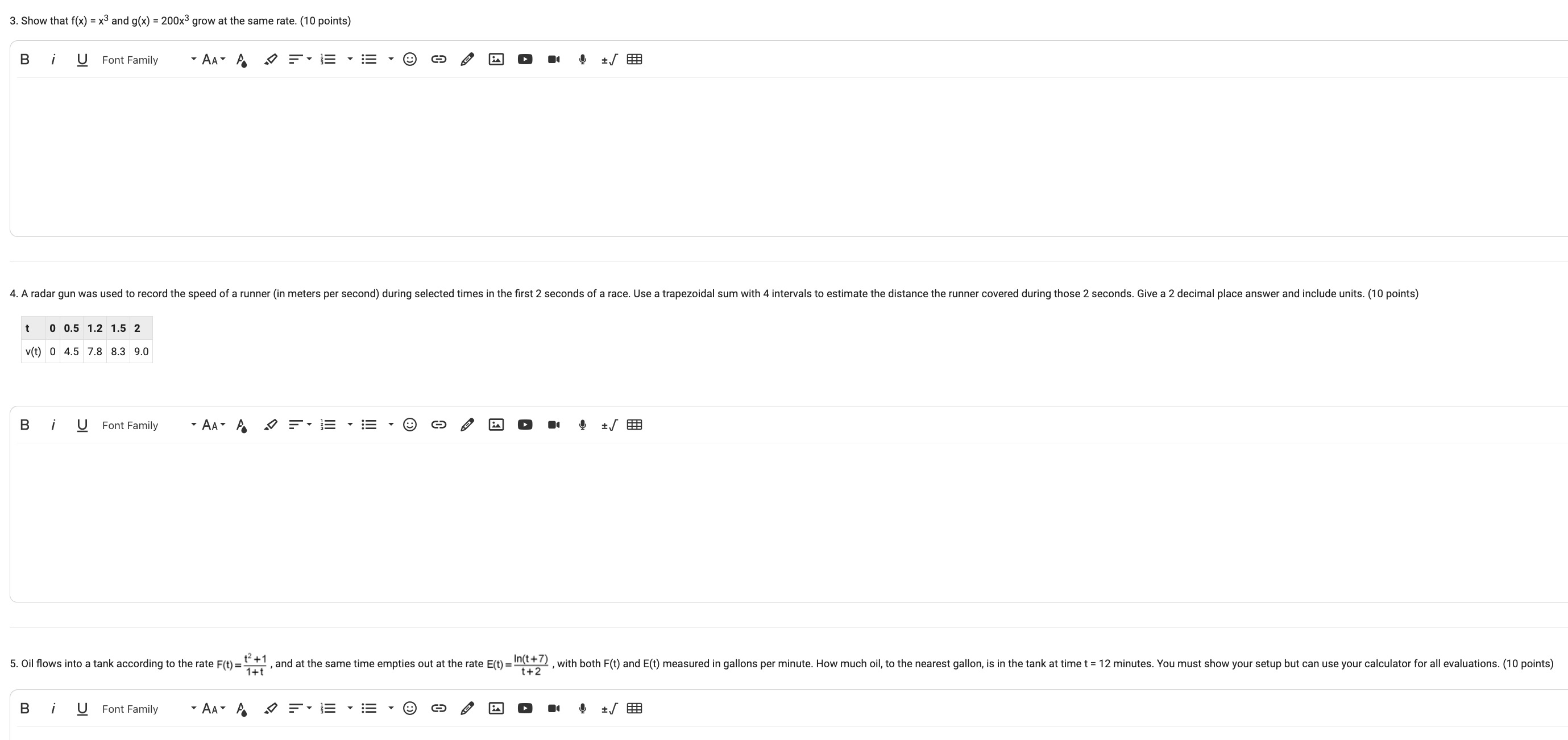
1. Write and then solve the differential equation for the statement: "The rate of change of y with respect to x is inversely proportional to the square root of y." (10 points) B i U Font Family 2. Solve the differential equation dy _ = $ for y = f(x) with the initial condition y(0) = 2. (10 points) B i U Font Family AAA DE EE.GON'VB Font Family 3. a. Solve the differential equation y' = 6x /1-y2 b. Explain why the initial value problem y'= 6x /1-y? with y(0) = 2 does not have a solution. (10 points) B i U Font Family4. The table below gives selected values for the function f(x). Use a trapezoidal estimation, with 6 trapezoids to approximate the value of f(x)dx . Give 3 decimal places for your answer. (10 points) X 1 1.1 1.2 1.5 1.7 1.9 2.0 F(X) 1 3 4 6 7 8 10 B i U Font Family AA DE EE.50 5. Using 4 equal-width intervals, show that the trapezoidal rule is the average of the upper and lower sum estimates for x2dx . (10 points) B i U Font Family1. The graph of f'(x) is continuous and increasing with an x-intercept at x = 4. Which of the following statements must be true? (5 points) The graph of f is always concave down. The graph of f is always increasing. The graph of f has a relative minimum at x = 4. The graph of f has an inflection point at x = 4. 2. Below is the graph of f '(x), the derivative of f(x), and has x-intercepts at x = -3, x = 1, and x = 2 and a relative maximum at x = -1.5 and a relative minimum at x = 1.5. Which of the following statement is false? (-1.5. 13.1) -3.2 -2.4 -1.6 -0.8 8.e 1.6 2.4 3.2 (1.5. -1.1) (5 points) Of is concave up from x = -1.5 to x = 1.5. Of has an inflection point at x = 1.5 Of has a relative minimum at x = 2. All of these are false. 3. The graph of y = f'(x), the derivative of f(x), is shown below. List the intervals where the graph of f is increasing. (5 points ) O (-4, -2) U (2, 4 ) O (-2, 2) O (-4, 0) O (0,4)4. Which of the following functions grows the fastest as x grows without bound? (5 points) Of ( x ) = ex O g(x) = ecosx O They all grow at the same rate. 5. Compare the growth rate of the functions f(x) = log4(x) and g(x) = 4*. (5 points) Of(x) grows faster than g(x). O g(x) grows faster than f(x). O f(x) and g(x) grow at the same rate. It cannot be determined. 6. f is a function that is differentiable for all reals. The value of f '(x) is given for several values of x in the table below. -8 -3 0 3 8 f '(x ) 5 4 0 -2 -4 If f '(x) is always decreasing, which statement about f(x) must be true? (5 points) f(x) has a relative maximum at x = 0. f(x) is concave upwards for all x. O f(x) has a point of inflection at x = 0. f(x) passes through the origin. 7. f is a differentiable function on the interval [0, 1] and g(x) = f(4x). The table below gives values of f '(x). What is the value of g '(0.1)? (5 points) 0.1 0.2 0.3 0.4 0.5 f'(x) 1 2 3 5 O O -4 O O Cannot be determined8. Use the graph of f(t) = 2t + 5 on the interval [-1, 4] to write the function F(x), where F(x) = ff (t)dt . (5 points) F(x) = 2x +5 F(x) = x2 +5x - 6 O F(x) = x2 +5x - 1 OF(x) = x2 +6x 9. The velocity of a particle moving along the x-axis is v(t) = cos(2t), with t measured in minutes and v(t) measured in feet per minute. To the nearest foot find the total distance travelled by the particle from t = 0 to t = it minutes. (5 points) 10. Find the range of the function F(x) = [ v36 -t2 dt . (5 points) O [-6, 0] O [0, 6] [0, 9rt] O [0, 18nt]1. The figure below shows the graph of ', the derivative of the function f, on the closed interval from x = -2 to x = 6. The graph of the derivative has horizontal tangent lines at x = 2 and x = 4. =X 2,-3) Find the x-value where f attains its absolute maximum value on the closed interval from x = -2 to x = 6. Justify your answer. (10 points) B i U FontFamily TAAT A X TiECECQ @ Z B O e 8 /BB 2. Acar travels along a straight road for 30 seconds starting at time t = 0. Its acceleration in ft/sec? is given by the linear graph below for the time interval [0, 30]. At t = 0, the velocity of the car is 0 and its position is 10. What is the position of the car when t = 20? You must show your work answer to 3 decimal places. Include units in your answer. ~- (10 points) B i U Font Family v Ar~ P. QO == O o L @ 0 e 8 i/ B 3. Show that f(x) = x3 and g(x) = 200x3 grow at the same rate. (10 points) B i U Font Family AA DE EE . @GONVB 4. A radar gun was used to record the speed of a runner (in meters per second) during selected times in the first 2 seconds of a race. Use a trapezoidal sum with 4 intervals to estimate the distance the runner covered during those 2 seconds. Give a 2 decimal place answer and include units. (10 points) t 0 0.5 1.2 1.5 2 v(t) 0 4.5 7.8 8.3 9.0 B i U Font Family AA A 5. Oil flows into a tank according to the rate F(t) = _ , and at the same time empties out at the rate E(t) = In , with both F(t) and E(t) measured in gallons per minute. How much oil, to the nearest gallon, is in the tank at time t = 12 minutes. You must show your setup but can use your calculator for all evaluations. (10 points) B i U Font Family
Step by Step Solution
There are 3 Steps involved in it

Get step-by-step solutions from verified subject matter experts
 Study Help