







Question: O M Question 15 M Question 14 M Question 12 QIn general, X-raX A diffraction g X D2L Lab 12 Resona X https://d2l.lonestar.edu/d2l/le/content/1354032/viewContent/24558662/Vi... 2
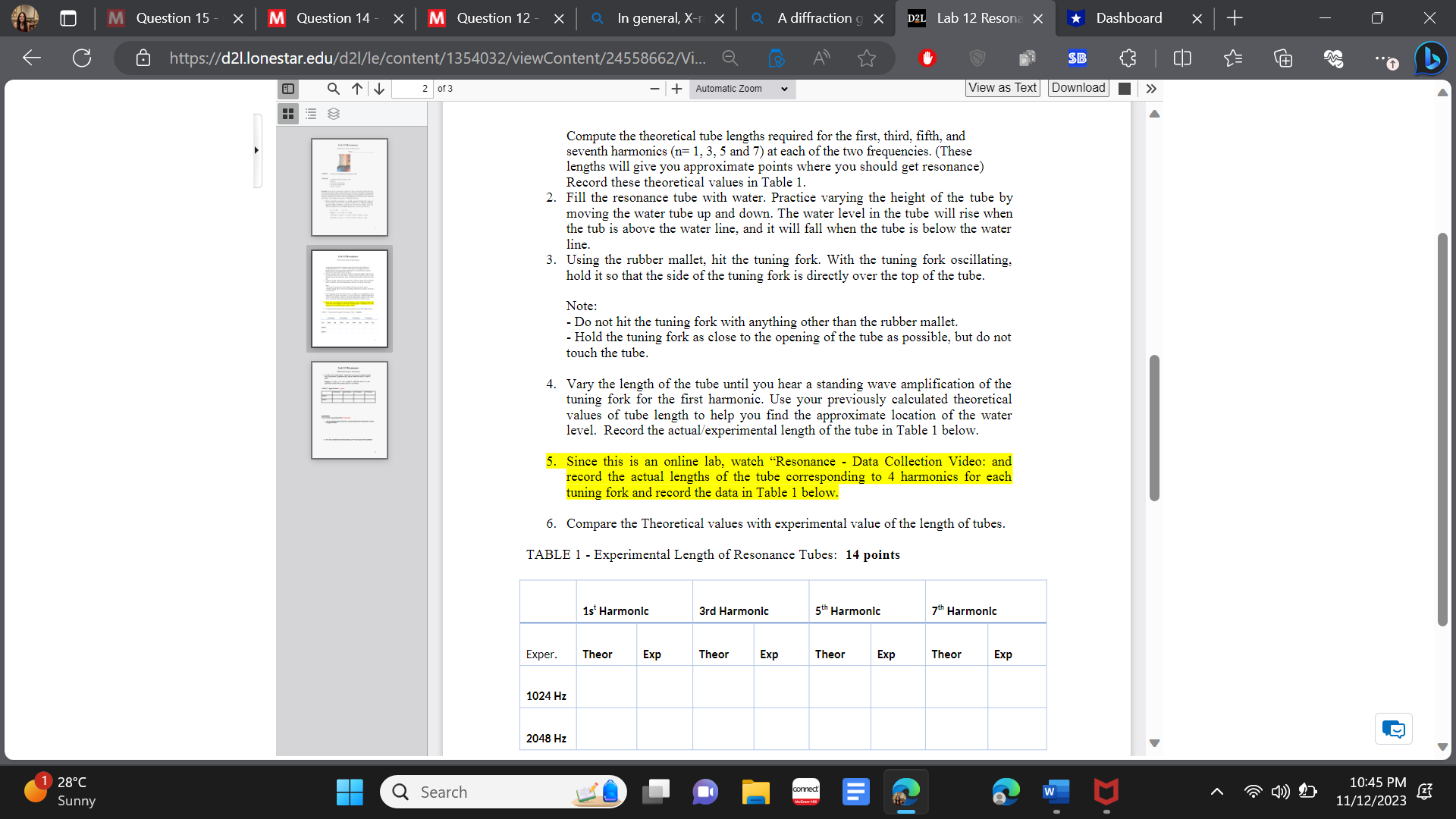
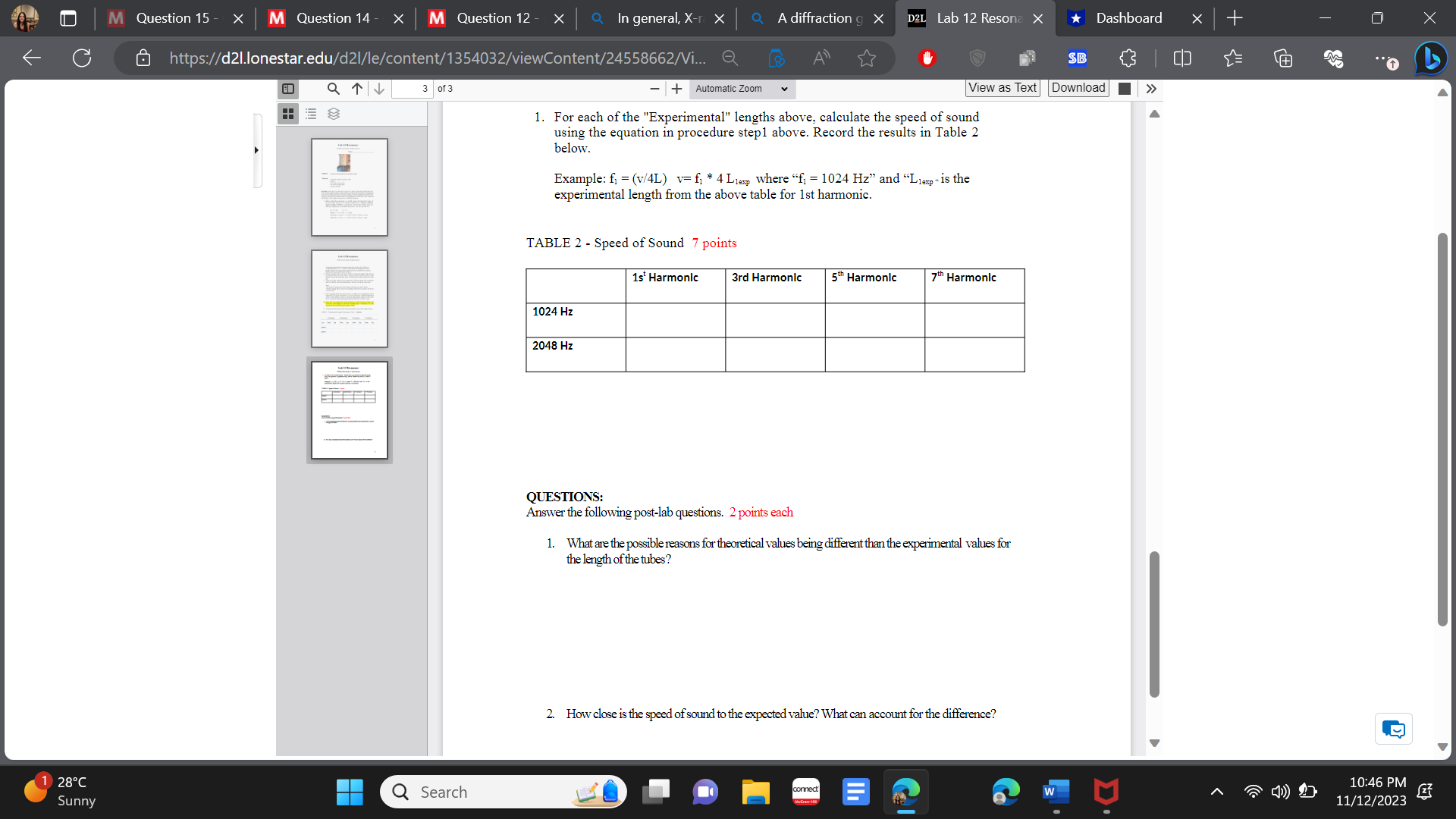
O M Question 15 M Question 14 M Question 12 QIn general, X-raX A diffraction g X D2L Lab 12 Resona X https://d2l.lonestar.edu/d2l/le/content/1354032/viewContent/24558662/Vi... 2 of 3 + Automatic Zoom 1 28C Q Search Sunny Dashboard SB View as Text Download >>> Compute the theoretical tube lengths required for the first, third, fifth, and seventh harmonics (n= 1, 3, 5 and 7) at each of the two frequencies. (These lengths will give you approximate points where you should get resonance) Record these theoretical values in Table 1. 2. Fill the resonance tube with water. Practice varying the height of the tube by moving the water tube up and down. The water level in the tube will rise when the tub is above the water line, and it will fall when the tube is below the water line. 3. Using the rubber mallet, hit the tuning fork. With the tuning fork oscillating, hold it so that the side of the tuning fork is directly over the top of the tube. Note: - Do not hit the tuning fork with anything other than the rubber mallet. - Hold the tuning fork as close to the opening of the tube as possible, but do not touch the tube. 4. Vary the length of the tube until you hear a standing wave amplification of the tuning fork for the first harmonic. Use your previously calculated theoretical values of tube length to help you find the approximate location of the water level. Record the actual/experimental length of the tube in Table 1 below. 5. Since this is an online lab, watch "Resonance - Data Collection Video: and record the actual lengths of the tube corresponding to 4 harmonics for each tuning fork and record the data in Table 1 below. 6. Compare the Theoretical values with experimental value of the length of tubes. TABLE 1 - Experimental Length of Resonance Tubes: 14 points 1st Harmonic 3rd Harmonic 5th Harmonic 7th Harmonic Exper. Theor Exp Theor Exp Theor Exp Theor Exp 1024 Hz 2048 Hz connect W D. + {" + 10:45 PM 11/12/2023 O M Question 15 M Question 14 M Question 12 QIn general, X-rax A diffraction g X D2L Lab 12 Resona X Dashboard SB View as Text Download >>> https://d2l.lonestar.edu/d2l/le/content/1354032/viewContent/24558662/Vi... Q 3 of 3 - + Automatic Zoom 1. For each of the "Experimental" lengths above, calculate the speed of sound using the equation in procedure step1 above. Record the results in Table 2 below. Example: f = (v/4L) v=f * 4 Llexp where "f = 1024 Hz" and "Llexp" is the experimental length from the above table for 1st harmonic. TABLE 2 - Speed of Sound 7 points 1 28C Q Search Sunny 1024 Hz 2048 Hz 1st Harmonic 3rd Harmonic 5th Harmonic 7th Harmonic QUESTIONS: Answer the following post-lab questions. 2 points each 1. What are the possible reasons for theoretical values being different than the experimental values for the length of the tubes? 2. How close is the speed of sound to the expected value? What can account for the difference? connect W D. + {" + 10:46 PM 11/12/2023
Step by Step Solution
There are 3 Steps involved in it

Get step-by-step solutions from verified subject matter experts
 Study Help