







Question: Objective This assignment will involve practice with characters and strings, using the libraries discussed in class (String, StringBuilder, Character), as well as basic File I/O
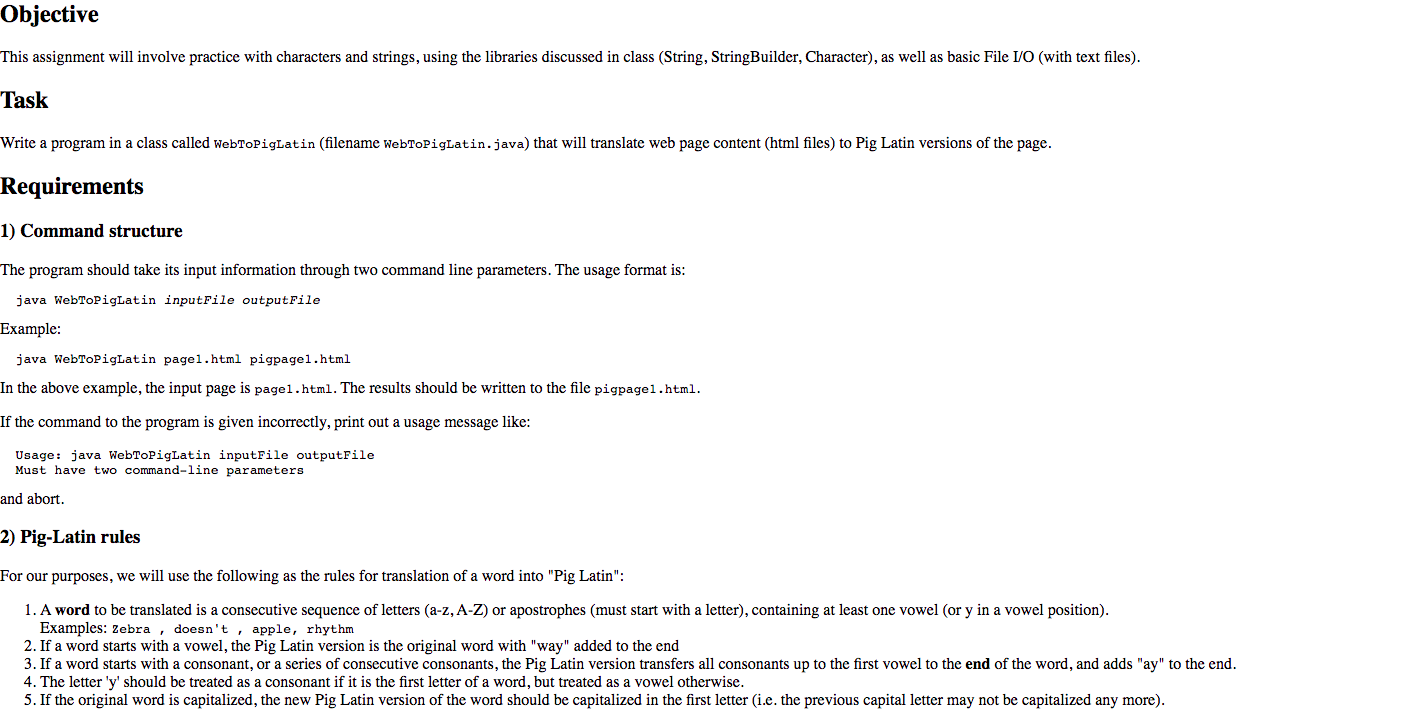
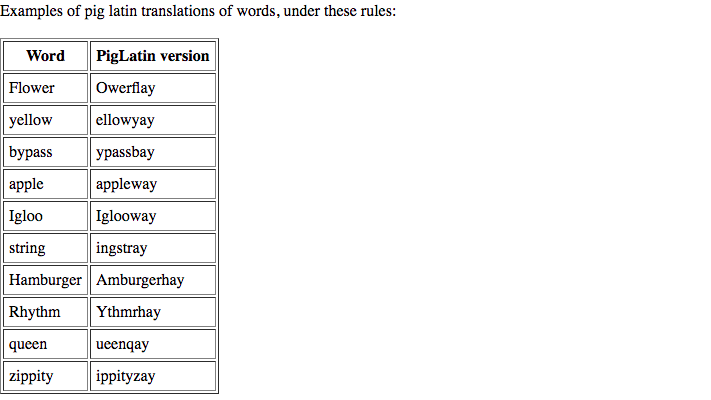
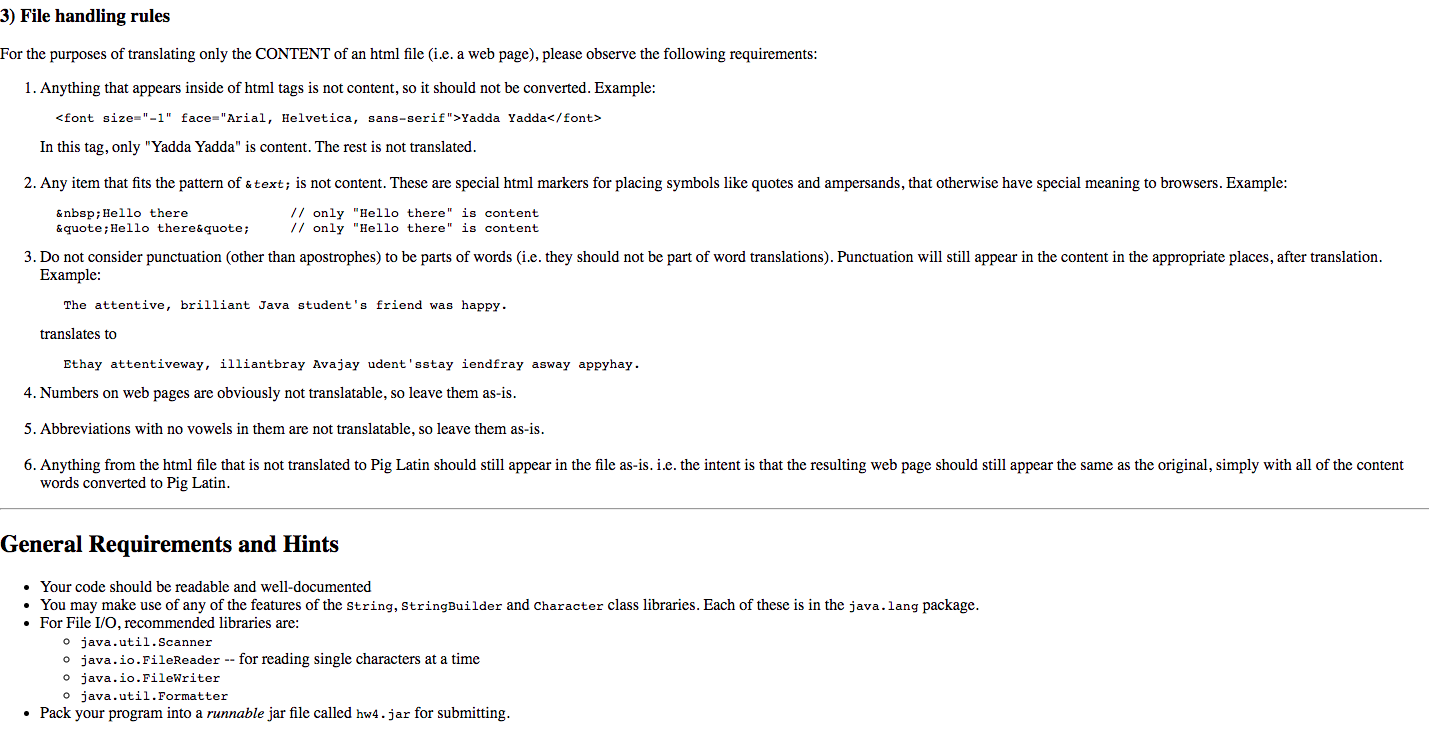
Objective This assignment will involve practice with characters and strings, using the libraries discussed in class (String, StringBuilder, Character), as well as basic File I/O (with text files). Task Write a program in a class called WebToPigLatin (filename WebToPiglatin.java) that will translate web page content (html files) to Pig Latin versions of the page. Requirements 1) Command structure The program should take its input information through two command line parameters. The usage format is: java WebToPigLatin inputFile outputFile Example: java WebToPigLatin pagel.html pigpagel.html In the above example, the input page is pagel.html. The results should be written to the file pigpagel.html. If the command to the program is given incorrectly, print out a usage message like: Usage: java WebToPigLatin inputFile outputFile Must have two command-line parameters and abort. 2) Pig-Latin rules For our purposes, we will use the following as the rules for translation of a word into "Pig Latin": 1. A word to be translated a consecutive sequence of letters (a-z, A-Z) or apostrophes (must start with a letter), containing at least one vowel (or y in a vowel position). Examples: Zebra , doesn't , apple, rhythm 2. If a word starts with a vowel, the Pig Latin version is the original word with "way" added to the end 3. If a word starts with a consonant, or a series of consecutive consonants, the Pig Latin version transfers all consonants up to the first vowel to the end of the word, and adds "ay" to the end. 4. The letter 'y' should be treated as a consonant if it is the first letter of a word, but treated as a vowel otherwise. 5. If the original word is capitalized, the new Pig Latin version of the word should be capitalized in the first letter (i.e. the previous capital letter may not be capitalized any more). Examples of pig latin translations of words, under these rules: Word PigLatin version Flower Owerflay yellow ellowyay bypass ypassbay apple appleway Igloo Iglooway string ingstray Hamburger Amburgerhay Rhythm Ythmrhay queen zippity ueenqay ippityzay 3) File handling rules For the purposes of translating only the CONTENT of an html file (i.e. a web page), please observe the following requirements: 1. Anything that appears inside of html tags is not content, so it should not be converted. Example: Yadda Yadda In this tag, only "Yadda Yadda" is content. The rest is not translated. 2. Any item that fits the pattern of &text; is not content. These are special html markers for placing symbols like quotes and ampersands, that otherwise have special meaning to browsers. Example: Hello there // only "Hello there" is content "e; Hello there"e; // only "Hello there" is content 3. Do not consider punctuation (other than apostrophes) to be parts of words (i.e. they should not be part of word translations). Punctuation will still appear in the content in the appropriate places, after translation. Example: The attentive, brilliant Java student's friend was happy. translates to Ethay attentiveway, illiantbray Avajay udent'sstay iendfray asway appyhay. 4. Numbers on web pages are obviously not translatable, so leave them as-is. 5. Abbreviations with no vowels in them are not translatable, so leave them as-is. 6. Anything from the html file that is not translated to Pig Latin should still appear in the file as-is. i.e. the intent is that the resulting web page should still appear the same as the original, simply with all of the content words converted to Pig Latin. General Requirements and Hints Your code should be readable and well-documented You may make use of any of the features of the string, StringBuilder and character class libraries. Each of these is in the java.lang package. For File I/O, recommended libraries are: o java.util.Scanner o java.io.FileReader -- for reading single characters at a time o java.io.FileWriter o java.util.Formatter Pack your program into a runnable jar file called hw4.jar for submitting. Objective This assignment will involve practice with characters and strings, using the libraries discussed in class (String, StringBuilder, Character), as well as basic File I/O (with text files). Task Write a program in a class called WebToPigLatin (filename WebToPiglatin.java) that will translate web page content (html files) to Pig Latin versions of the page. Requirements 1) Command structure The program should take its input information through two command line parameters. The usage format is: java WebToPigLatin inputFile outputFile Example: java WebToPigLatin pagel.html pigpagel.html In the above example, the input page is pagel.html. The results should be written to the file pigpagel.html. If the command to the program is given incorrectly, print out a usage message like: Usage: java WebToPigLatin inputFile outputFile Must have two command-line parameters and abort. 2) Pig-Latin rules For our purposes, we will use the following as the rules for translation of a word into "Pig Latin": 1. A word to be translated a consecutive sequence of letters (a-z, A-Z) or apostrophes (must start with a letter), containing at least one vowel (or y in a vowel position). Examples: Zebra , doesn't , apple, rhythm 2. If a word starts with a vowel, the Pig Latin version is the original word with "way" added to the end 3. If a word starts with a consonant, or a series of consecutive consonants, the Pig Latin version transfers all consonants up to the first vowel to the end of the word, and adds "ay" to the end. 4. The letter 'y' should be treated as a consonant if it is the first letter of a word, but treated as a vowel otherwise. 5. If the original word is capitalized, the new Pig Latin version of the word should be capitalized in the first letter (i.e. the previous capital letter may not be capitalized any more). Examples of pig latin translations of words, under these rules: Word PigLatin version Flower Owerflay yellow ellowyay bypass ypassbay apple appleway Igloo Iglooway string ingstray Hamburger Amburgerhay Rhythm Ythmrhay queen zippity ueenqay ippityzay 3) File handling rules For the purposes of translating only the CONTENT of an html file (i.e. a web page), please observe the following requirements: 1. Anything that appears inside of html tags is not content, so it should not be converted. Example: Yadda Yadda In this tag, only "Yadda Yadda" is content. The rest is not translated. 2. Any item that fits the pattern of &text; is not content. These are special html markers for placing symbols like quotes and ampersands, that otherwise have special meaning to browsers. Example: Hello there // only "Hello there" is content "e; Hello there"e; // only "Hello there" is content 3. Do not consider punctuation (other than apostrophes) to be parts of words (i.e. they should not be part of word translations). Punctuation will still appear in the content in the appropriate places, after translation. Example: The attentive, brilliant Java student's friend was happy. translates to Ethay attentiveway, illiantbray Avajay udent'sstay iendfray asway appyhay. 4. Numbers on web pages are obviously not translatable, so leave them as-is. 5. Abbreviations with no vowels in them are not translatable, so leave them as-is. 6. Anything from the html file that is not translated to Pig Latin should still appear in the file as-is. i.e. the intent is that the resulting web page should still appear the same as the original, simply with all of the content words converted to Pig Latin. General Requirements and Hints Your code should be readable and well-documented You may make use of any of the features of the string, StringBuilder and character class libraries. Each of these is in the java.lang package. For File I/O, recommended libraries are: o java.util.Scanner o java.io.FileReader -- for reading single characters at a time o java.io.FileWriter o java.util.Formatter Pack your program into a runnable jar file called hw4.jar for submitting
Step by Step Solution
There are 3 Steps involved in it

Get step-by-step solutions from verified subject matter experts
 Study Help