



Question: Okay so i need to solve this from the general equation Na(flux) not avagadros number Na = (Na+Nb)ya -DabC(dCa/dx) because of distatnace C is concentration.
Okay so i need to solve this from the general equation
Na(flux) not avagadros number
Na = (Na+Nb)ya -DabC(dCa/dx) because of distatnace
C is concentration. I need to solve this so please written example so I can follow not typed. And Please no written paragraph. I need help.
The bottom solution is give without steps and use log mean but we are not supposed to use log mean to solve this.
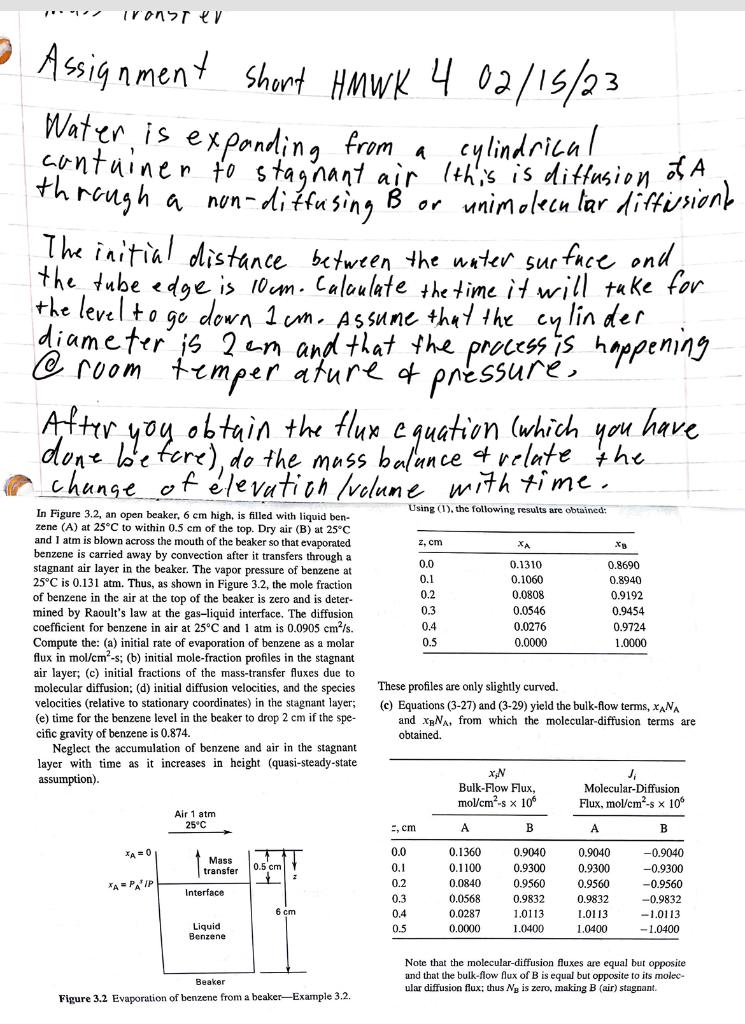
Assignment shont HMWK 402/15/23 Water is expanding from a cylindrical cantuinen to stagnant air lthis is dittusion of A through a nun-diffusing B or unimolecular diffissiont The initial distance between the unter surfuce ond the tube edge is 10cm. Calaulate thetime it will take for the levelto ge down 1cm. Assume that the cylinder diameter is 2cm and that the process is happening (2) room tiemper ature of pressure, After yoy obtain the flux equation (which you have done loetcre), do the mass balunce of relate the change of elevation lvalume with time. In Figure 3.2, an open beaker, 6cm high, is filled with liquid ben- Using (1), the following results are obtained: zene (A) at 25C to within 0.5cm of the top. Dry air (B) at 25C and 1atm is blown across the mouth of the beaker so that evaporated benzene is carried away by convection after it transfers through a stagnant air layer in the beaker. The vapor pressure of benzene at 25C is 0.131 atm. Thus, as shown in Figure 3.2, the mole fraction of benzene in the air at the top of the beaker is zero and is determined by Raoult's law at the gas-liquid interface. The diffusion coefficient for benzene in air at 25C and 1atm is 0.0905cm2/s. Compute the: (a) initial rate of evaporation of benzene as a molar flux in mol/cm2s; (b) initial mole-fraction profiles in the stagnant air layer; (c) initial fractions of the mass-transfer fluxes due to molecular diffusion; (d) initial diffusion velocities, and the species These profiles are only slightly curved. velocities (relative to stationary coordinates) in the stagnant layer; (c) Equations (3-27) and (3-29) yield the bulk-flow terms, xANA (e) time for the benzene level in the beaker to drop 2cm if the specific gravity of benzene is 0.874. Neglect the accumulation of benzene and air in the stagnant layer with time as it increases in height (quasi-steady-state assumption). Note that the molecular-diffusion fluxes are equal but opposite and that the bulk-flow fux of B is equal but opposite to its molecular diffusion flux; thus NB is zero, making B (air) stagnant. Figure 3.2 Evaporation of benzene from a beaker-Example 3.2. Assignment shont HMWK 402/15/23 Water is expanding from a cylindrical cantuinen to stagnant air lthis is dittusion of A through a nun-diffusing B or unimolecular diffissiont The initial distance between the unter surfuce ond the tube edge is 10cm. Calaulate thetime it will take for the levelto ge down 1cm. Assume that the cylinder diameter is 2cm and that the process is happening (2) room tiemper ature of pressure, After yoy obtain the flux equation (which you have done loetcre), do the mass balunce of relate the change of elevation lvalume with time. In Figure 3.2, an open beaker, 6cm high, is filled with liquid ben- Using (1), the following results are obtained: zene (A) at 25C to within 0.5cm of the top. Dry air (B) at 25C and 1atm is blown across the mouth of the beaker so that evaporated benzene is carried away by convection after it transfers through a stagnant air layer in the beaker. The vapor pressure of benzene at 25C is 0.131 atm. Thus, as shown in Figure 3.2, the mole fraction of benzene in the air at the top of the beaker is zero and is determined by Raoult's law at the gas-liquid interface. The diffusion coefficient for benzene in air at 25C and 1atm is 0.0905cm2/s. Compute the: (a) initial rate of evaporation of benzene as a molar flux in mol/cm2s; (b) initial mole-fraction profiles in the stagnant air layer; (c) initial fractions of the mass-transfer fluxes due to molecular diffusion; (d) initial diffusion velocities, and the species These profiles are only slightly curved. velocities (relative to stationary coordinates) in the stagnant layer; (c) Equations (3-27) and (3-29) yield the bulk-flow terms, xANA (e) time for the benzene level in the beaker to drop 2cm if the specific gravity of benzene is 0.874. Neglect the accumulation of benzene and air in the stagnant layer with time as it increases in height (quasi-steady-state assumption). Note that the molecular-diffusion fluxes are equal but opposite and that the bulk-flow fux of B is equal but opposite to its molecular diffusion flux; thus NB is zero, making B (air) stagnant. Figure 3.2 Evaporation of benzene from a beaker-Example 3.2
Step by Step Solution
There are 3 Steps involved in it

Get step-by-step solutions from verified subject matter experts