Question: Old MathJax webview explain these ponits in detail from union point of view in wally janitorial services case study from wally janitorial services case study(
Old MathJax webview
explain these ponits in detail from union point of view in wally janitorial services case study
from wally janitorial services case study( collective bargaining simulation : wally's janitorial services)
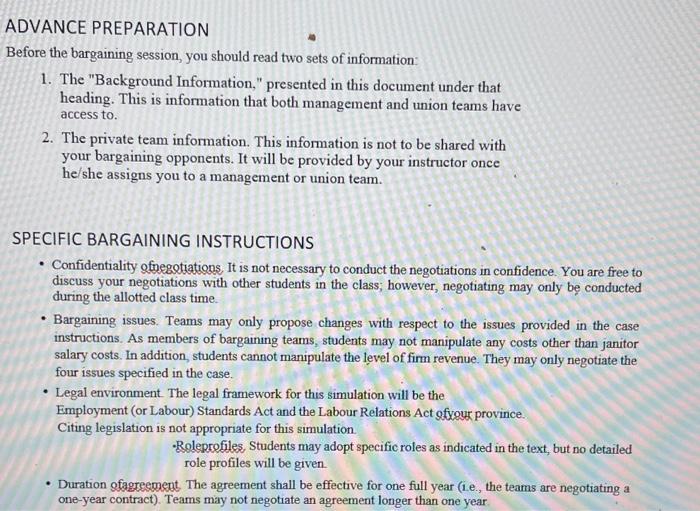
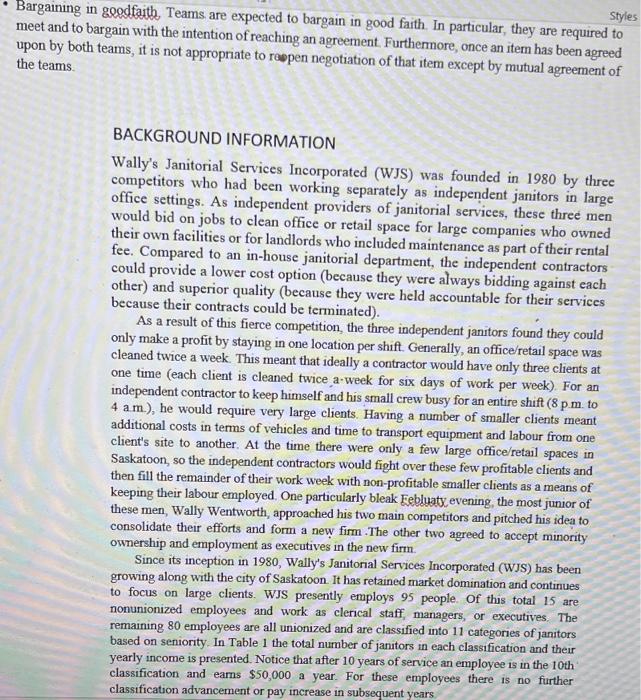
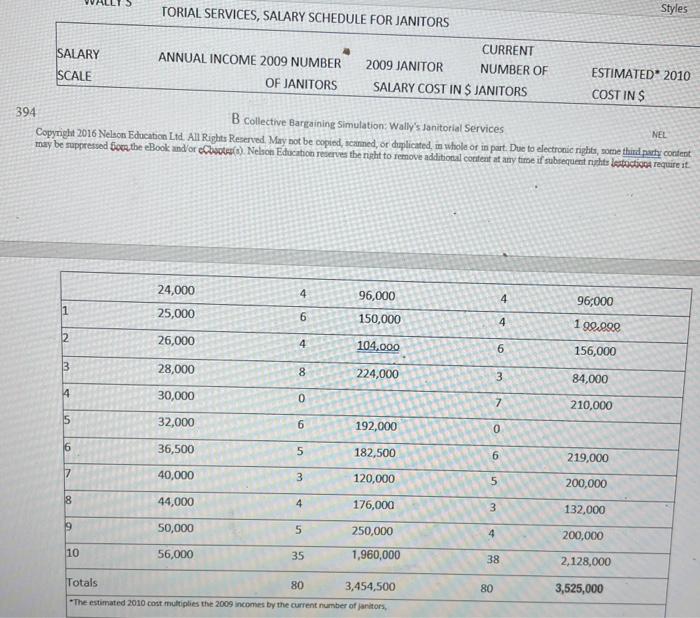
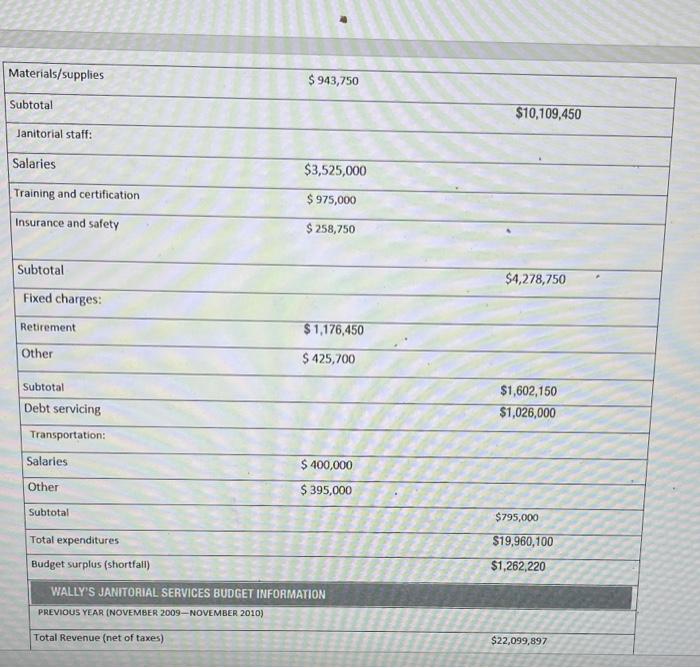
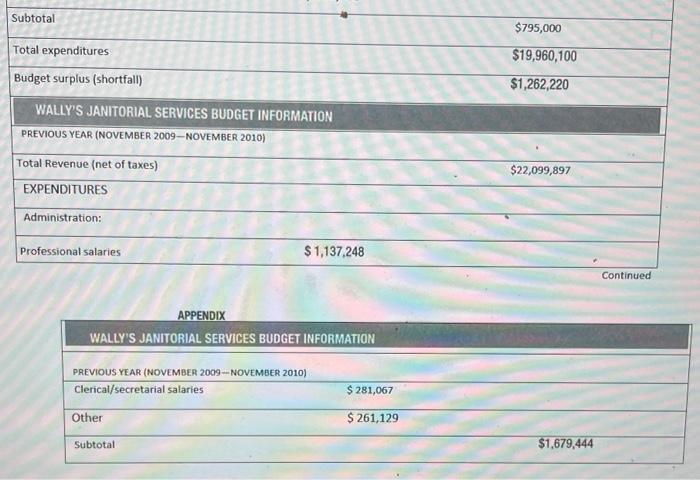
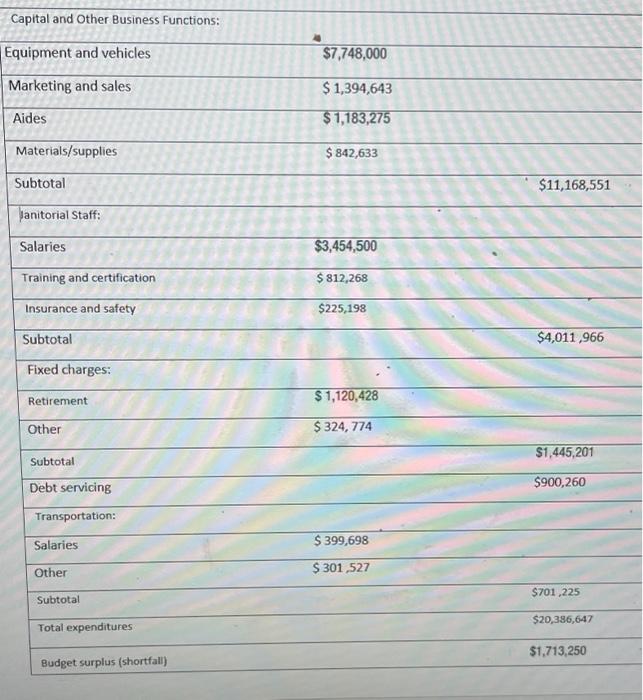
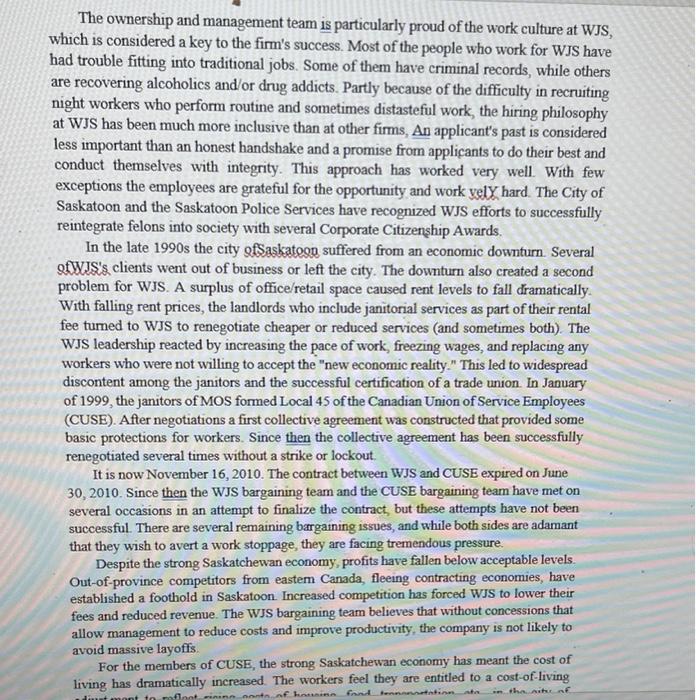
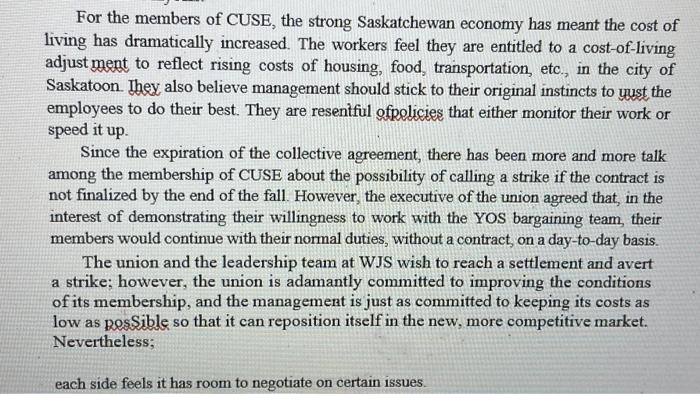
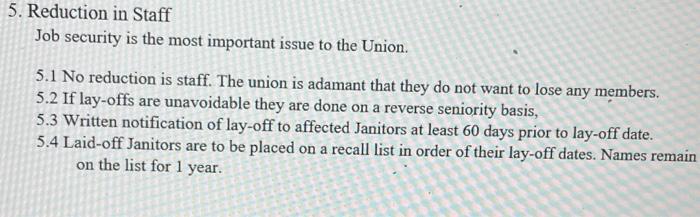
5. Reduction in Staff Job security is the most important issue to the Union. 5.1 No reduction is staff. The union is adamant that they do not want to lose any members. 5.2 If lay-offs are unavoidable they are done on a reverse seniority basis, 5.3 Written notification of lay-off to affected Janitors at least 60 days prior to lay-off date. 5.4 Laid-off Janitors are to be placed on a recall list in order of their lay-off dates. Names remain on the list for 1 year. ADVANCE PREPARATION Before the bargaining session, you should read two sets of information: 1. The "Background Information," presented in this document under that heading. This is information that both management and union teams have 2. The private team information. This information is not to be shared with your bargaining opponents. It will be provided by your instructor once he/she assigns you to a management or union team. access to. SPECIFIC BARGAINING INSTRUCTIONS Confidentiality ofuegotiations. It is not necessary to conduct the negotiations in confidence. You are free to discuss your negotiations with other students in the class, however, negotiating may only be conducted during the allotted class time. Bargaining issues. Teams may only propose changes with respect to the issues provided in the case instructions. As members of bargaining teams, students may not manipulate any costs other than janitor salary costs. In addition, students cannot manipulate the level of firn revenue. They may only negotiate the four issues specified in the case. Legal environment. The legal framework for this simulation will be the Employment (or Labour) Standards Act and the Labour Relations Act ofyour province. Citing legislation is not appropriate for this simulation Roleprofiles, Students may adopt specific roles as indicated in the text, but no detailed role profiles will be given Duration ofagreement. The agreement shall be effective for one full year (i.e., the teams are negotiating a one-year contract) Teams may not negotiate an agreement longer than one year Styles Bargaining in good faith, Teams are expected to bargain in good faith. In particular, they are required to meet and to bargain with the intention of reaching an agreement. Furthermore, once an item has been agreed upon by both teams, it is not appropriate to reopen negotiation of that item except by mutual agreement of the teams BACKGROUND INFORMATION Wally's Janitorial Services Incorporated (WJS) was founded in 1980 by three competitors who had been working separately as independent janitors in large office settings. As independent providers of janitorial services, these three men would bid on jobs to clean office or retail space for large companies who owned their own facilities or for landlords who included maintenance as part of their rental fee. Compared to an in-house janitorial department, the independent contractors could provide a lower cost option (because they were always bidding against cach other) and superior quality (because they were held accountable for their services because their contracts could be terminated). As a result of this fierce competition, the three independent janitors found they could only make a profit by staying in one location per shift. Generally, an office retail space was cleaned twice a week. This meant that ideally a contractor would have only three clients at one time (each client is cleaned twice a week for six days of work per week). For an independent contractor to keep himself and his small crew busy for an entire shift (8 p.m. to 4 am.), he would require very large clients. Having a number of smaller clients meant additional costs in terms of vehicles and time to transport equipment and labour from one client's site to another. At the time there were only a few large office/retail spaces in Saskatoon, so the independent contractors would fight over these few profitable clients and then fill the remainder of their work week with non-profitable smaller clients as a means of keeping their labour employed One particularly bleak Febluaty evening the most junior of these men, Wally Wentworth, approached his two main competitors and pitched his idea to consolidate their efforts and form a new firm . The other two agreed to accept minority ownership and employment as executives in the new firm. Since its inception in 1980, Wally's Janitorial Services Incorporated (WJS) has been growing along with the city of Saskatoon. It has retained market domination and continues to focus on large clients. WJS presently employs 95 people of this total 15 are nonunionized employees and work as clerical staff managers, or executives. The remaining 80 employees are all unionized and are classified into 11 categories of janitors based on seniority. In Table 1 the total number of janitors in each classification and their yearly income is presented. Notice that after 10 years of service an employee is in the 10th classification and earns $50,000 a year. For these employees there is no further classification advancement or pay increase in subsequent years. TORIAL SERVICES, SALARY SCHEDULE FOR JANITORS Styles SALARY ANNUAL INCOME 2009 NUMBER OF JANITORS CURRENT 2009 JANITOR NUMBER OF SALARY COST IN S JANITORS ISCALE ESTIMATED 2010 COST IN S 394 B Collective Bargaining Simulation: Wally's Janitorial Services Copyright 2016 Nelson Education Ltd. All Rights Reserved. May not be copied, scanned, or duplicated. I whole or in part. Due to electronic rights, nomne third party content, may be suppressed for the eBook and for bots). Nelson Education reserves the right to remove additional content at any time if subsequent rights letection require at NEL 4 96,000 24,000 25,000 4 96,000 1 6 150,000 4 199.099 2 26,000 4 104.000 6 156,000 3 28,000 8 224,000 3 84,000 4 30,000 0 7 210,000 5 32,000 6 192,000 0 6 36,500 5 182,500 6 219,000 7 40,000 3 120,000 5 200,000 8 44,000 4 176,000 3 132,000 9 50,000 5 250,000 4 200,000 10 56,000 35 1,960,000 38 2,128,000 80 Totals 80 3,454,500 *The estimated 2010 cost multiplies the 2009 incomes by the current number of janitors, 3,525,000 CURRENT YEAR (NOVEMBER 2010-NOVEMBER 2011) PROJECTED BUDGET Total Revenue (net of taxes) EXPENDITURES $21,222,320 Administration: Professional salaries Clerical/secretarial salaries Other $1,137,500 $ 281,250 $ 250,000 Subtotal $1,668,750 Capital and Other Business Functions: Equipment and vehicles Marketing and sales $ 6,558,100 $ 1,420,000 C d WALLY'S JANITORIAL SERVICES BUDGET INFORMATION CURRENT YEAR (NOVEMBER 2010 NOVEMBER 2011) PROJECTED BUDGET Aides $ 1,187,600 Materials/supplies $943,750 Subtotal $10,109,450 Janitorial staff: Salaries $3,525,000 Training and certification $ 975,000 Insurance and safety $ 258,750 Subtotal $4,278,750 Fixed charges: Retirement $ 1,176,450 Other $ 425,700 Subtotal Debt servicing $1,602,150 $1,026,000 Transportation: Salaries $ 400,000 Other $ 395,000 Subtotal $795,000 Total expenditures Budget surplus (shortfall) $19,960,100 $1,262,220 WALLY'S JANITORIAL SERVICES BUDGET INFORMATION PREVIOUS YEAR (NOVEMBER 2009-NOVEMBER 2010) Total Revenue (net of taxes) $22,099,897 Subtotal $795,000 Total expenditures $19,960,100 Budget surplus (shortfall) $1,262,220 WALLY'S JANITORIAL SERVICES BUDGET INFORMATION PREVIOUS YEAR (NOVEMBER 2009-NOVEMBER 2010) Total Revenue (net of taxes) EXPENDITURES $22,099,897 Administration: Professional salaries $ 1,137,248 Continued APPENDIX WALLY'S JANITORIAL SERVICES BUDGET INFORMATION PREVIOUS YEAR (NOVEMBER 2009-NOVEMBER 2010) Clerical/secretarial salaries $ 281,067 Other $ 261,129 Subtotal $1,679,444 Capital and Other Business Functions: Equipment and vehicles $7,748,000 Marketing and sales $ 1,394,643 Aides $ 1,183,275 Materials/supplies $ 842,633 Subtotal $11,168,551 Janitorial Staff: Salaries $3,454,500 Training and certification $ 812,268 Insurance and safety $225,198 Subtotal $4,011,966 Fixed charges: Retirement $ 1,120,428 Other $ 324,774 $1,445,201 Subtotal Debt servicing $900,260 Transportation: Salaries $ 399,698 Other $ 301,527 $701,225 Subtotal $20,386,647 Total expenditures $1,713,250 Budget surplus (shortfall) The ownership and management team is particularly proud of the work culture at WJS, which is considered a key to the firm's success. Most of the people who work for WJS have had trouble fitting into traditional jobs. Some of them have criminal records, while others are recovering alcoholics and/or drug addicts. Partly because of the difficulty in recruiting night workers who perform routine and sometimes distasteful work, the hiring philosophy at WJS has been much more inclusive than at other firms, An applicant's past is considered less important than an honest handshake and a promise from applicants to do their best and conduct themselves with integrity. This approach has worked very well With few exceptions the employees are grateful for the opportunity and work wely hard The City of Saskatoon and the Saskatoon Police Services have recognized WJS efforts to successfully reintegrate felons into society with several Corporate Citizenship Awards In the late 1990s the city of Saskatoon suffered from an economic downturn. Several WIS's clients went out of business or left the city. The downturn also created a second problem for WJS. A surplus of office/retail space caused rent levels to fall dramatically With falling rent prices, the landlords who include janitorial services as part of their rental fee tumed to WJS to renegotiate cheaper or reduced services and sometimes both). The WJS leadership reacted by increasing the pace of work, freezing wages, and replacing any workers who were not willing to accept the "new economic reality." This led to widespread discontent among the janitors and the successful certification of a trade union In January of 1999, the janitors of MOS formed Local 45 of the Canadian Union of Service Employees (CUSE). After negotiations a first collective agreement was constructed that provided some basic protections for workers. Since then the collective agreement has been successfully renegotiated several times without a strike or lockout. It is now November 16, 2010. The contract between WJS and CUSE expired on June 30, 2010. Since then the WJS bargaining team and the CUSE bargaining team have met on several occasions in an attempt to finalize the contract, but these attempts have not been successful. There are several remaining bargaining issues, and while both sides are adamant that they wish to avert a work stoppage, they are facing tremendous pressure. Despite the strong Saskatchewan economy, profits have fallen below acceptable levels Out-of-province competitors from eastem Canada, fleeing contracting economies, have established a foothold in Saskatoon. Increased competition has forced WJS to lower their fees and reduced revenue. The WJS bargaining team believes that without concessions that allow management to reduce costs and improve productivity, the company is not likely to avoid massive layoffs For the members of CUSE, the strong Saskatchewan economy has meant the cost of living has dramatically increased. The workers feel they are entitled to a cost-of-living istant to flat in ont of hot foundation the Air For the members of CUSE, the strong Saskatchewan economy has meant the cost of living has dramatically increased. The workers feel they are entitled to a cost-of-living adjust ment to reflect rising costs of housing, food, transportation, etc., in the city of Saskatoon. They also believe management should stick to their original instincts to yust the employees to do their best. They are resentful ofpolicies that either monitor their work or speed it up Since the expiration of the collective agreement, there has been more and more talk among the membership of CUSE about the possibility of calling a strike if the contract is not finalized by the end of the fall However, the executive of the union agreed that, in the interest of demonstrating their willingness to work with the YOS bargaining team, their members would continue with their normal duties, without a contract, on a day-to-day basis. The union and the leadership team at WJS wish to reach a settlement and avert a strike; however, the union is adamantly committed to improving the conditions of its membership, and the management is just as committed to keeping its costs as low as possible so that it can reposition itself in the new, more competitive market. Nevertheless; each side feels it has room to negotiate on certain iss issues