







Question: Old MathJax webview give detailed conclusions . The shift in the transformation from a traditional organization characterized by vertical hierarchical and bureaucratic structure with the
Old MathJax webview
give detailed conclusions
.
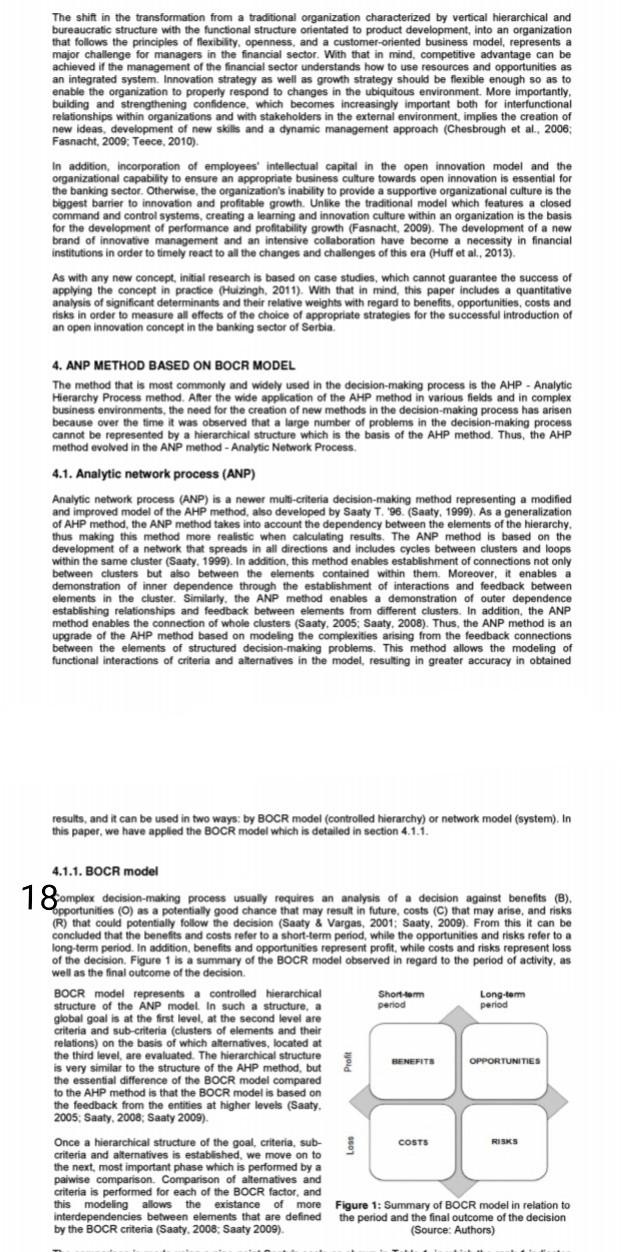
The shift in the transformation from a traditional organization characterized by vertical hierarchical and bureaucratic structure with the functional structure orientated to product development, into an organization that follows the principles of flexibility, openness, and a customer-oriented business model, represents a major challenge for managers in the financial sector. With that in mind, competitive advantage can be achieved if the management of the financial sector understands how to use resources and opportunities as an integrated system. Innovation strategy as well as growth strategy should be flexible enough so as to enable the organization to properly respond to changes in the ubiquitous environment. More importantly, building and strengthening confidence, which becomes increasingly important both for interfunctional relationships within organizations and with stakeholders in the external environment, implies the creation of new ideas, development of new skills and a dynamic management approach (Chesbrough et al., 2006 Fasnacht, 2009, Teece, 2010) In addition, incorporation of employees intellectual capital in the open innovation model and the organizational capability to ensure an appropriate business culture towards open innovation is essential for the banking sector. Otherwise, the organization's inability to provide a supportive organizational culture is the biggest barrier to innovation and profitable growth. Unlike the traditional model which features a closed command and control systems, creating a learning and innovation culture within an organization is the basis for the development of performance and profitability growth (Fasnacht, 2009). The development of a new brand of innovative management and an intensive colaboration have become a necessity in financial institutions in order to timely react to all the changes and challenges of this era (Huff et al., 2013). As with any new concept, initial research is based on case studies, which cannot guarantee the success of applying the concept in practice (Huizingh, 2011). With that in mind, this paper includes a quantitative analysis of significant determinants and their relative weights with regard to benefits, opportunities, costs and risks in order to measure all effects of the choice of appropriate strategies for the successful introduction of an open innovation concept in the banking sector of Serbia. 4. ANP METHOD BASED ON BOCR MODEL The method that is most commonly and widely used in the decision-making process is the AHP - Analytic Hierarchy Process method. After the wide application of the AHP method in various fields and in complex business environments, the need for the creation of new methods in the decision-making process has arisen because over the time it was observed that a large number of problems in the decision-making process cannot be represented by a hierarchical structure which is the basis of the AHP method. Thus, the AHP method evolved in the ANP method - Analytic Network Process 4.1. Analytic network process (ANP) Analytic network process (ANP) is a newer multi-criteria decision-making method representing a modified and improved model of the AHP method, also developed by Saaty T. 96 (Saaty, 1999). As a generalization of AHP method, the ANP method takes into account the dependency between the elements of the hierarchy, thus making this method more realistic when calculating results. The ANP method is based on the development of a network that spreads in all directions and includes cycles between clusters and loops within the same cluster (Saaty, 1999). In addition, this method enables establishment of connections not only between clusters but also between the elements contained within them. Moreover, it enables a demonstration of inner dependence through the establishment of interactions and feedback between elements in the cluster. Similarly, the ANP method enables a demonstration of outer dependence establishing relationships and feedback between elements from different clusters. In addition, the ANP method enables the connection of whole clusters (Saaty, 2005, Saaty, 2008). Thus, the ANP method is an upgrade of the AHP method based on modeling the complexities arising from the feedback connections between the elements of structured decision-making problems. This method allows the modeling of functional interactions of criteria and alternatives in the model, resulting in greater accuracy in obtained results, and it can be used in two ways: by BOCR model (controlied hierarchy) or network model (system), In this paper, we have applied the BOCR model which detailed in section 4.1.1 4.1.1. BOCR model 18 Complex decision-making process usually requires an analysis of a decision against benefits (B). opportunities (0) as a potentially good chance that may result in future, costs (C) that may arise, and risks (R) that could potentially follow the decision (Saaty & Vargas, 2001: Saaty, 2009). From this it can be concluded that the benefits and costs refer to a short-term period, while the opportunities and risks refer to a long-term period. In addition, benefits and opportunities represent profit, while costs and risks represent loss of the decision Figure 1 is a summary of the BOCR model observed in regard to the period of activity, as well as the final outcome of the decision BOCR model represents a controlled hierarchical Short-term Long-term structure of the ANP model in such a structure, a period period global goal is at the first level, at the second level are criteria and sub-criteria (clusters of elements and their relations) on the basis of which alternatives, located at the third level, are evaluated. The hierarchical structure BENEFITS OPPORTUNITIES is very similar to the structure of the AHP method, but the essential difference of the BOCR model compared to the AHP method is that the BOCR model is based on the feedback from the entities at higher levels (Saaty. 2005: Saaty, 2008; Saaty 2009) Once a hierarchical structure of the goal criteria, sub- COSTS RISKS criteria and alternatives is established, we move on to the next most important phase which is performed by a palwise comparison. Comparison of alternatives and criteria is performed for each of the BOCR factor, and this modeling allows the existance of more Figure 1: Summary of BOCR model in relation to interdependencies between elements that are defined the period and the final outcome of the decision by the BOCR criteria (Saaty. 2008: Saaty 2009) (Source: Authors)Step by Step Solution
There are 3 Steps involved in it
1 Expert Approved Answer
Step: 1 Unlock

Question Has Been Solved by an Expert!
Get step-by-step solutions from verified subject matter experts
Step: 2 Unlock
Step: 3 Unlock
 Study Help