







Question: Old MathJax webview i need a questions and answer on this case study plz provide me thanks i attachted book edition and case study chapter
Old MathJax webview
i need a questions and answer on this case study plz provide me thanks
i attachted book edition and case study chapter
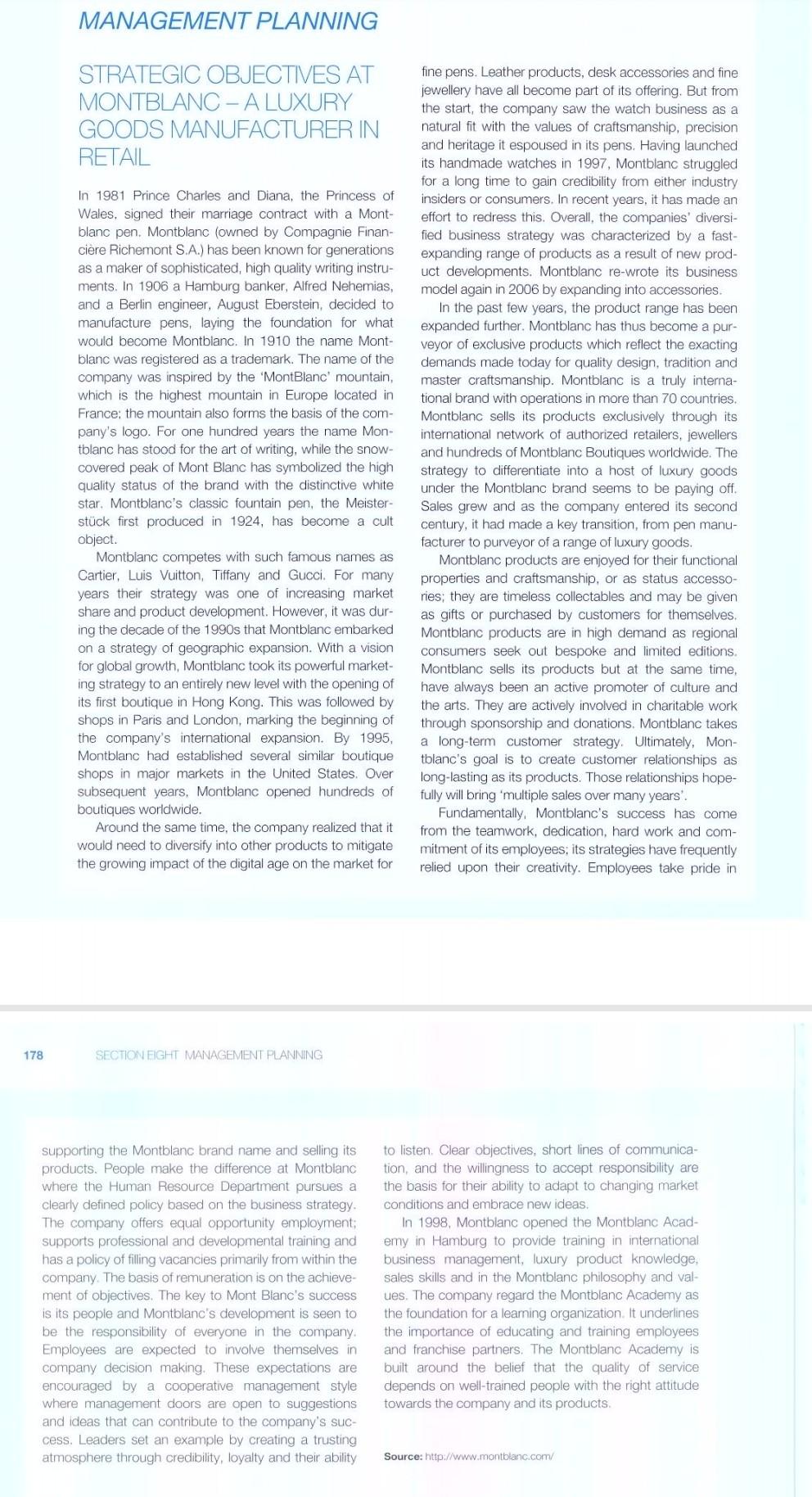
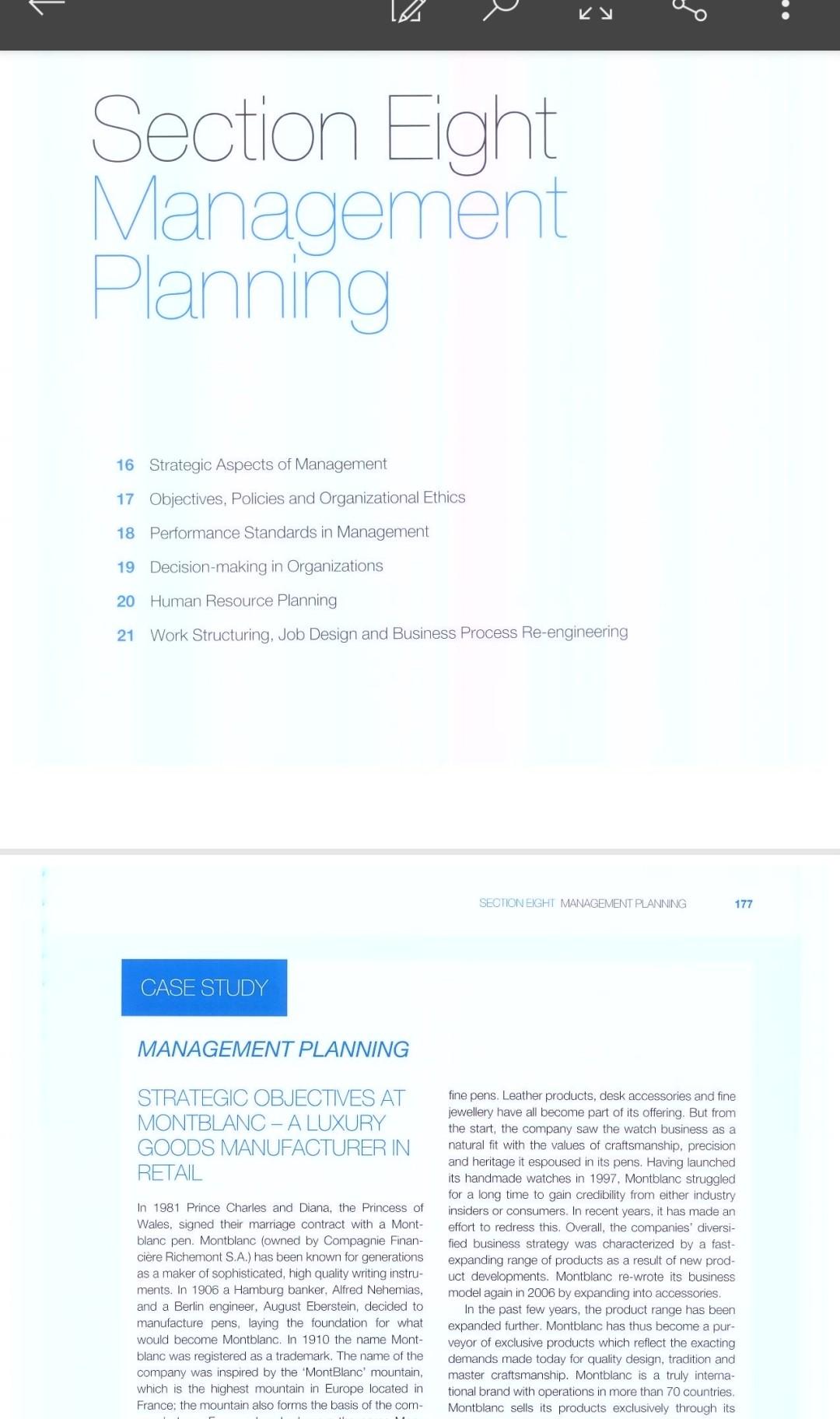
MANAGEMENT PLANNING STRATEGIC OBJECTIVES AT MONTBLANC - A LUXURY GOODS MANUFACTURER IN RETAIL In 1981 Prince Charles and Diana, the Princess of Wales, signed their marriage contract with a Mont- blanc pen. Montblanc (owned by Compagnie Finan- ciere Richemont S.A.) has been known for generations as a maker of sophisticated, high quality writing instru- ments. In 1906 a Hamburg banker, Alfred Nehemias, and a Berlin engineer, August Eberstein, decided to manufacture pens, laying the foundation for what would become Montblanc. In 1910 the name Mont- blanc was registered as a trademark. The name of the was inspired by the 'Mont Blanc mountain, which is the highest mountain in Europe located in France: the mountain also forms the basis of the com- pany's logo. For one hundred years the name Mon- tblanc has stood for the art of writing, while the snow- covered peak of Mont Blanc has symbolized the high quality status of the brand with the distinctive white star. Montblanc's classic fountain pen, the Meister- stck first produced in 1924, has become a cult object. Montblanc competes with such famous names as Cartier, Luis Vuitton, Tiffany and Gucci. For many years their strategy was one of increasing market share and product development. However, it was dur- ing the decade of the 1990s that Montblanc embarked on a strategy of geographic expansion. With a vision for global growth, Montblanc took its powerful market- ing strategy to an entirely new level with the opening of its first boutique in Hong Kong. This was followed by shops in Paris and London, marking the beginning of the company's international expansion. By 1995, Montblanc had established several similar boutique shops in major markets in the United States. Over subsequent years, Montblanc opened hundreds of boutiques worldwide. Around the same time, the company realized that it would need to diversify into other products to mitigate the growing impact of the digital age on the market for fine pens. Leather products, desk accessories and fine jewellery have all become part of its offering. But from the start, the company saw the watch business as a natural fit with the values of craftsmanship, precision and heritage it espoused in its pens. Having launched its handmade watches in 1997, Montblanc struggled for a long time to gain credibility from either industry insiders or consumers. In recent years, it has made an effort to redress this. Overall, the companies' diversi- fied business strategy was characterized by a fast- expanding range of products as a result of new prod- uct developments. Montblanc re-wrote its business model again in 2006 by expanding into accessories In the past few years, the product range has been expanded further. Montblanc has thus become a pur- veyor of exclusive products which reflect the exacting demands made today for quality design, tradition and master craftsmanship. Montblanc is a truly interna- tional brand with operations in more than 70 countries. Montblanc sells its products exclusively through its international network of authorized retailers, jewellers and hundreds of Montblanc Boutiques worldwide. The strategy to differentiate into a host of luxury goods under the Montblanc brand seems to be paying off. Sales grew and as the company entered its second century, it had made a key transition, from pen manu- facturer to purveyor of a range of luxury goods. Montblanc products are enjoyed for their functional properties and craftsmanship, or as status accesso- ries; they are timeless collectables and may be given as gifts or purchased by customers for themselves. Montblanc products are in high demand as regional consumers seek out bespoke and limited editions. Montblanc sells its products but at the same time, have always been an active promoter of culture and the arts. They are actively involved in charitable work through sponsorship and donations. Montblanc takes a long-term customer strategy. Ultimately, Mon- tblanc's goal is to create customer relationships as long-lasting as its products. Those relationships hope- fully will bring 'multiple sales over many years'. Fundamentally, Montblanc's success has come from the teamwork, dedication, hard work and com- mitment of its employees; its strategies have frequently relied upon their creativity. Employees take pride in 178 SECTION FIGHT MANAGEMENT PLANNING supporting the Montblanc brand name and selling its products. People make the difference at Montblanc where the Human Resource Department pursues a clearly defined policy based on the business strategy. The company offers equal opportunity employment; supports professional and developmental training and has a policy of filling vacancies primarily from within the company. The basis of remuneration is on the achieve- ment of objectives. The key to Mont Blanc's success is its people and Montblanc's development is seen to be the responsibility of everyone in the company. Employees are expected to involve themselves in company decision making. These expectations are encouraged by a cooperative management style where management doors are open to suggestions and ideas that can contribute to the company's suc- cess. Leaders set an example by creating a trusting atmosphere through credibility, loyalty and their ability to listen. Clear objectives, short lines of communica- tion, and the willingness to accept responsibility are the basis for their ability to adapt to changing market conditions and embrace new ideas. In 1998, Montblanc opened the Montblanc Acad- emy in Hamburg to provide training in international business management, luxury product knowledge, sales skills and in the Montblanc philosophy and val- ues. The company regard the Montblanc Academy as the foundation for a learning organization. It underlines the importance of educating and training employees and franchise partners. The Montblanc Academy is built around the belief that the quality of service depends on well-trained people with the right attitude towards the company and its products Source: http://www.montblanc.com/ Section Eight Management Planning 16 Strategic Aspects of Management 17 Objectives, Policies and Organizational Ethics 18 Performance Standards in Management 19 Decision-making in Organizations 20 Human Resource Planning 21 Work Structuring, Job Design and Business Process Re-engineering SEOTION EIGHT MANAGEMENT PLANNING 177 CASE STUDY MANAGEMENT PLANNING STRATEGIC OBJECTIVES AT MONTBLANC - A LUXURY GOODS MANUFACTURER IN RETAIL In 1981 Prince Charles and Diana, the Princess of Wales, signed their marriage contract with a Mont- blanc pen. Montblanc (owned by Compagnie Finan- ciere Richemont S.A.) has been known for generations as a maker of sophisticated, high quality writing instru- ments. In 1906 a Hamburg banker, Alfred Nehemias, and a Berlin engineer, August Eberstein, decided to manufacture pens, laying the foundation for what would become Montblanc. In 1910 the name Mont- blanc was registered as a trademark. The name of the company was inspired by the MontBlanc' mountain, which is the highest mountain in Europe located in France: the mountain also forms the basis of the com- fine pens. Leather products, desk accessories and fine jewellery have all become part of its offering. But from the start, the company saw the watch business as a natural fit with the values of craftsmanship, precision and heritage it espoused in its pens. Having launched its handmade watches in 1997. Montblanc struggled for a long time to gain credibility from either industry insiders or consumers. In recent years, it has made an effort to redress this. Overall, the companies' diversi- fied business strategy was characterized by a fast- expanding range of products as a result of new prod- uct developments. Montblanc re-wrote its business model again in 2006 by expanding into accessories In the past few years, the product range has been expanded further. Montblanc has thus become a pur- veyor of exclusive products which reflect the exacting demands made today for quality design, tradition and master craftsmanship. Montblanc is a truly interna- tional brand with operations in more than 70 countries. Montblanc sells its products exclusively through its 7th edition MANAGEMENT THEORY AND PRACTICE G. A. Cole and Phil Kelly was a Vacher www.cengage.co.uk/colekellyStep by Step Solution
There are 3 Steps involved in it
1 Expert Approved Answer
Step: 1 Unlock

Question Has Been Solved by an Expert!
Get step-by-step solutions from verified subject matter experts
Step: 2 Unlock
Step: 3 Unlock
 Study Help