







Question: Old MathJax webview Need all the answer. I will give upvote Case: Welcome Home Church Questions 1. What are the marketing management problems facing WHC?
Old MathJax webview
Need all the answer. I will give upvote Case: Welcome Home Church
Questions 1. What are the marketing management problems facing WHC? 2. What marketing research objectives would you propose? 3. Based on the information presented in the case, what types of information should Odom attempt to find? 4. Does the questionnaire contain the right type and number of questions to obtain the kind of information Reverend Love needs?
This is the complete case study, please solve asap. definetly give upvote
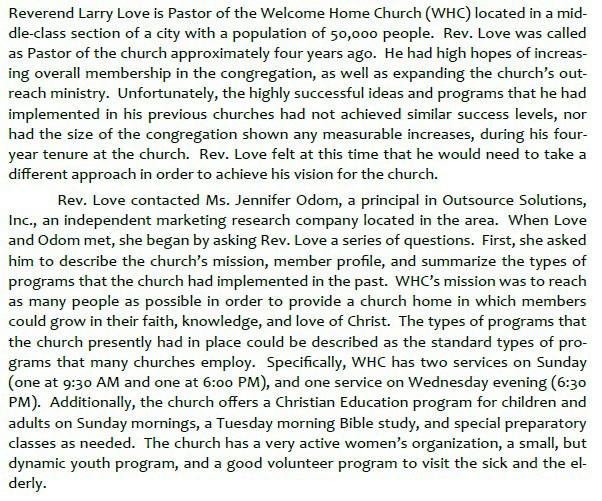
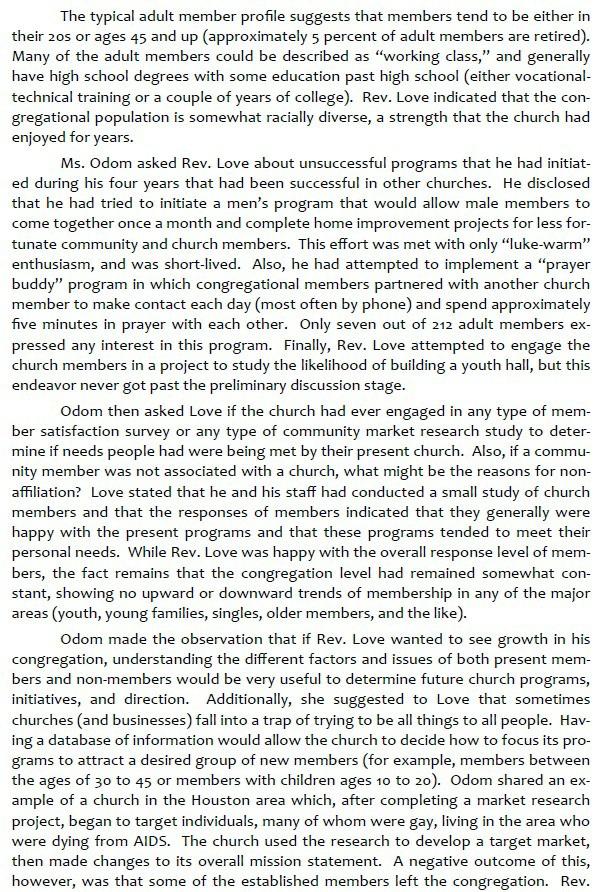
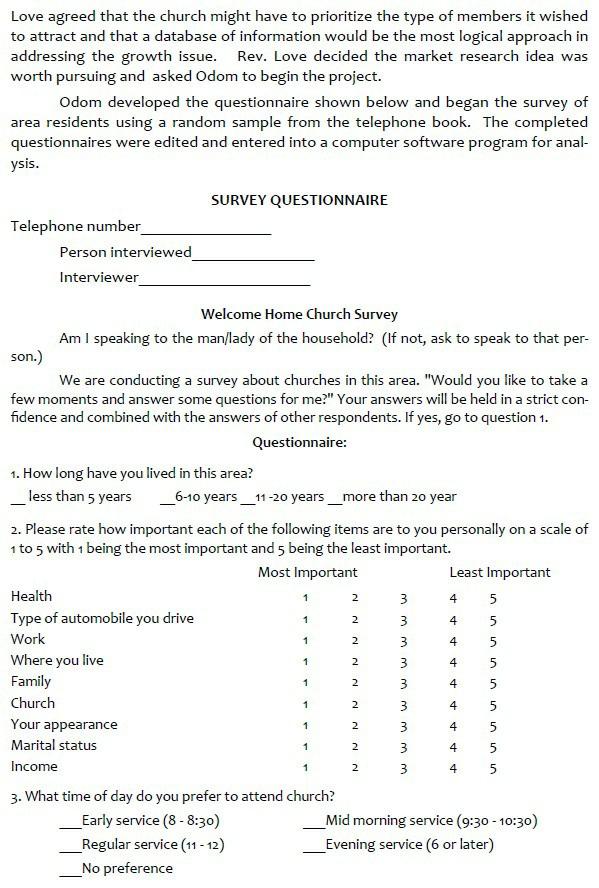
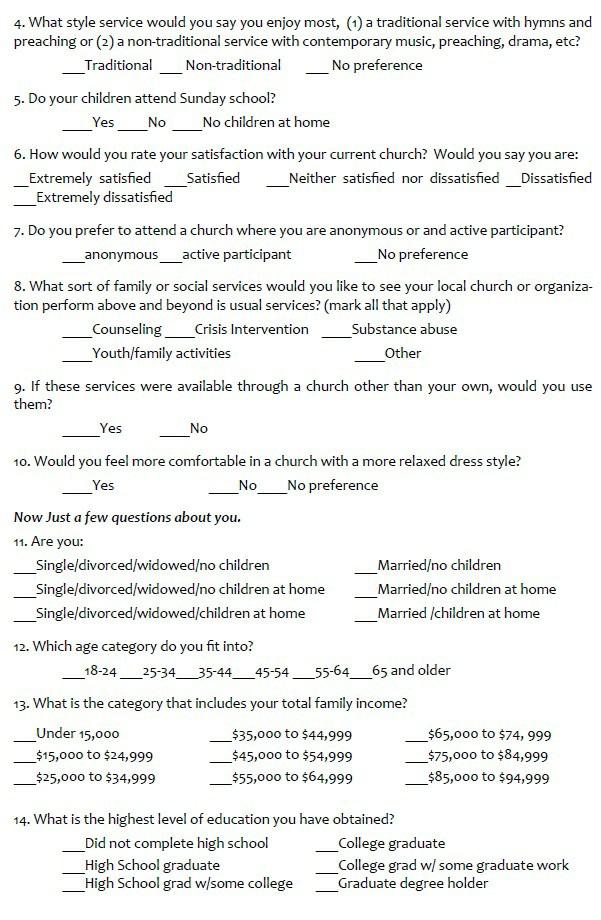
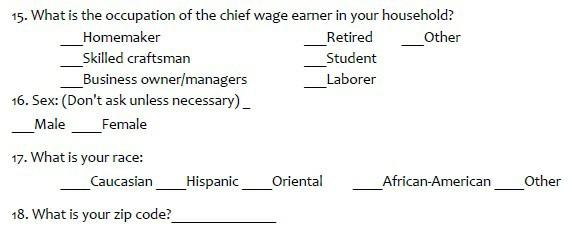
Reverend Larry Love is Pastor of the Welcome Home Church (WHC) located in a mid- dle-class section of a city with a population of 50,000 people. Rev. Love was called as Pastor of the church approximately four years ago. He had high hopes of increas- ing overall membership in the congregation, as well as expanding the church's out- reach ministry. Unfortunately, the highly successful ideas and programs that he had implemented in his previous churches had not achieved similar success levels, nor had the size of the congregation shown any measurable increases, during his four- year tenure at the church. Rev. Love felt at this time that he would need to take a different approach in order to achieve his vision for the church. Rev. Love contacted Ms. Jennifer Odom, a principal in Outsource Solutions, Inc., an independent marketing research company located in the area. When Love and Odom met, she began by asking Rev. Love a series of questions. First, she asked him to describe the church's mission, member profile, and summarize the types of programs that the church had implemented in the past. WHC's mission was to reach as many people as possible in order to provide a church home in which members could grow in their faith, knowledge, and love of Christ. The types of programs that the church presently had in place could be described as the standard types of pro- grams that many churches employ. Specifically, WHC has two services on Sunday (one at 9:30 AM and one at 6:00 PM), and one service on Wednesday evening (6:30 PM). Additionally, the church offers a Christian Education program for children and adults on Sunday mornings, a Tuesday morning Bible study, and special preparatory classes as needed. The church has a very active women's organization, a small, but dynamic youth program, and a good volunteer program to visit the sick and the el- derly. The typical adult member profile suggests that members tend to be either in their 20s or ages 45 and up (approximately 5 percent of adult members are retired). Many of the adult members could be described as "working class," and generally have high school degrees with some education past high school (either vocational- technical training or a couple of years of college). Rev. Love indicated that the con- gregational population is somewhat racially diverse, a strength that the church had enjoyed for years. Ms. Odom asked Rev. Love about unsuccessful programs that he had initiat- ed during his four years that had been successful in other churches. He disclosed that he had tried to initiate a men's program that would allow male members to come together once a month and complete home improvement projects for less for- tunate community and church members. This effort was met with only "luke-warm" enthusiasm, and was short-lived. Also, he had attempted to implement a "prayer buddy" program in which congregational members partnered with another church member to make contact each day (most often by phone) and spend approximately five minutes in prayer with each other. Only seven out of 212 adult members ex- pressed any interest in this program. Finally, Rev. Love attempted to engage the church members in a project to study the likelihood of building a youth hall, but this endeavor never got past the preliminary discussion stage. Odom then asked Love if the church had ever engaged in any type of mem- ber satisfaction survey or any type of community market research study to deter- mine if needs people had were being met by their present church. Also, if a commu- nity member was not associated with a church, what might be the reasons for non- affiliation? Love stated that he and his staff had conducted a small study of church members and that the responses of members indicated that they generally were happy with the present programs and that these programs tended to meet their personal needs. While Rev. Love was happy with the overall response level of mem- bers, the fact remains that the congregation level had remained somewhat con- stant, showing no upward or downward trends of membership in any of the major areas (youth, young families, singles, older members, and the like). Odom made the observation that if Rev. Love wanted to see growth in his congregation, understanding the different factors and issues of both present mem- bers and non-members would be very useful to determine future church programs, initiatives, and direction. Additionally, she suggested to Love that sometimes churches and businesses) fall into a trap of trying to be all things to all people. Hav- ing a database of information would allow the church to decide how to focus its pro- grams to attract a desired group of new members (for example, members between the ages of 30 to 45 or members with children ages 10 to 20). Odom shared an ex- ample of a church in the Houston area which, after completing a market research project, began to target individuals, many of whom were gay, living in the area who were dying from AIDS. The church used the research to develop a target market, then made changes to its overall mission statement. A negative outcome of this, however, was that some of the established members left the congregation. Rev. Love agreed that the church might have to prioritize the type of members it wished to attract and that a database of information would be the most logical approach in addressing the growth issue. Rev. Love decided the market research idea was worth pursuing and asked Odom to begin the project. Odom developed the questionnaire shown below and began the survey of area residents using a random sample from the telephone book. The completed questionnaires were edited and entered into a computer software program for anal- ysis. SURVEY QUESTIONNAIRE Telephone number Person interviewed Interviewer Welcome Home Church Survey Am I speaking to the man/lady of the household? (If not, ask to speak to that per- son.) We are conducting a survey about churches in this area. "Would you like to take a few moments and answer some questions for me?" Your answers will be held in a strict con- fidence and combined with the answers of other respondents. If yes, go to question 1. Questionnaire: 1. How long have you lived in this area? less than 5 years __6-10 years _11-20 years _more than 20 year 2. Please rate how important each of the following items are to you personally on a scale of 1 to 5 with 1 being the most important and 5 being the least important. Most Important Least Important 1 2 3 4 1 2 3 4 Health Type of automobile you drive Work Where you live Family 1 2 3 4 1 2 3 4 5 1 2 3 4 5 Church 1 2 3 3 4 5 2 2 2 2 1 2 3 4 5 Your appearance Marital status 1 2 st 5 mm Income 1 2 4 5 3. What time of day do you prefer to attend church? _Early service (8 - 8:30) _Mid morning service (9:30-10:30) _Regular service (11 - 12) _Evening service (6 or later) No preference 4. What style service would you say you enjoy most, () a traditional service with hymns and preaching or (2) a non-traditional service with contemporary music, preaching, drama, etc? _Traditional__Non-traditional No preference 5. Do your children attend Sunday school? _Yes No _No children at home 6. How would you rate your satisfaction with your current church? Would you say you are: _Neither satisfied nor dissatisfied _Dissatisfied Extremely satisfied Satisfied Extremely dissatisfied 7. Do you prefer to attend a church where you are anonymous or and active participant? _anonymous_active participant _No preference 8. What sort of family or social services would you like to see your local church or organiza- tion perform above and beyond is usual services? (mark all that apply) Counseling___Crisis Intervention Substance abuse _Youth/family activities Other 9. If these services were available through a church other than your own, would you use them? Yes No 10. Would you feel more comfortable in a church with a more relaxed dress style? _Yes No No preference Now Just a few questions about you. 11. Are you: Single divorced/widowedo children _Single divorced/widowedo children at home Single/divorced/widowed/children at home Marriedo children Marriedo children at home Married children at home 12. Which age category do you fit into? _18-24__25-34__35-44__45-54_55-64__65 and older 13. What is the category that includes your total family income? _Under 15,000 _$15,000 to $24,999 _ $25,000 to $34,999 _$35,000 to $44,999 _$45,000 to $54,999 _$55,000 to $64,999 _$65,000 to $74, 999 _$75,000 to $84,999 _$85,000 to $94,999 14. What is the highest level of education you have obtained? Did not complete high school College graduate High School graduate College grad w/ some graduate work High School grad w/some college Graduate degree holder 15. What is the occupation of the chief wage eamer in your household? _Homemaker Retired Other Skilled craftsman Student _Business owner/managers Laborer 16. Sex: (Don't ask unless necessary) Male Female 17. What is your race: Caucasian Hispanic Oriental African-American Other 18. What is your zip codeStep by Step Solution
There are 3 Steps involved in it
1 Expert Approved Answer
Step: 1 Unlock

Question Has Been Solved by an Expert!
Get step-by-step solutions from verified subject matter experts
Step: 2 Unlock
Step: 3 Unlock
 Study Help