







Question: Old MathJax webview Old MathJax webview Old MathJax webview Assignment 2- 7% of total grade Farms in Canada have changed during the last 50 years.
Old MathJax webview
Old MathJax webview
Old MathJax webview
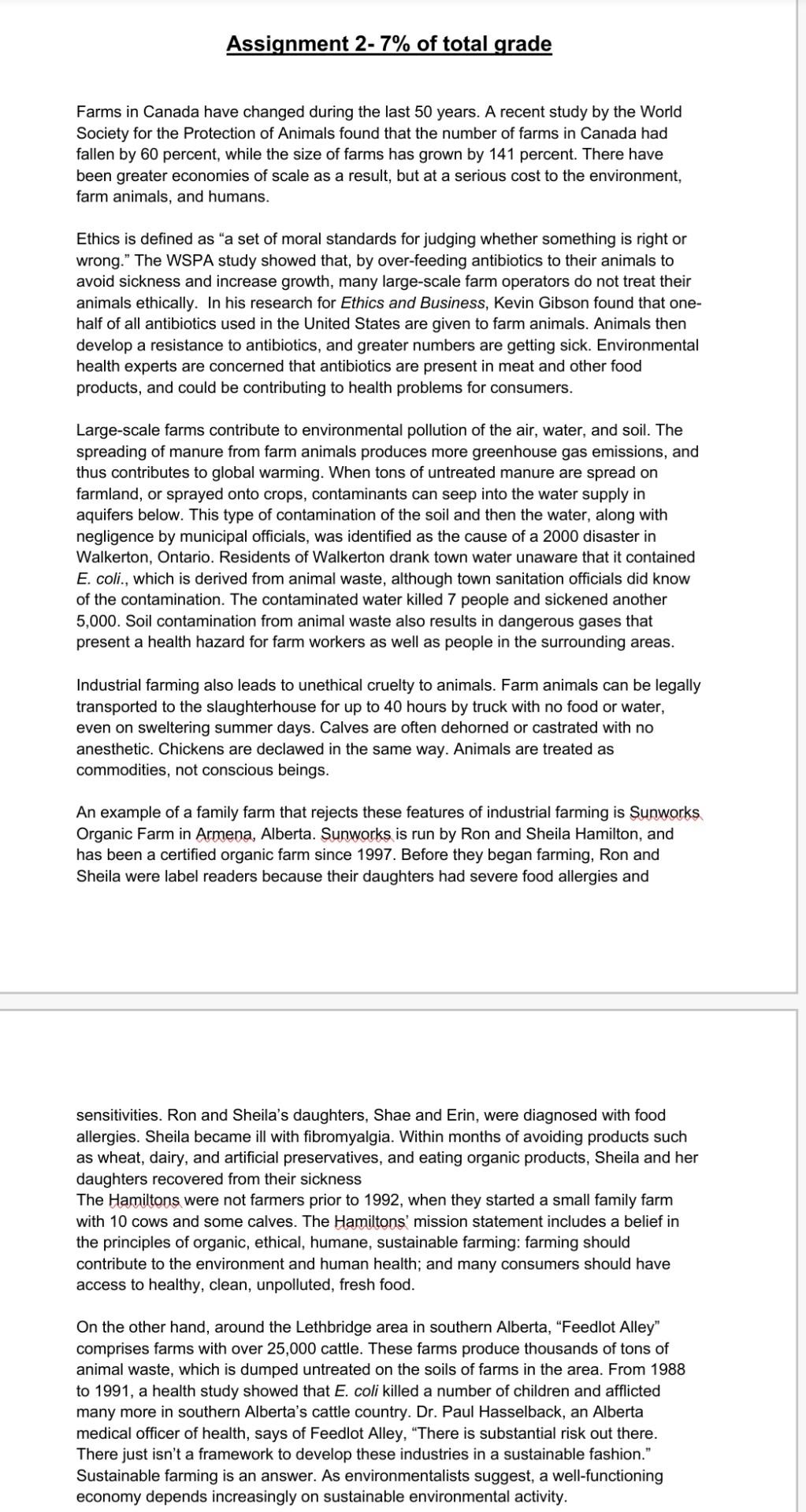
Assignment 2- 7% of total grade Farms in Canada have changed during the last 50 years. A recent study by the World Society for the Protection of Animals found that the number of farms in Canada had fallen by 60 percent, while the size of farms has grown by 141 percent. There have been greater economies of scale as a result, but at a serious cost to the environment, farm animals, and humans. Ethics is defined as "a set of moral standards for judging whether something is right or wrong." The WSPA study showed that, by over-feeding antibiotics to their animals to avoid sickness and increase growth, many large-scale farm operators do not treat their animals ethically. In his research for Ethics and Business, Kevin Gibson found that one- half of all antibiotics used in the United States are given to farm animals. Animals then develop a resistance to antibiotics, and greater numbers are getting sick. Environmental health experts are concerned that antibiotics are present in meat and other food products, and could be contributing to health problems for consumers. Large-scale farms contribute to environmental pollution of the air, water, and soil. The spreading of manure from farm animals produces more greenhouse gas emissions, and thus contributes to global warming. When tons of untreated manure are spread on farmland, or sprayed onto crops, contaminants can seep into the water supply in aquifers below. This type of contamination of the soil and then the water, along with negligence by municipal officials, was identified as the cause of a 2000 disaster in Walkerton, Ontario. Residents of Walkerton drank town water unaware that it contained E. coli., which is derived from animal waste, although town sanitation officials did know of the contamination. The contaminated water killed 7 people and sickened another 5,000. Soil contamination from animal waste also results in dangerous gases that present a health hazard for farm workers as well as people in the surrounding areas. Industrial farming also leads to unethical cruelty to animals. Farm animals can be legally transported to the slaughterhouse for up to 40 hours by truck with no food or water, even on sweltering summer days. Calves are often dehorned or castrated with no anesthetic. Chickens are declawed in the same way. Animals are treated as commodities, not conscious beings. An example of a family farm that rejects these features of industrial farming is Sunworks Organic Farm in Armena, Alberta. Sunworks is run by Ron and Sheila Hamilton, and has been a certified organic farm since 1997. Before they began farming, Ron and Sheila were label readers because their daughters had severe food allergies and sensitivities. Ron and Sheila's daughters, Shae and Erin, were diagnosed with food allergies. Sheila became ill with fibromyalgia. Within months of avoiding products such as wheat, dairy, and artificial preservatives, and eating organic products, Sheila and her daughters recovered from their sickness The Hamiltons were not farmers prior to 1992, when they started a small family farm with 10 cows and some calves. The Hamiltons' mission statement includes a belief in the principles of organic, ethical, humane, sustainable farming: farming should contribute to the environment and human health; and many consumers should have access to healthy, clean, unpolluted, fresh food. On the other hand, around the Lethbridge area in southern Alberta, "Feedlot Alley" comprises farms with over 25,000 cattle. These farms produce thousands of tons of animal waste, which is dumped untreated on the soils of farms in the area. From 1988 to 1991, a health study showed that E. coli killed a number of children and afflicted many more in southern Alberta's cattle country. Dr. Paul Hasselback, an Alberta medical officer of health, says of Feedlot Alley, "There is substantial risk out there. There just isn't a framework to develop these industries in a sustainable fashion." Sustainable farming is an answer. As environmentalists suggest, a well-functioning economy depends increasingly on sustainable environmental activity. Assignment 2- 7% of total grade Farms in Canada have changed during the last 50 years. A recent study by the World Society for the Protection of Animals found that the number of farms in Canada had fallen by 60 percent, while the size of farms has grown by 141 percent. There have been greater economies of scale as a result, but at a serious cost to the environment, farm animals, and humans. Ethics is defined as "a set of moral standards for judging whether something is right or wrong." The WSPA study showed that, by over-feeding antibiotics to their animals to avoid sickness and increase growth, many large-scale farm operators do not treat their animals ethically. In his research for Ethics and Business, Kevin Gibson found that one- half of all antibiotics used in the United States are given to farm animals. Animals then develop a resistance to antibiotics, and greater numbers are getting sick. Environmental health experts are concerned that antibiotics are present in meat and other food products, and could be contributing to health problems for consumers. Large-scale farms contribute to environmental pollution of the air, water, and soil. The spreading of manure from farm animals produces more greenhouse gas emissions, and thus contributes to global warming. When tons of untreated manure are spread on farmland, or sprayed onto crops, contaminants can seep into the water supply in aquifers below. This type of contamination of the soil and then the water, along with negligence by municipal officials, was identified as the cause of a 2000 disaster in Walkerton, Ontario. Residents of Walkerton drank town water unaware that it contained E. coli., which is derived from animal waste, although town sanitation officials did know of the contamination. The contaminated water killed 7 people and sickened another 5,000. Soil contamination from animal waste also results in dangerous gases that present a health hazard for farm workers as well as people in the surrounding areas. Industrial farming also leads to unethical cruelty to animals. Farm animals can be legally transported to the slaughterhouse for up to 40 hours by truck with no food or water, even on sweltering summer days. Calves are often dehorned or castrated with no anesthetic. Chickens are declawed in the same way. Animals are treated as commodities, not conscious beings. An example of a family farm that rejects these features of industrial farming is Sunworks Organic Farm in Armena, Alberta. Sunworks is run by Ron and Sheila Hamilton, and has been a certified organic farm since 1997. Before they began farming, Ron and Sheila were label readers because their daughters had severe food allergies and sensitivities. Ron and Sheila's daughters, Shae and Erin, were diagnosed with food allergies. Sheila became ill with fibromyalgia. Within months of avoiding products such as wheat, dairy, and artificial preservatives, and eating organic products, Sheila and her daughters recovered from their sickness The Hamiltons were not farmers prior to 1992, when they started a small family farm with 10 cows and some calves. The Hamiltons' mission statement includes a belief in the principles of organic, ethical, humane, sustainable farming: farming should contribute to the environment and human health; and many consumers should have access to healthy, clean, unpolluted, fresh food. On the other hand, around the Lethbridge area in southern Alberta, "Feedlot Alley" comprises farms with over 25,000 cattle. These farms produce thousands of tons of animal waste, which is dumped untreated on the soils of farms in the area. From 1988 to 1991, a health study showed that E. coli killed a number of children and afflicted many more in southern Alberta's cattle country. Dr. Paul Hasselback, an Alberta medical officer of health, says of Feedlot Alley, "There is substantial risk out there. There just isn't a framework to develop these industries in a sustainable fashion." Sustainable farming is an answer. As environmentalists suggest, a well-functioning economy depends increasingly on sustainable environmental activity
Step by Step Solution
There are 3 Steps involved in it
1 Expert Approved Answer
Step: 1 Unlock

Question Has Been Solved by an Expert!
Get step-by-step solutions from verified subject matter experts
Step: 2 Unlock
Step: 3 Unlock
 Study Help