



Question: Once you have read the case assigned to you, answer the questions below in proper sentence format following And answer the following about 400-500 words
Once you have read the case assigned to you, answer the questions below in proper sentence format following And answer the following about 400-500 words each answe.
- Complete a Summary of your case, giving an indication to who the Plaintiff and Defendant were in the case. Additionally, ensure that you provide an indication of the outcome and judgment rendered.
- Identify the main arguments of both the Defendant and the Plaintiff of your particular case. Identify the Law being used within the case, and provide the legal definition of this case.
- Based on the facts outlined within the case, what would the business lesson taught from the actions of this case be? Explain your answer in detail.
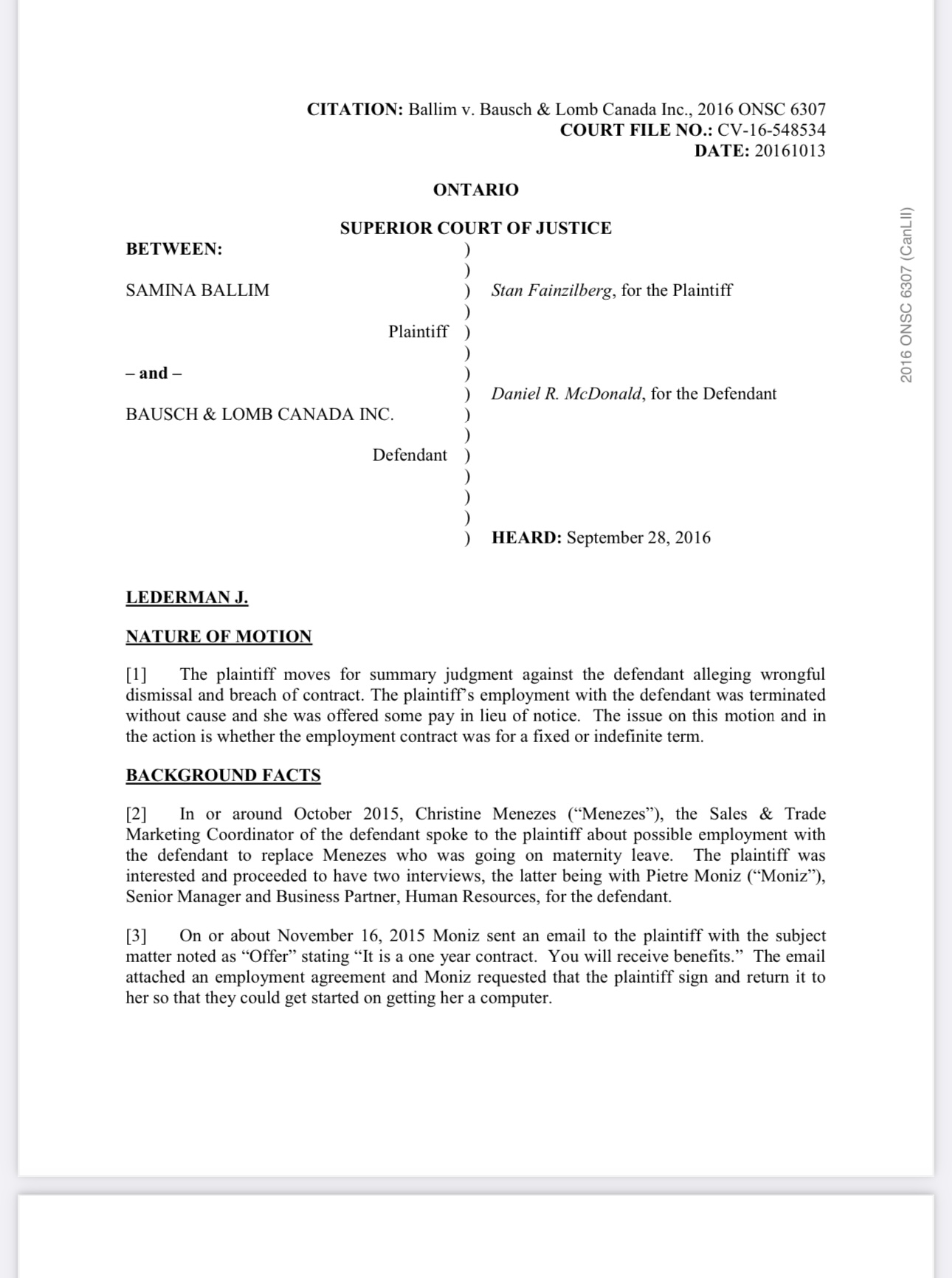
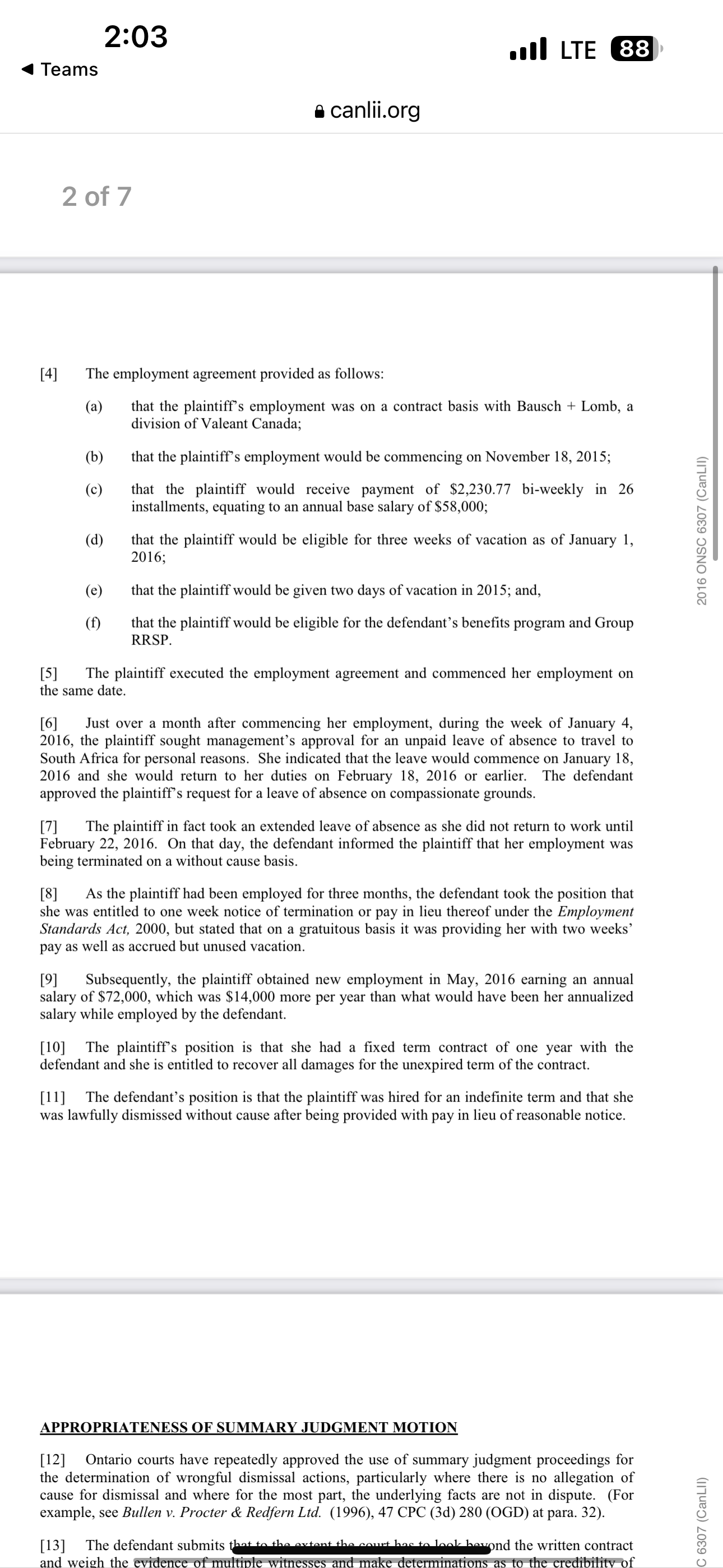
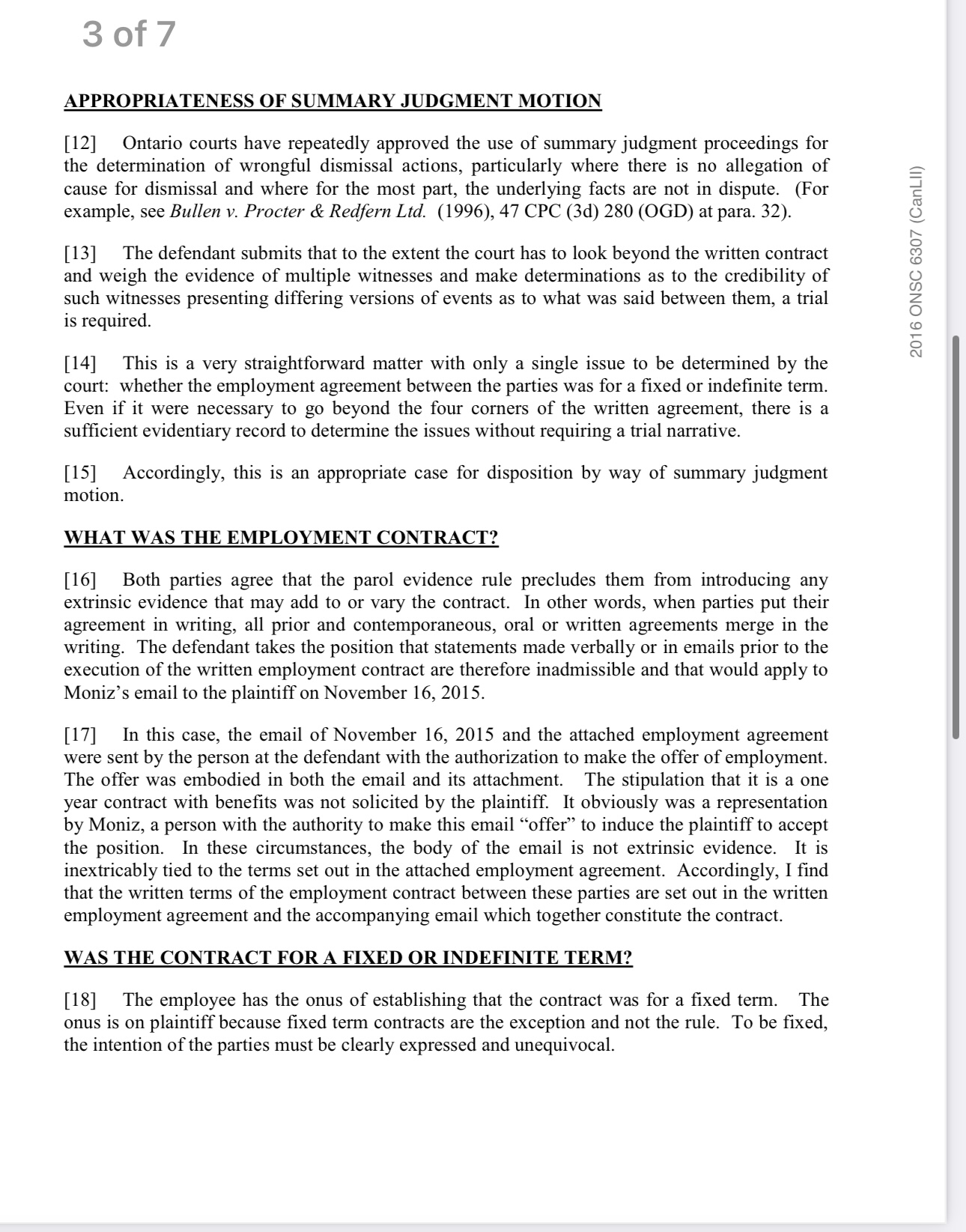
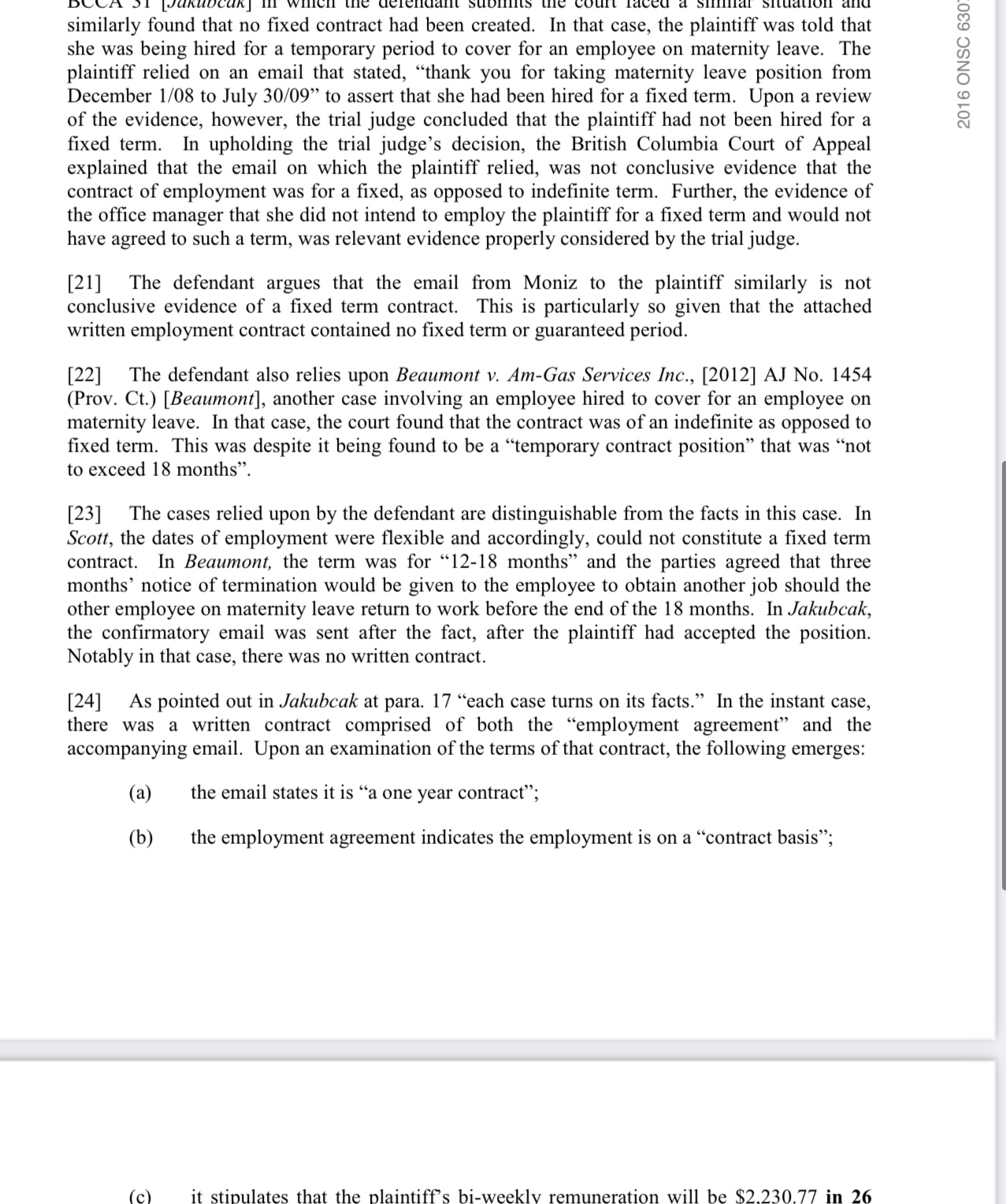
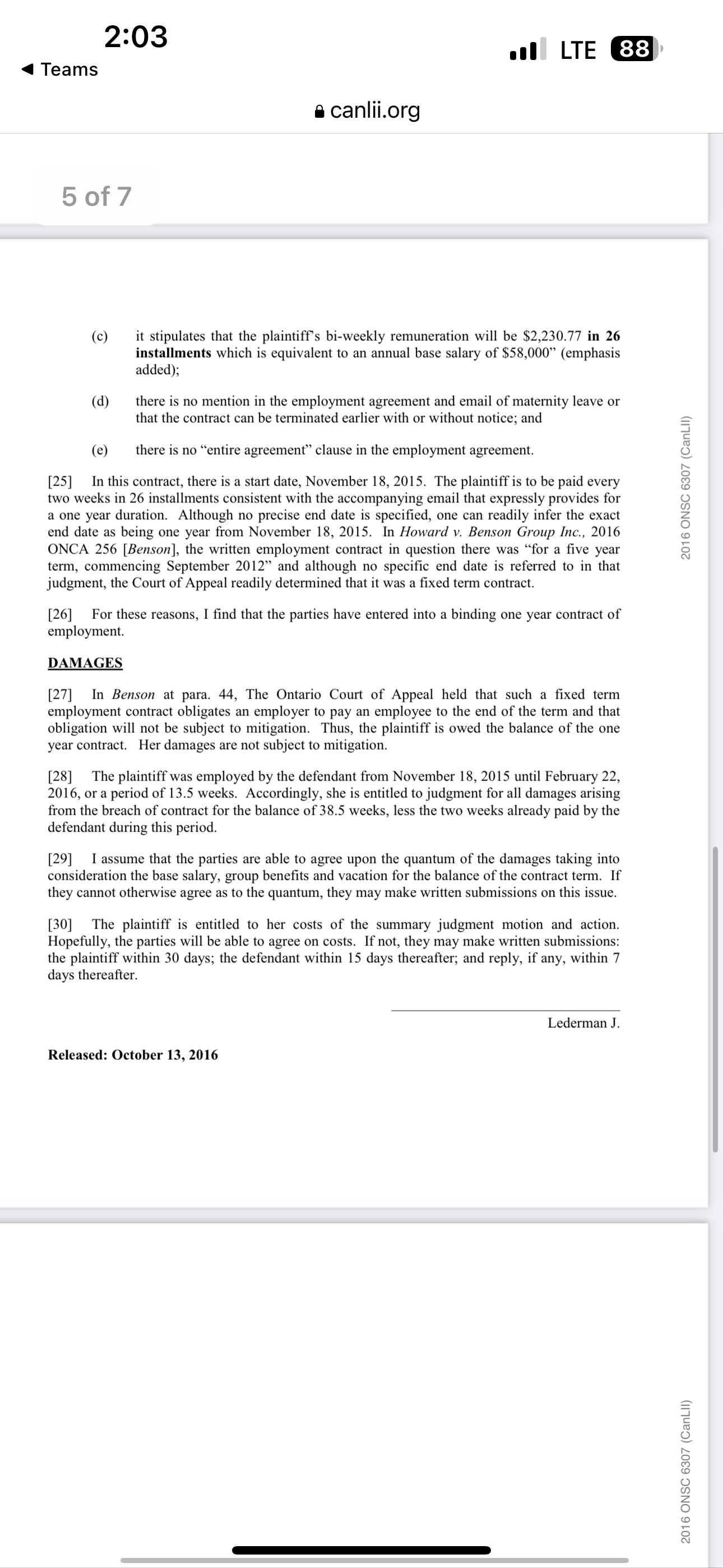
CITATION: Ballim v. Bausch & Lomb Canada Inc., 2016 ONSC 6307 COURT FILE NO.: CV-16-548534 DATE: 20161013 ONTARIO SUPERIOR COURT OF JUSTICE BETWEEN: SAMINA BALLIM Stan Fainzilberior the Plaintiff 2016 ONSC 6307 (CanLII) Plaintiff - and - Daniel R. Mcdonald, for the Defendant BAUSCH & LOMB CANADA INC. Defendant HEARD: September 28, 2016 LEDERMAN J. NATURE OF MOTION [1] The plaintiff moves for summary judgment against the defendant alleging wrongful dismissal and breach of contract. The plaintiff's employment with the defendant was terminated without cause and she was offered some pay in lieu of notice. The issue on this motion and in the action is whether the employment contract was for a fixed or indefinite term. BACKGROUND FACTS In or around October 2015, Christine Menezes ("Menezes"), the Sales & Trade Marketing Coordinator of the defendant spoke to the plaintiff about possible employment with the defendant to replace Menezes who was going on maternity leave. The plaintiff was interested and proceeded to have two interviews, the latter being with Pietre Moniz ("Moniz"), Senior Manager and Business Partner, Human Resources, for the defendant. [3] On or about November 16, 2015 Moniz sent an email to the plaintiff with the subject matter noted as "Offer" stating "It is a one year contract. You will receive benefits." The email attached an employment agreement and Moniz requested that the plaintiff sign and return it to her so that they could get started on getting her a computer.2103 II" LTE ' Teams s canlii.org 20f7 [4] The employment agreement provided as follows: (a) that the plaintiff's employment was on a contract basis with Bausch + Lomb, a division of Valeant Canada; (b) that the plaintiffs employment would be commencing on November 18, 2015; (c) that the plaintiff would receive payment of $2,230.77 bi-weekly in 26 installments, equating to an annual base salary of $58,000; (d) that the plaintiff would be eligible for three weeks of vacation as of January 1, 2016; (e) that the plaintiff would be given two days of vacation in 2015; and, (t) that the plaintiff would be eligible for the defendant's benets program and Group RRSP. [5] The plaintiff executed the employment agreement and commenced her employment on the same date. [6] Just over a month after commencing her employment, during the week of January 4, 2016, the plaintiff sought management's approval for an unpaid leave of absence to travel to South Africa for personal reasons. She indicated that the leave would commence on January 18, 2016 and she would return to her duties on February 18, 2016 or earlier. The defendant approved the plaintiff's request for a leave of absence on compassionate grounds. [7] The plaintiff in fact took an extended leave of absence as she did not return to work until February 22, 2016. On that day, the defendant informed the plaintiff that her employment was being terminated on a without cause basis. [8] As the plaintiff had been employed for three months, the defendant took the position that she was entitled to one week notice of termination or pay in lieu thereof under the Employment Standards Act, 2000, but stated that on a gratuitous basis it was providing her with two weeks\" pay as well as accrued but unused vacation. [9] Subsequently, the plaintiff obtained new employment in May, 2016 earning an annual salary of $72,000, which was $14,000 more per year than what would have been her annualized salary while employed by the defendant. [10] The plaintiffs position is that she had a fixed term contract of one year with the defendant and she is entitled to recover all damages for the unexpired term of the contract. [1 l] The defendant's position is that the plaintiff was hired for an indefinite term and that she was lawfully dismissed without cause after being provided with pay in lieu of reasonable notice. APPROPRIATENESS 0F SUMMARY JUDGMENT MOTION [12] Ontario courts have repeatedly approved the use of summary judgment proceedings for the determination of wrongful dismissal actions, particularly where there is no allegation of cause for dismissal and where for the most part, the underlying facts are not in dispute. (For example, see Butler: V. Procter & Redfem Ltd. (1996), 47 CPC (3d) 280 (OGD) at para. 32). [13] The defendant submits mm the written contract and weigh the evidence of multiple Witnesses and make determinations as to the eredibilitv of 2016 ONSC 6307 (CanLH) C 6307 (CanLl I) 3of7 APPROPRIATENESS OF SUMMARY JUDGMENT MOTION [12] Ontario courts have repeatedly approved the use of summary judgment proceedings for the determination of wrongful dismissal actions, particularly where there is no allegation of cause for dismissal and where for the most part, the underlying facts are not in dispute. (For example, see Bullen v. Procter & Redfern Ltd. (1996), 47 CPC (3d) 280 (OGD) at para. 32). [13] The defendant submits that to the extent the court has to look beyond the written contract and weigh the evidence of multiple witnesses and make determinations as to the credibility of such witnesses presenting differing versions of events as to what was said between them, a trial is required. [14] This is a very straightforward matter with only a single issue to be determined by the court: whether the employment agreement between the parties was for a xed or indenite term. Even if it were necessary to go beyond the four corners of the written agreement, there is a sufcient evidentiary record to determine the issues without requiring a trial narrative. [15] Accordingly, this is an appropriate case for disposition by way of summary judgment motion. WHAT WAS THE EMPLOYMENT CONTRACT? [16] Both parties agree that the parol evidence rule precludes them from introducing any extrinsic evidence that may add to or vary the contract. In other words, when parties put their agreement in writing, all prior and contemporaneous, oral or written agreements merge in the writing. The defendant takes the position that statements made verbally or in emails prior to the execution of the written employment contract are therefore inadmissible and that would apply to Moniz's email to the plaintiff on November 16, 2015. [17] In this case, the email of November 16, 2015 and the attached employment agreement were sent by the person at the defendant with the authorization to make the offer of employment. The offer was embodied in both the email and its attachment. The stipulation that it is a one year contract with benets was not solicited by the plaintiff. It obviously was a representation by Moniz, a person with the authority to make this email \"offer" to induce the plaintiff to accept the position. In these circumstances, the body of the email is not extrinsic evidence. It is inextricably tied to the terms set out in the attached employment agreement. Accordingly, I nd that the written terms of the employment contract between these parties are set out in the written employment agreement and the accompanying email which together constitute the contract. WAS THE CONTRACT FOR A FIXED OR [NDEFINITE TERM? [18] The employee has the onus of establishing that the contract was for a xed term. The onus is on plaintiff because xed term contracts are the exception and not the rule. To be xed, the intention of the parties must be clearly expressed and unequivocal. 2016 ONSC 6307' (CariLllj similarly found that no fixed contract had been created. In that case, the plaintiff was told that she was being hired for a temporary period to cover for an employee on maternity leave. The 2016 ONSC 630 plaintiff relied on an email that stated, "thank you for taking maternity leave position from December 1/08 to July 30/09" to assert that she had been hired for a fixed term. Upon a review of the evidence, however, the trial judge concluded that the plaintiff had not been hired for a fixed term. In upholding the trial judge's decision, the British Columbia Court of Appeal explained that the email on which the plaintiff relied, was not conclusive evidence that the contract of employment was for a fixed, as opposed to indefinite term. Further, the evidence of the office manager that she did not intend to employ the plaintiff for a fixed term and would not have agreed to such a term, was relevant evidence properly considered by the trial judge. [21] The defendant argues that the email from Moniz to the plaintiff similarly is not conclusive evidence of a fixed term contract. This is particularly so given that the attached written employment contract contained no fixed term or guaranteed period. [22] The defendant also relies upon Beaumont v. Am-Gas Services Inc., [2012] AJ No. 1454 (Prov. Ct.) [Beaumont], another case involving an employee hired to cover for an employee on maternity leave. In that case, the court found that the contract was of an indefinite as opposed to fixed term. This was despite it being found to be a "temporary contract position" that was "not to exceed 18 months". [23] The cases relied upon by the defendant are distinguishable from the facts in this case. In Scott, the dates of employment were flexible and accordingly, could not constitute a fixed term contract. In Beaumont, the term was for "12-18 months" and the parties agreed that three months' notice of termination would be given to the employee to obtain another job should the other employee on maternity leave return to work before the end of the 18 months. In Jakubcak, the confirmatory email was sent after the fact, after the plaintiff had accepted the position. Notably in that case, there was no written contract. [24] As pointed out in Jakubcak at para. 17 "each case turns on its facts." In the instant case, there was a written contract comprised of both the "employment agreement" and the accompanying email. Upon an examination of the terms of that contract, the following emerges: (a) the email states it is "a one year contract"; (b) the employment agreement indicates the employment is on a "contract basis"; s that plaintiff's bi-weekly will be $2.230.77 in 262'03 III LTE ' Teams a canlii.org 50f7 (c) it stipulates that the plaintiff's bi-weekly remuneration will be $2,230.77 in 26 installments which is equivalent to an annual base salary of $58,000" (emphasis added); (d) there is no mention in the employment agreement and email of maternity leave or that the contract can be terminated earlier with or without notice; and (e) there is no "entire agreement\" clause in the employment agreement. [25] In this contract, there is a start date, November 18, 2015. The plaintiff is to be paid every two weeks in 26 installments consistent with the accompanying email that expressly provides for a one year duration. Although no precise end date is specied, one can readily infer the exact end date as being one year from November 18, 2015. In Howard v, Benson Group Ina, 2016 ONCA 256 [Benson], the written employment contract in question there was \"for a five year term, commencing September 2012\" and although no specic end date is referred to in that _'udgment, the Court of Appeal readily determined that it was a xed term contract. 26 For these reasons, I nd that the parties have entered into a binding one year contract of employment. DAMAGES 27 In Benron at para. 44, The Ontario Court of Appeal held that such a xed term employment contract obligates an employer to pay an employee to the end of the term and that obligation will not be subject to mitigation. Thus, the plaintiff is owed the balance of the one year contract. Her damages are not subject to mitigation. 28 The plaintiff was employed by the defendant from November 18, 2015 until February 22, 2016, or a period of 13.5 weeks. Accordingly, she is entitled to judgment for all damages arising from the breach of contract for the balance of 38.5 weeks, less the two weeks already paid by the defendant during this period. 29 I assume that the parties are able to agree upon the quantum of the damages taking into consideration the base salary, group benefits and vacation for the balance of the contract term. If they cannot otherwise agree as to the quantum, they may make written submissions on this issue. 30 The plaintiff is entitled to her costs of the summary judgment motion and action. Hopefully, the parties will be able to agree on costs. If not, they may make written submissions: the plaintiff within 30 days; the defendant within 15 days thereafter; and reply, if any, within 7 days thereafter. Lederman J . Released: October 13, 2016 2016 ONSC 6307 {CanLIIJ 2016 ONSC 6307 (CanLll)
Step by Step Solution
There are 3 Steps involved in it

Get step-by-step solutions from verified subject matter experts