







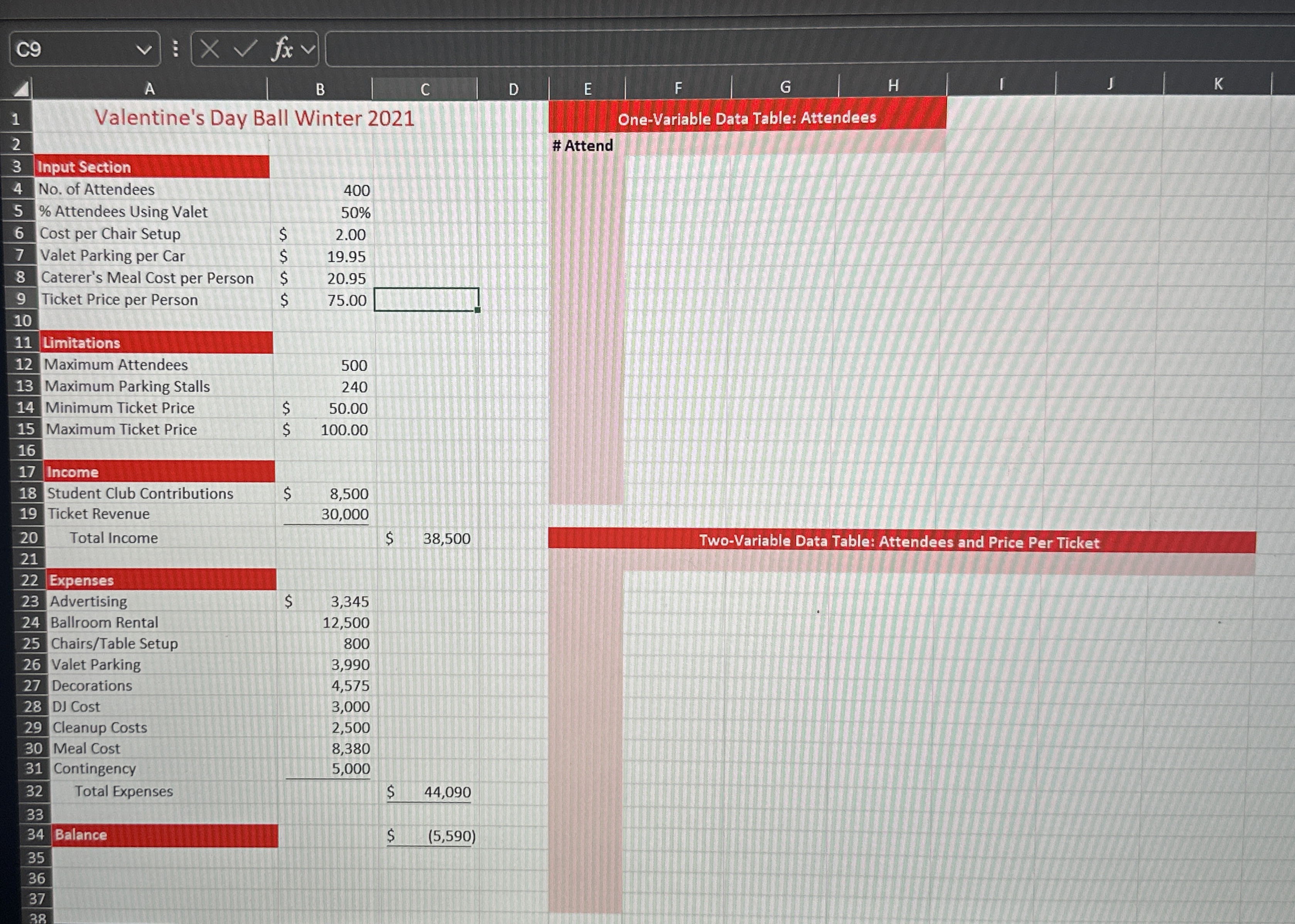
Question: One - Variable Data Table: Attendees # Attend Input Section No . of Attendees % Attendees Using Valet Cost per Chair Setup Valet Parking per
OneVariable Data Table: Attendees
# Attend
Input Section
No of Attendees
Attendees Using Valet
Cost per Chair Setup
Valet Parking per Car
Caterer's Meal Cost per Person
Ticket Price per Person
Limitations
Income
Student Club Contributions
Ticket Revenue
$
Expenses
Advertising
$
Ballroom Rental
ChairsTable Setup
Valet Parking
Decorations
DJ Cost
Cleanup Costs
Meal Cost
Contingency
Total Expenses
Balance
$ You are on the budget committee for the formal Valentines Day Ball at your university. The ball includes dinner and dancing. Your committee have prepared a tentative budget outlining income and expenses in the attached Dance.xlsx file. The primary sources of income are contributions from student organizations and ticket prices. Expenses include the actual cost of the dinner, facilities, parking, and other costs at a luxurious hotel in the city. Your goal is to balance the income and expenses, decide on the most appropriate ticket price per student, and ensure your budget falls within the limitations you must work with. You decide to use Excel WhatIf Analysis tools to help you make proper decision. Currently, the estimated budget has a deficit. Use Goal Seek to achieve a $ balance by changing the ticket price per person. Answer question on the Q&A worksheet You believe that between and students will attend. Because the ticket revenue, chair setup, catering cost, and valet parking expenses are dependent on the number of students, you decide to create a onevariable data table to compare the budget effects based on different number of students attending. Using WhatIf analysis tool to build the onevariable data table, based on the ticket price that makes a $ balance. The onevariable data table contains four columns: # Attend, Total Revenue, Total Expenses, and Balance. In the first column, enter the series of substitution values ranging from to at increments of students. Enter references to the total revenue, total expenses, and balance formulas in the correct location for the onevariable data table. Complete the onevariable data table and then answer questions through on the Q&A worksheet Now you want to compare the balance of different combinations of attendees and ticket prices per person using a twovariable data table. Using the same series of substitution values for # Attend from the onevariable data table. Enter the series of substitution values for ticket price from $ to $ at $ increments. Enter the reference to the Balance formula in the correct location for the two variable data table. Complete the twovariable data table and answer questions and on the Q&A worksheet. Question requires three combinations to list. You negotiated different cost per meal and ballroom rental rates based on or attendees. You estimated tentative ticket prices per attendee. You use Scenario Manager to help you decide the target number of attendees. Create a first scenario named Attend, using the number of attendees, meal cost per person, ticket price per person, and ballroom rental variables as the changing cells. Enter these values for the first scenario: $ $ and $ Create a second scenario named Attend, using the same changing cells, entering these values for the second scenario: $ $ and $ Create a third scenario named Attend, using the same changing cells, entering these values for the third scenario: $ $ and $ Create a fourth scenario named Attend, using the same changing cells, entering these values for the fourth scenario: $ $ and $ Then generate a scenario summary report using the total revenue, total expenses, and balance as the results, and then answer question through on the Q&A What is the ticket price per person to balance the initial budget using Goal Seek? For the onevariable data table, how many attendees creates the largest deficit? For the onevariable data table, what is the largest deficit? For the onevariable data table, how many attendees creates a breakeven point? For the twovariable data table, what ticket prices do not produce a breakeven point? For the twovariable data table, list the combinations of ticket prices and attendees that startgenerating profit For the scenario summary, which scenario provides the highest positive balance and by whatamount? For the scenario summary, which scenario provides a negative balance? What is the balance? Is this balance close enough that you might achieve break even? How is this possible?
Step by Step Solution
There are 3 Steps involved in it
1 Expert Approved Answer
Step: 1 Unlock

Question Has Been Solved by an Expert!
Get step-by-step solutions from verified subject matter experts
Step: 2 Unlock
Step: 3 Unlock
 Study Help