





Question: ONLY QUESTION/PART 3 Consider the system in Problem 2 for Lab 1. Instead of two single server queues, there is now one multiple server queue.

ONLY QUESTION/PART 3
ONLY QUESTION/PART 3 Consider the system in

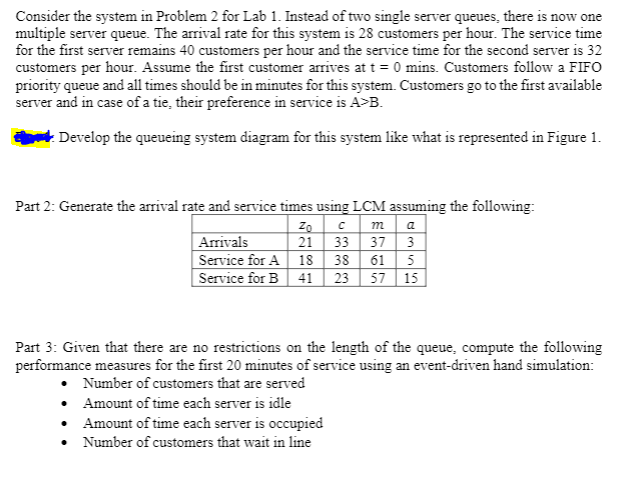
Consider the system in Problem 2 for Lab 1. Instead of two single server queues, there is now one multiple server queue. The arrival rate for this system is 28 customers per hour. The service time for the first server remains 40 customers per hour and the service time for the second server is 32 customers per hour. Assume the first customer arrives at t = 0 mins. Customers follow a FIFO priority queue and all times should be in minutes for this system. Customers go to the first available server and in case of a tie their preference in service is AB. Develop the queueing system diagram for this system like what is represented in Figure 1. Part 2: Generate the arrival rate and service times using LCM assuming the following: Zo cm a Arrivals 21 33 373 Service for A 18 38 615 Service for B 41 23 57 15 Part 3: Given that there are no restrictions on the length of the queue, compute the following performance measures for the first 20 minutes of service using an event-driven hand simulation: Number of customers that are served Amount of time each server is idle Amount of time each server is occupied Number of customers that wait in line Consider the system in Problem 2 for Lab 1. Instead of two single server queues, there is now one multiple server queue. The arrival rate for this system is 28 customers per hour. The service time for the first server remains 40 customers per hour and the service time for the second server is 32 customers per hour. Assume the first customer arrives at t = 0 mins. Customers follow a FIFO priority queue and all times should be in minutes for this system. Customers go to the first available server and in case of a tie their preference in service is AB. Develop the queueing system diagram for this system like what is represented in Figure 1. Part 2: Generate the arrival rate and service times using LCM assuming the following: Zo cm a Arrivals 21 33 373 Service for A 18 38 615 Service for B 41 23 57 15 Part 3: Given that there are no restrictions on the length of the queue, compute the following performance measures for the first 20 minutes of service using an event-driven hand simulation: Number of customers that are served Amount of time each server is idle Amount of time each server is occupied Number of customers that wait in line

Step by Step Solution

There are 3 Steps involved in it

1 Expert Approved Answer
Step: 1 Unlock blur-text-image

Question Has Been Solved by an Expert!

Get step-by-step solutions from verified subject matter experts

Step: 2 Unlock
Step: 3 Unlock

Students Have Also Explored These Related General Management Questions!