







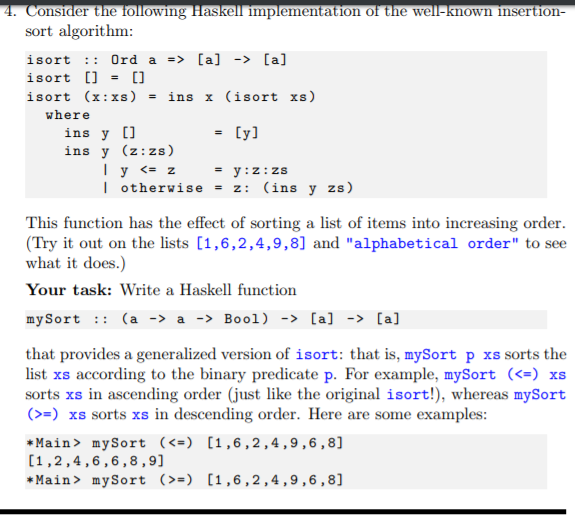
Question: onsider the following Haskell implementation of the we sort algorithm: isort Ord a ->[a] -> [a] isort - sort (x:xs) = ins x (isort xs)
![Ord a ->[a] -> [a] isort - sort (x:xs) = ins x](https://dsd5zvtm8ll6.cloudfront.net/si.experts.images/questions/2024/09/66f545be5dc7b_20566f545bdf2a02.jpg)
onsider the following Haskell implementation of the we sort algorithm: isort Ord a ->[a] -> [a] isort - sort (x:xs) = ins x (isort xs) own insertion- where ins y ins y (z:zs) I otherwise z: (ins y zs) This function has the effect of sorting a list of items into increasing order. (Try it out on the lists [1,6,2,4,9,8] and "alphabetical order" to see what it does Your task: Write a Haskell function mySort (a > a Bool) -a]-> [a] that provides a generalized version of isort: that is, mySort p xs sorts the list xs according to the binary predicate p. For example, mySort (-) xs sorts xs in descending order. Here are some examples *Main> mySort ( mySort (>) [1,6,2,4,9,6,8] onsider the following Haskell implementation of the we sort algorithm: isort Ord a ->[a] -> [a] isort - sort (x:xs) = ins x (isort xs) own insertion- where ins y ins y (z:zs) I otherwise z: (ins y zs) This function has the effect of sorting a list of items into increasing order. (Try it out on the lists [1,6,2,4,9,8] and "alphabetical order" to see what it does Your task: Write a Haskell function mySort (a > a Bool) -a]-> [a] that provides a generalized version of isort: that is, mySort p xs sorts the list xs according to the binary predicate p. For example, mySort (-) xs sorts xs in descending order. Here are some examples *Main> mySort ( mySort (>) [1,6,2,4,9,6,8]
Step by Step Solution
There are 3 Steps involved in it

Get step-by-step solutions from verified subject matter experts
 Study Help